Working radius decides what a truck-mounted crane can actually lift — not the number painted on the boom. A crane rated at 10 tonnes may lift that load only when the boom is short and the outriggers are fully deployed, and it may lift far less at the radius where your job actually happens. Sizing a truck-mounted crane means working backward from the load, the radius, and the lifting height, then checking the crane load chart, the outrigger footprint, the chassis, and the axle loads before you ever compare nominal tonnage. Get that order wrong and you either buy a crane that cannot do the job or one so heavy it leaves no cargo payload.
Start With the Lift, Not the Crane
Every crane sizing question begins with three numbers that come from the job site, not from a brochure:
- Load weight — the actual weight of the item, plus rigging, slings, shackles, and any lifting beam. A 4.5-tonne pump skid with a spreader bar and four slings can easily become a 5.2-tonne lift.
- Working radius — the horizontal distance from the crane’s rotation center to the center of the load. This is measured with the boom positioned where the work happens, not fully retracted.
- Lifting height — the vertical distance from the ground to the bottom of the hook at the required radius, plus clearance for the load and rigging.
Add two more that buyers often forget: how often the crane will be used (occasional utility work versus a daily production cycle), and whether the truck can still carry useful cargo with the crane mounted. A crane that lifts everything but leaves you unable to haul material is not a productive asset.
For illustration, consider a hypothetical utility fleet replacing a pole and transformer set. The heaviest single lift is 3.2 tonnes at a 6-meter radius with a 9-meter hook height. That is a completely different crane from one that needs to place 3.2 tonnes at a 14-meter radius. Same load, roughly double the crane. This is why “what size crane do I need” cannot be answered in tonnes alone.
How to Read a Crane Load Chart
The load chart is the only document that tells you what a crane can lift. Nominal tonnage is a marketing label; the chart is the engineering limit. A typical chart is organized by boom length and radius, and it usually includes separate columns for different outrigger spans.
| Chart Factor | What It Tells You | Why It Matters |
|---|---|---|
| Working radius | Horizontal reach from rotation center to hook | Capacity drops sharply as radius increases |
| Boom length | Number of extended sections | Longer boom at the same radius usually means lower capacity |
| Outrigger span | Full, half, or retracted deployment | Narrow outriggers reduce stability and capacity |
| Rotation angle | Over the rear, side, or front | Capacity is often highest over the rear and lowest over the front |
| Rope falls | Single or multi-part line | Affects maximum load on the hook, not the structural limit |
Two rules follow from this. First, if your lift radius is not on the chart, the crane is not rated for that lift — you do not interpolate upward. Second, always use the chart column that matches how you will actually set up the outriggers on site. If the job site is a narrow urban street where you can only deploy half-span outriggers, use the half-span column, not the full-span column.
Rated capacity does not mean the crane can lift that weight at full boom extension. It means the crane can lift that weight at the specific radius, boom length, and outrigger configuration shown on the chart.
Working Radius, Lifting Height, and the Trade-Off Between Them
Radius and height fight each other. To reach farther out, the boom must extend and lower. To reach higher, the boom must raise, which brings the load closer in. A crane that easily handles a load at 8 meters of radius may be at its limit at 12 meters, and a crane that reaches 18 meters of height may only be good for a fraction of its nominal capacity at that height.
This is why buyers should sketch the lift before requesting a quotation. Mark the truck position, the load pick point, the load set point, and the highest obstacle in the path. The worst-case combination of radius and height usually appears at the set point, not the pick point, especially when placing loads over a wall, into a building, or onto a roof.
For a utility or construction fleet, an articulating crane and a telescopic crane solve different problems. Articulating cranes tend to offer better reach at moderate capacity and can fold into a compact transport position, which suits trucks that also carry cargo. Telescopic cranes tend to offer higher single-line capacity and simpler load charts, which suits heavier, more repetitive lifts. Neither is universally better — the answer depends on the duty cycle.
Outriggers, Stability, and the Ground Underneath
The crane’s capacity is only valid when the outriggers are deployed as the chart assumes. Three practical points matter more than the brochure spec:
- Outrigger spread — full-span deployment gives the highest capacity. On narrow sites, half-span or single-side deployment reduces it.
- Ground bearing pressure — soft soil, fresh fill, or asphalt in summer heat can fail under an outrigger pad. Use larger pads or cribbing, and check the site before positioning the truck.
- Chassis counterweight — a crane mounted behind the cab shifts weight to the rear axle. A crane mounted at the rear of the frame changes the load distribution in a different way and can affect steering axle load when the boom is extended.
Stability is a system property. It includes the crane, the subframe, the chassis frame, the suspension, the tires, and the ground. A crane that is well within its chart can still tip a poorly matched truck if the outriggers sink or the chassis is overloaded on one side.
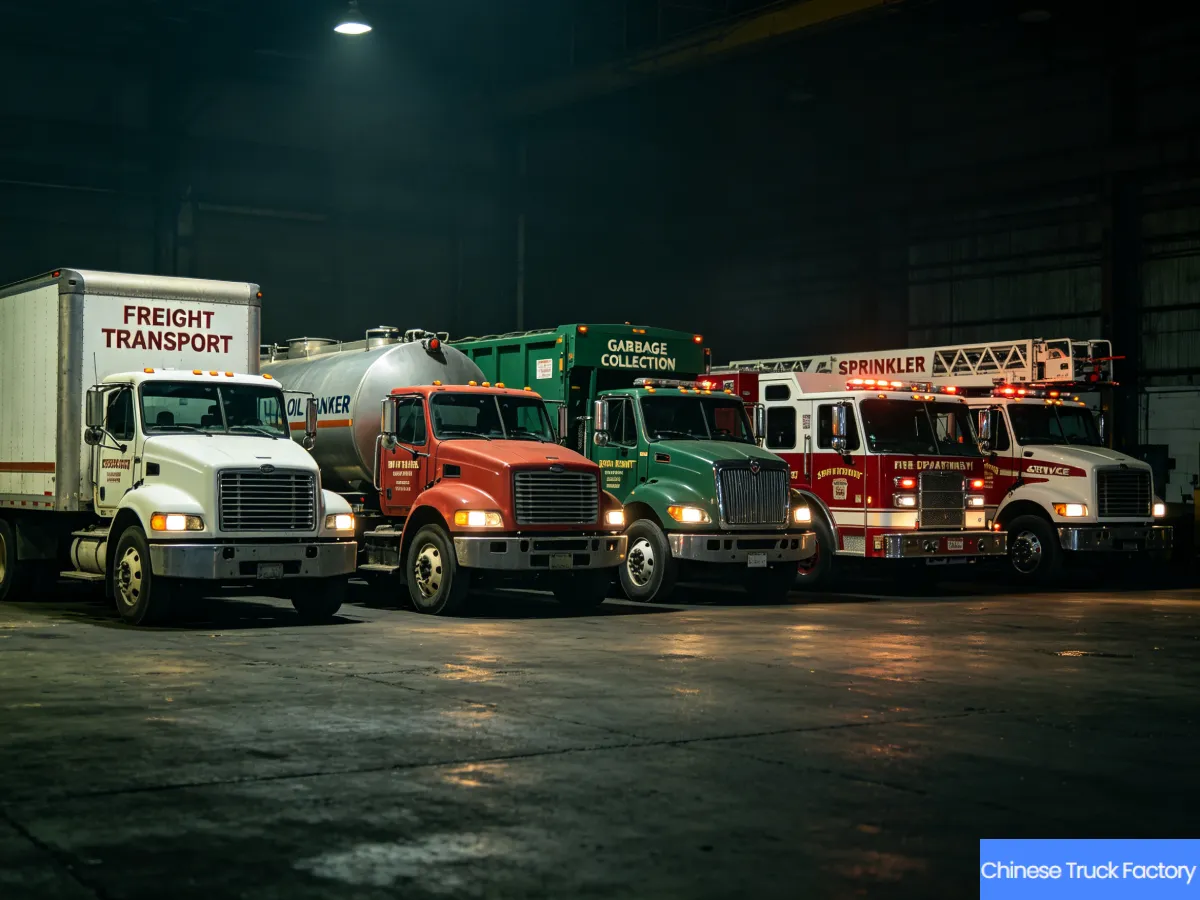
Crane Weight vs Remaining Cargo Payload
This is the trade-off that catches most first-time buyers. Every kilogram of crane, subframe, outrigger, and stabilizer is a kilogram you cannot use for cargo. A larger crane does not just cost more — it reduces what the truck can legally carry.
| Configuration | Typical Crane Class | Crane + Mounting Weight | Effect on Cargo Payload | Best Use Case |
|---|---|---|---|---|
| Light utility | 3–5 tonne class | Relatively low | Small reduction | Service trucks, small utility work, light cargo |
| Medium duty | 6–10 tonne class | Moderate | Noticeable reduction | Construction support, equipment delivery, mixed cargo |
| Heavy duty | 12–16 tonne class and above | High | Large reduction | Dedicated lifting trucks with limited cargo |
Indicative weight figures vary widely by manufacturer, boom length, and mounting method, so the exact numbers must come from the specific crane datasheet and the body builder’s mounting drawing. What matters at the selection stage is the principle: decide how much cargo you need to carry, subtract the crane package, and see whether the remaining payload still makes the truck useful for its intended work.
Buyers who skip this step often end up with a truck that lifts beautifully but cannot legally carry the material it was purchased to move. For a broader look at how crane bodies integrate with chassis and cargo configurations, see truck-mounted crane configurations.
Chassis, Axle Load, and GVW Checks
Once the crane is chosen, the chassis has to carry it. Three checks matter:
- Front and rear axle load with the crane mounted. The crane’s position on the frame determines how much weight goes to each axle. A crane mounted too far forward can overload the steering axle; too far back can overload the rear axle or reduce steering grip.
- Gross vehicle weight rating (GVWR). Crane, subframe, body, cargo, fuel, and crew must all fit within the chassis rating — and within the legal limit for the destination market, which is often lower than the technical rating.
- Frame strength and subframe design. Crane mounting requires a properly engineered subframe that distributes load into the chassis rails. A crane bolted directly to a standard cargo frame is a reliability problem waiting to happen.
Legal axle limits vary by country and sometimes by road class within a country. A configuration that is legal in one market may be overweight in another. This is one of the most common reasons a specification that looks correct on paper fails at registration. For buyers comparing chassis options, the heavy-duty diesel truck range shows how different axle and frame configurations are typically matched to crane and body work.
Productivity: How the Crane Fits the Daily Cycle
Lifting capacity is only half the productivity story. The other half is cycle time:
- Time to position the truck and deploy outriggers
- Time to rig the load
- Time to lift, swing, and place
- Time to return the boom and stow the outriggers
- Travel time between lifts
A crane with a slightly lower capacity but faster outrigger deployment and a smoother control system can outperform a larger crane on a job with many short lifts. Conversely, a heavy crane with slow setup may be the right choice for a few large, planned lifts per day. Match the crane to the cycle, not to the biggest number on the chart.
For fleets that also move material between sites, the crane truck is often paired with other vehicles. If your operation includes bulk haulage alongside lifting, the construction vehicle solutions section covers how crane trucks fit into a mixed fleet.

Fuel, Maintenance, and the Real Operating Cost
Crane trucks are not fuel-efficient in the same way as line-haul tractors, because their duty cycle is dominated by idling, positioning, and hydraulic work rather than steady highway speed. Actual fuel consumption depends on gross weight, route, idling time, PTO engagement, and how often the crane runs at full flow. There is no single reliable number that applies to every operation, and any figure quoted without stating the duty cycle should be treated as indicative only.
Maintenance on a crane truck splits into two systems:
Chassis and powertrain
- Engine oil, filters, and coolant per the engine manufacturer’s schedule
- Transmission, differential, and wheel bearing service
- Brake wear, which is higher on trucks that stop frequently
- Tire wear, which is uneven on trucks with heavy rear-mounted equipment
- PTO and hydraulic pump drive inspection
Crane and hydraulic system
- Hydraulic oil level, condition, and filter changes
- Hose and fitting inspection for chafing, cracking, and leaks
- Crane pin, bushing, and slew bearing lubrication
- Outrigger beam and pad condition
- Load moment indicator or overload protection function check
- Wire rope or hook inspection where applicable
Downtime usually costs more than the parts. A crane truck that is out of service for a week during a scheduled project can cost far more than the repair itself. This is why spare parts availability, hydraulic component commonality, and local service capability should be part of the buying decision, not an afterthought. Buyers who operate mixed fleets often find that standardizing on a chassis family with widely available parts reduces long-term cost more than choosing the lowest purchase price.
Total Cost of Ownership for a Crane Truck
Purchase price is the smallest part of the decision. A practical TCO model for a crane truck includes:
| Cost Element | What to Estimate |
|---|---|
| Purchase price | Chassis, crane, body, subframe, options |
| Freight and shipping | Method, route, port handling, insurance |
| Import and compliance | Duty, taxes, homologation, registration |
| Fuel or energy | Based on duty cycle, not a generic average |
| Tires | Driven by axle load and road surface |
| Scheduled maintenance | Engine, hydraulic, crane, brakes |
| Unscheduled repairs | Hydraulic, structural, electrical |
| Downtime | Lost production during repairs |
| Residual value | Brand, condition, hours, market demand |
Two crane trucks with the same nominal capacity can have very different TCO. One may have a lighter crane package that leaves more cargo payload, lower tire wear, and lower fuel burn. The other may have a heavier package that lifts more but hauls less. The right answer depends on which task dominates the working day.
Compliance and Destination Market Checks
There is no single “globally compliant” crane truck. Before confirming a specification, buyers should verify:
- Emission standard required for registration in the destination market
- Vehicle type approval or homologation requirements
- Axle weight and gross weight limits, including any road-class restrictions
- Overall length, width, and height limits
- Steering side (left-hand or right-hand drive)
- Lighting, marking, and reflective requirements
- Braking and safety system requirements
- Fuel quality and availability, and whether DEF/AdBlue is required and available
- Crane certification or inspection requirements, if any, in the destination market
- Local service capability and spare parts availability for both chassis and crane
Regulations change, and requirements differ by country. Buyers should confirm current rules with the relevant authority or a qualified local agent before placing an order. For fleets importing equipment, the overseas shipping process explains how documentation, port handling, and delivery are typically managed.
How to Prepare a Crane Truck Inquiry
A supplier cannot size a crane correctly without the right information. Before requesting a quotation, prepare:
- Destination country and port
- Application and typical load types
- Maximum load weight, including rigging
- Maximum working radius
- Maximum lifting height
- Frequency of lifts per day
- Cargo you also need to carry, and its weight and volume
- Road conditions, gradients, and typical route length
- Drive configuration preference (4×2, 6×4, 8×4, etc.)
- Steering side required
- Emission standard required
- Quantity and delivery timeline
- Any required options — winch, remote control, extra outrigger, work lights
Suppliers who ask for these details before quoting are usually the ones who can match a crane to the job. Suppliers who quote a tonnage without asking about radius and height are guessing.
Evaluating a Crane Truck Supplier
When comparing suppliers, use a consistent framework rather than a single number:
- Application fit — does the proposed crane match your radius and height, not just your load weight?
- Load chart transparency — will the supplier provide the actual load chart for the proposed crane and mounting position?
- Chassis and axle load calculation — is there a documented axle load check with the crane mounted?
- Crane and hydraulic component quality — are components from established manufacturers with parts availability?
- Mounting and subframe engineering — is the subframe designed for the crane, or adapted from a generic body?
- Parts and service support — can the supplier provide spare parts lists and identify local service options?
- Documentation — are drawings, load charts, and inspection records provided with the truck?
- Total cost — is the quotation comparable on the same Incoterm, with the same options, and with realistic freight?
Chinese Truck Factory works within this framework by matching crane and chassis as a system rather than selling a crane and a truck separately. Buyers evaluating lifting capacity should compare the actual load chart before selecting a truck-mounted crane, and the specialized vehicle range shows how different bodies and cranes are configured for specific applications.
Send Your Lift Requirements for a Crane Truck Configuration Review
Frequently Asked Questions
Does a higher crane tonnage always mean a better crane truck?
No. A higher-tonnage crane adds weight, cost, and often reduces the cargo payload the truck can legally carry. The right crane is the one that meets your maximum load at your maximum working radius and lifting height, with enough remaining payload for the cargo you need to move.
How do I calculate the working radius I actually need?
Measure the horizontal distance from where the truck will be parked to the furthest point where you need to place a load. Use the set point, not the pick point, and account for any obstacles that force you to position the truck farther away.
Can I use a crane load chart from a different model?
No. Load charts are specific to the crane model, boom configuration, and outrigger setup. Using a chart from a different crane or a different mounting position can lead to an unsafe lift or a structural failure.
What happens if I overload the crane occasionally?
Overloading stresses the boom, slew bearing, subframe, and chassis in ways that may not show immediately but accumulate over time. It also defeats the overload protection system, which is designed to prevent exactly this. Occasional overloads are one of the most common causes of premature crane and subframe failure.
How much cargo payload will I lose when I add a crane?
It depends on the crane class, boom length, mounting position, and subframe design. Light utility cranes reduce payload only slightly; heavy cranes can consume a large share of the available payload. The exact figure must come from the specific crane datasheet and mounting drawing.
Do I need a different chassis for a crane truck than for a standard cargo truck?
Usually yes. Crane mounting requires a reinforced frame or a properly engineered subframe, and the axle load distribution changes with the crane’s position. A chassis rated for cargo is not automatically suitable for crane mounting without a documented load check.
How often should crane hydraulics be serviced?
Service intervals depend on the crane manufacturer, hydraulic oil type, operating environment, and duty cycle. Follow the crane manufacturer’s manual, and treat any change in hydraulic performance, noise, or oil condition as a reason for inspection rather than waiting for the next scheduled interval.
What information do I need before requesting a quotation?
At minimum: maximum load weight including rigging, maximum working radius, maximum lifting height, required cargo payload, destination country and port, steering side, emission requirement, and quantity. Providing these details upfront usually shortens the quotation process and reduces the risk of a mismatched specification.
The most suitable crane truck is not the one with the highest nominal capacity. It is the configuration that matches your heaviest lift at the radius and height where the work actually happens, leaves enough payload for the cargo you need to carry, stays within the legal weight limits of the destination market, and can be maintained with the parts and service available to your fleet. Buyers who start with the load and work backward to the crane, chassis, and body usually end up with a truck that earns its keep. Buyers who start with a tonnage number and work forward often end up with a truck that lifts well and hauls nothing.