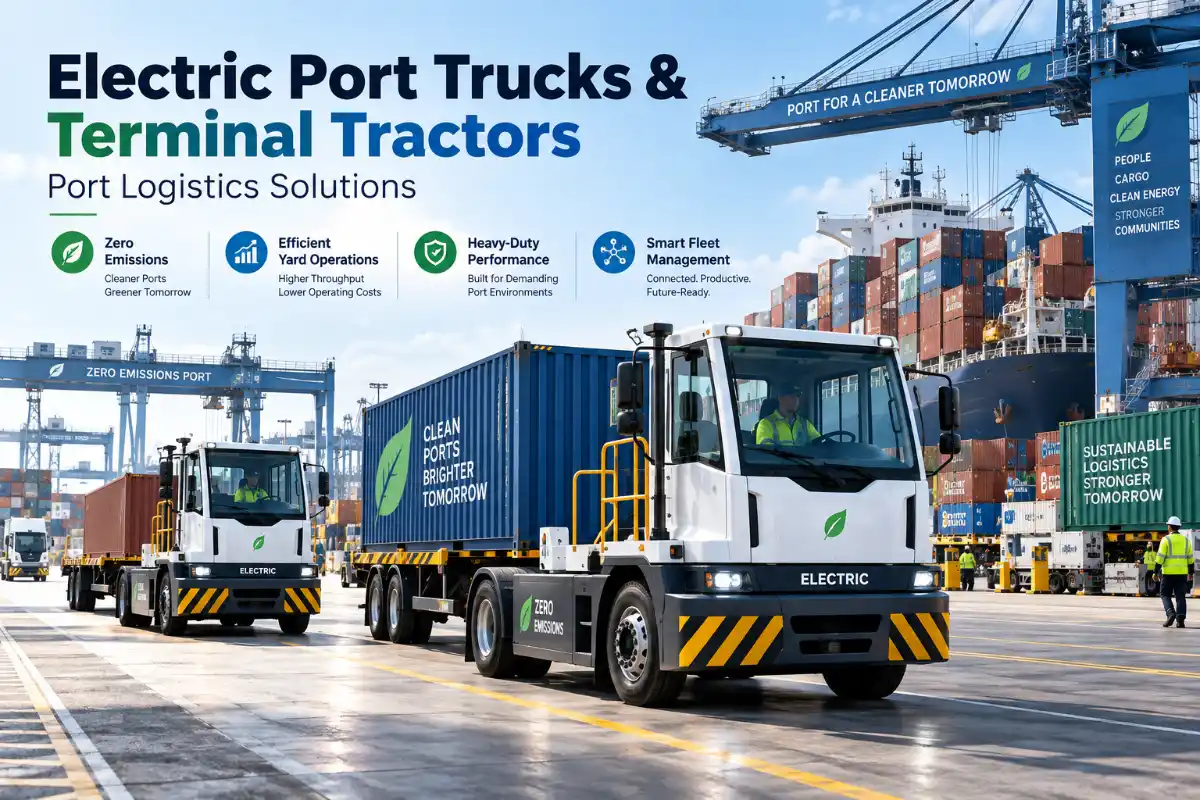
Electric Trucks for Port Logistics and Container Terminal Operations
Electric trucks are a strong fit for port work when routes are predictable,
vehicles return to a known charging point, and payload and shift requirements
are clear before the vehicle is specified. We support electric terminal tractors
and heavy-duty electric tractor configurations for container shunting,
yard movements and short-haul drayage.
Port vehicles spend much of their working life accelerating, slowing,
queuing and moving heavy loads over relatively short distances.
That duty cycle is different from long-haul highway transport and is one
reason battery-electric trucks are being deployed in container terminals,
distribution yards and short drayage routes.
The operational advantage is straightforward: an electric drivetrain has
no tailpipe exhaust while operating, produces less powertrain noise than a
diesel engine and can recover part of the vehicle's kinetic energy through
regenerative braking. The business case, however, depends on the route,
electricity cost, charger utilization and the amount of infrastructure
required at the site.
Electric should not automatically be specified for every port route.
Long, irregular highway runs, very limited charging dwell time or a depot
with insufficient electrical capacity may require a different battery,
charging plan or vehicle type.
Electric trucks are particularly suited to repeated container-yard
movements and return-to-base logistics where charging can be planned.
Operating pattern
Electric suitability
Main point to check
Container shunting inside a terminal
Strong fit
Trailer weight, fifth-wheel requirements and shift energy use
Gate-to-yard or warehouse shuttle
Strong fit
Daily distance and charging time between shifts
Short port-to-depot drayage
Good fit when routes are predictable
Road approval, GCW, highway speed and return reserve
Two- or three-shift operation
Requires charging analysis
Break duration, charger power and simultaneous charging demand
Long-distance variable routes
Evaluate route by route
Range reserve and reliable charging away from the depot
Choose the Truck Around the Job
“Electric port truck” can describe very different vehicles. A terminal
tractor working entirely inside a yard does not need the same gearing,
suspension, road equipment or driving range as a tractor hauling containers
from the port to an inland warehouse.
Terminal / Yard
Electric Terminal Tractor
Intended for repeated trailer and container movements inside ports,
logistics parks and distribution yards. The important specifications
are low-speed pulling performance, turning radius, fifth-wheel lift,
visibility, cab access and shift runtime.
Road + Port
4×2 Electric Tractor
Suitable for lighter combination weights and short road-connected
port routes where maneuverability and lower vehicle weight are useful.
Road registration and local axle-weight rules must be confirmed for
the destination market.
Heavy Drayage
6×4 Electric Tractor
A better starting point where higher combination weight, traction
or difficult grades require tandem drive axles. Battery capacity,
continuous motor output and thermal management become more important
as workload increases.
For other chassis and application-specific configurations, see our
truck types.
The Specification Should Start With Your Duty Cycle
Brochure range alone is not enough to specify an electric port truck.
Two fleets driving the same daily distance can require different batteries
if one carries heavier containers, operates on grades, runs air conditioning
continuously or has less time available for charging.
Information to confirm
Why it affects the truck
Useful information to send us
Gross combination weight
Affects drivetrain load, axle specification and energy use
Maximum tractor + trailer + cargo weight
Container / trailer type
Determines fifth-wheel height and coupling requirements
20 ft, 40 ft, skeletal trailer, terminal trailer, etc.
Daily operating distance
Forms the base energy requirement
Average and maximum km per shift or per day
Shift pattern
Determines charging opportunities
Hours per shift, number of shifts and break duration
Maximum grade
Affects continuous motor demand and thermal load
Maximum grade percentage and approximate distance
Typical speed
Yard work and highway work have very different energy profiles
Average and maximum operating speed
Ambient conditions
Temperature, humidity and salt exposure affect component selection
Typical temperature range and whether the truck works near seawater
Voltage, available kW/MW and number of vehicles to charge
Range and Charging: Plan Around the Shift, Not a Headline Number
The useful range of a heavy electric truck changes with gross weight,
driving speed, gradients, temperature, auxiliary loads and the battery
reserve the fleet wants to keep at the end of a shift. For that reason,
a quoted range should always state the test conditions behind it.
Required usable energy ≈ expected shift energy + operating reserveRequired charger power ≈ energy to replenish ÷ available charging time
Charging losses, battery temperature and charger derating also need to be
included in the final calculation. A truck that parks for eight hours
overnight can use a very different charging strategy from a truck that
receives only 30–60 minutes of charging between shifts.
Overnight Charging
Usually the simplest arrangement for a single-shift or return-to-base
fleet. Lower charging power may be sufficient when vehicles remain
parked for several hours.
Opportunity Charging
Useful where vehicles stop during meal breaks, loading windows or
shift changes. Charger position matters because driving across a
terminal solely to charge reduces productive time.
High-Utilization Fleet
Two- and three-shift fleets need simultaneous charging demand,
charger redundancy and site power to be planned together. Ordering
vehicles before checking grid capacity can create avoidable downtime.
Port Conditions Need More Than an Electric Drivetrain
Ports combine heavy loads with dust, rain, humidity, salt exposure,
frequent coupling and uncoupling, low-speed maneuvering and long operating
hours. These conditions should be part of the vehicle specification rather
than treated as accessories after the truck has been selected.
Corrosion protectionConfirm treatment for chassis, battery enclosure, connectors and exposed hardware in coastal service.
Battery thermal managementCheck operating and charging limits for the temperatures expected at the terminal.
Ingress protectionHigh-voltage components and connectors should be specified for water, dust and wash-down conditions.
Low-speed torqueContainer work depends on controllable pulling performance, not only peak motor horsepower.
Fifth-wheel geometryConfirm coupling height, lift function and compatibility with the terminal's trailer fleet.
Driver visibilityCab layout, mirrors or cameras and easy entry matter in repeated coupling cycles.
Brake and regeneration settingsRegenerative braking should work with the site's speed limits, grades and trailer braking system.
Service accessDiagnostic tools, spare parts and isolation procedures should be planned before fleet deployment.
Calculate Cost With Your Local Energy and Utilization Data
There is no useful universal statement such as “an electric truck saves
30%” without specifying electricity price, diesel price, annual utilization,
charging infrastructure and maintenance assumptions. A port fleet running
two shifts every day can produce a very different payback period from a
low-utilization fleet using the same vehicle.
Vehicle acquisitionTruck, battery configuration and options
Charging infrastructureChargers, cabling, transformers and site construction
EnergyElectricity tariff, demand charges and charging losses
MaintenanceScheduled service, tires, brakes, cooling and electrical systems
Utilization and downtimeHours available for productive work versus charging or service
Battery and residual valueWarranty terms, expected state of health and end-of-service value
When you request a quotation, provide your local electricity and diesel
prices if you want the vehicle comparison to include an operating-cost
estimate rather than a generic percentage.
What Public Port Deployments Tell Us
Public demonstration projects show why port electrification needs to be
designed around the actual duty cycle. The examples below are independent
industry references and are not specifications for trucks sold on this page.
Port of Long Beach electric yard tractor project
A California Energy Commission project used battery-electric yard
tractors with 217 kWh battery packs. Some units were configured to
accept two 100 kW charging connections simultaneously for a maximum
charging rate of 200 kW.
C-PORT demonstration
A California Air Resources Board port demonstration included a
battery-electric yard tractor equipped with a 154 kWh battery and a
70 kW charging station, illustrating that charger and battery sizing
can vary substantially between operating programs.
Measured terminal operation
Research published through the National Center for Sustainable
Transportation reported a 220 kWh battery-electric yard tractor and
found that the electric equipment could provide comparable operating
hours to diesel equipment over a typical eight-hour shift in the
studied terminal duty cycle.
Industry references: California Energy Commission port terminal
demonstration reports; California Air Resources Board C-PORT project;
National Center for Sustainable Transportation / UC Davis research.
Always compare these project conditions with your own route and load.
From Duty-Cycle Data to a Vehicle Quotation
A useful quotation should define what the truck is expected to do,
rather than giving only a chassis price. For export projects, the vehicle,
charging arrangement, destination requirements and spare-parts plan should
be reviewed together before the final specification is confirmed.
Send the operating profileCountry, daily distance, load, trailer type, shifts, grades and working temperature.
Select the vehicle formatTerminal tractor, 4×2 road tractor, 6×4 road tractor or application-specific chassis.
Match battery and drivetrainSize the configuration around expected energy use, continuous load and reserve.
Check the charging planConfirm charger standard, power, charging window and depot electrical capacity.
Confirm destination requirementsRoad registration, steering position, dimensions, axle limits and documentation vary by market.
Finalize commercial and shipping detailsConfirm configuration, quantity, spare parts, delivery terms and shipping destination before production or dispatch.
If the truck will operate on public roads, confirm local homologation
and registration requirements before ordering. Port-only equipment and
road-going tractors may be subject to different rules.
Electric Port Truck Questions Buyers Usually Ask
What is the difference between an electric terminal tractor and an electric drayage truck?
A terminal tractor is normally optimized for repeated trailer
movements inside a yard, with low-speed operation, tight turning
and frequent coupling. A drayage tractor may need public-road
approval, higher road speed, longer range and different axle,
braking and safety requirements.
How much range does an electric port truck need?
The correct range is the distance required for the actual shift
plus an operating reserve. Daily kilometers alone are not enough:
gross weight, speed, grade, temperature and auxiliary loads all
affect energy consumption.
How long does an electric terminal tractor take to charge?
Charging time depends on usable battery capacity, starting state
of charge, charger output and the battery's permitted charging
curve. A quoted “minutes to 80%” figure is only meaningful when
those conditions are stated.
Can electric port trucks operate two or three shifts per day?
They can be configured for high utilization when the energy used
per shift and the available charging windows are compatible.
Multi-shift fleets should model charger power and simultaneous
charging demand before vehicles are ordered.
Are electric trucks suitable for hot, humid or coastal ports?
They can be, but battery thermal management, corrosion protection,
connector sealing and cooling-system capacity should be specified
for the local climate and salt exposure.
Which battery chemistry is used?
Battery chemistry and capacity depend on the selected truck model.
Ask for the chemistry, nominal and usable capacity, thermal
management system, cycle-life assumptions and battery warranty in
the final technical specification.
Can the trucks use solar power?
A depot can combine grid power, solar generation and stationary
energy storage, but the system must be sized around when energy is
generated and when trucks need to charge. Installing solar panels
does not by itself guarantee a fully carbon-neutral operation.
What information should I provide for a quotation?
Send the destination country, required quantity, daily or
per-shift distance, maximum combination weight, container or
trailer type, number of shifts, maximum grade, working temperature,
road-use requirement and available charging power.
Can you provide a fixed electric truck price from this page?
A meaningful price requires the vehicle configuration first.
Battery size, axle layout, road specification, cab, fifth wheel,
charging equipment, quantity and delivery destination can all
change the final quotation.
Send Us Your Port Duty Cycle
Tell us what the truck needs to move, how far it travels per shift and
how much time is available for charging. We can use that information to
discuss a suitable vehicle configuration and quotation.