6×4 Dump Truck
Often considered for general construction and short-haul material transport where traction and payload are more important than the maneuverability of a smaller two-axle truck.
Construction Truck Sourcing & Configuration
Construction trucks should be matched to the work they will actually do. A dump truck hauling stone on an unpaved site needs a different chassis, axle setup and body from a vehicle carrying material on public roads. A concrete mixer has another set of priorities, including drum capacity, chassis weight, hydraulic system, route conditions and discharge requirements.
Chinese Truck Factory supports construction-truck sourcing for roadwork, earthmoving, infrastructure, concrete supply and other vocational applications. Tell us the material, required capacity, operating conditions and destination country, and we can discuss a suitable chassis and body configuration before quotation.
There is no single construction-truck specification that works for every project. A short-haul earthmoving job may place more emphasis on traction, body strength and turning space. Highway-connected construction work may require closer attention to legal axle load, road speed and emission rules. Mixer trucks must balance usable concrete capacity against the allowable gross vehicle weight of the selected chassis.
For this reason, we recommend starting with the job rather than choosing a truck only by horsepower or advertised capacity. The specification can then be narrowed down to a practical chassis, axle arrangement, body or drum size, powertrain and optional equipment.
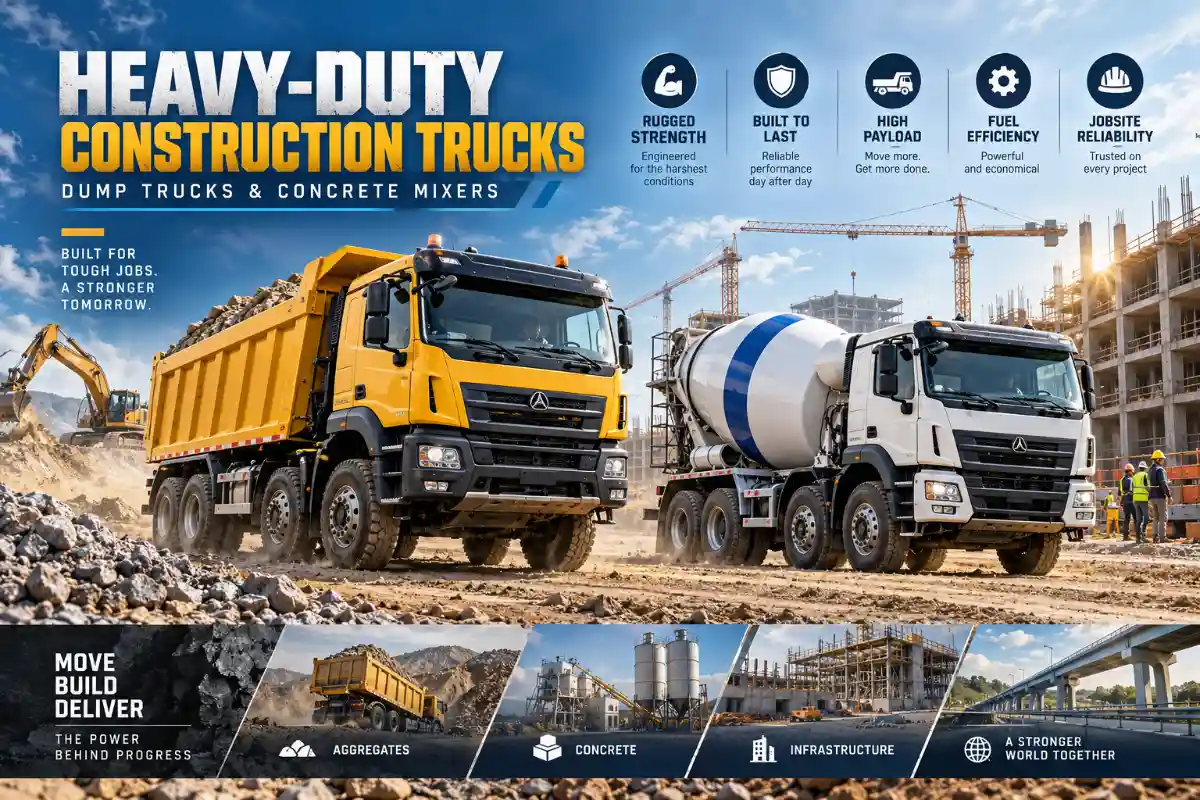
| Application | Typical Vehicle | Main Selection Factors |
|---|---|---|
| Earth, sand and aggregate transport | Construction dump truck | Payload, body volume, axle configuration, traction and road condition |
| Rock, demolition material or abrasive loads | Heavy-duty dump truck | Body material, floor thickness, suspension, tires and hydraulic system |
| Ready-mix concrete delivery | Concrete mixer truck | Drum capacity, chassis GVW, hydraulic drive, route and discharge conditions |
| Road and bridge construction | Dump truck, mixer truck or vocational chassis | Site access, turning radius, grade, duty cycle and road legality |
| Equipment and material lifting | Truck-mounted crane | Lifting load, working radius, crane load chart and chassis capacity |
Dump trucks are commonly used for moving soil, sand, gravel, aggregate, demolition waste and other bulk material between excavation areas, stockpiles and processing or disposal points.
The important number is not simply the size of the dump body. The material density, rated chassis payload, axle limits and gross vehicle weight must work together. A body that is too large for the chassis can encourage overloading, while an unnecessarily heavy body reduces usable payload.
Often considered for general construction and short-haul material transport where traction and payload are more important than the maneuverability of a smaller two-axle truck.
Can be suitable where additional axle capacity is needed and the site provides enough turning space. Local axle-weight regulations should be checked before choosing the final configuration.
Abrasive stone or demolition work may require closer attention to dump-body steel, floor and side-wall construction, rear-gate design, suspension and tire selection.
Cylinder arrangement, tipping angle and hydraulic component selection should suit the body size and material. Stable ground conditions are also important during unloading.
If you are comparing dump-truck configurations, see our heavy-duty dump truck buying guide or review the DT-200 dump truck as a reference platform.
A concrete mixer truck combines a truck chassis with a rotating mixing drum, hydraulic drive system, water system and discharge equipment. Its job is to transport fresh concrete while maintaining agitation between the batching plant and the placement point.
Drum size alone should not decide the purchase. Concrete is heavy, so the usable load must remain within the chassis, axle and legal gross-weight limits. Route length, road gradients, site access and the time between batching and discharge also matter.
Match nominal drum class with the chassis rather than choosing the largest drum available. Our mixer capacity guide covers common 6 m³, 8 m³, 10 m³ and 12 m³ classes.
Confirm the hydraulic pump, motor, reducer and control arrangement used on the selected build, especially when service parts need to be sourced locally.
Frequent hills, rough access roads and stop-start urban delivery can change the appropriate engine, transmission, axle and cooling setup.
For more detail, read the concrete mixer truck capacity guide .
A useful quotation starts with operating information. The more accurately the job is described, the easier it is to avoid an oversized, undersized or poorly matched truck.
Soil, wet clay, gravel, large rock, demolition material and concrete have different densities and handling requirements. Material type affects both usable capacity and body design.
Tell us whether the vehicle will work mainly on paved roads, unfinished construction roads, muddy sites, steep grades or a combination of public road and off-road conditions.
Short repeated cycles have different cooling, transmission and fuel considerations from longer road transport between a plant and job site.
Axle-load limits, gross vehicle weight, dimensions, steering side and registration requirements vary by country. These should be checked before the final specification is approved.
Engine and after-treatment requirements differ by destination market. Confirm the applicable emission level before ordering rather than assuming one specification is suitable everywhere.
Parts availability, filter specifications, diagnostic access and service familiarity can be just as important as the initial purchase price for a working fleet.
Specifications should be tied to a defined model and configuration. Instead of treating broad figures as universal values, confirm the following items on the quotation and final technical sheet.
| Specification | Dump Truck | Concrete Mixer | Why It Matters |
|---|---|---|---|
| Drive / axle layout | 4×2, 6×4, 8×4 or project-specific | Matched to drum and legal load | Traction, payload distribution and road legality |
| Rated payload / GVW | Confirm chassis and body together | Confirm concrete load and chassis limit | Prevents an oversized body from exceeding vehicle limits |
| Body or drum capacity | Matched to material density | Matched to usable concrete load | Nominal volume is not the same as legal payload |
| Engine and transmission | Matched to grade and loaded operation | Matched to loaded route and duty cycle | Affects gradeability, driveability and service requirements |
| Suspension and tires | Selected for road and site conditions | Selected for axle load and route | Important for traction, stability and tire life |
| Hydraulic equipment | Tipping cylinder and hydraulic circuit | Pump, motor, reducer and drum drive | Key working system on both truck types |
| Emission configuration | Destination-market dependent | Destination-market dependent | May affect registration and import compliance |
| Cab and steering | Confirm LHD/RHD and cab requirements | Confirm LHD/RHD and cab requirements | Must suit local traffic rules and operator requirements |
Transport of aggregate, base material, soil and concrete between stockpiles, batching plants and active roadwork sections.
Material transport and concrete delivery where loaded gradients, access routes and project schedules influence vehicle selection.
Repeated short-haul cycles between excavation points, fill areas and temporary stockpiles, often on unfinished ground.
Material and ready-mix delivery where maneuverability, road access, neighborhood restrictions and discharge space may matter more than maximum vehicle size.
Depending on the chassis, vehicle type and destination market, a construction truck quotation may need to cover more than the engine and body capacity. The following points are useful to discuss before an order is finalized.
| Chassis | Axle arrangement, wheelbase, rated vehicle weight and frame configuration |
|---|---|
| Powertrain | Engine, emission level, transmission, axle ratio and cooling requirements |
| Dump Body | Volume, material, floor and side construction, rear gate and tipping system |
| Mixer Equipment | Drum class, hydraulic pump, motor, reducer, water system and discharge chute |
| Running Gear | Suspension, tires, wheel specification and braking configuration |
| Cab | Left- or right-hand drive, seating, climate equipment and visibility options |
| Site Equipment | Lighting, cameras, alarms, guards and application-specific options where available |
| Documentation | Technical documents and export paperwork appropriate to the order and destination |
Send the truck type, quantity, material, target payload or drum capacity, road conditions, duty cycle and destination country.
Review the chassis, body or mixer equipment, engine, axle setup, dimensions and important options before the quotation is finalized.
Confirm price terms, production or availability information, specification documents and destination requirements.
Shipping route, destination port and required export documentation can then be coordinated according to the agreed order terms.
Construction dump trucks commonly need to work both on job sites and, depending on the project, on public roads. Mining applications can involve heavier loads, rougher haul roads and different duty cycles. The correct chassis, body, tires, suspension and braking specification therefore depends on the actual route and operating environment rather than the vehicle name alone.
A 6×4 truck is commonly considered where traction, maneuverability and a practical heavy-duty payload are required. An 8×4 layout can provide additional axle capacity, but it also needs more turning space and must still comply with local axle-load and gross-weight rules. The better choice depends on payload, site access and road regulations.
Start with the amount of concrete you need to deliver per trip, then check whether that load is suitable for the chassis and local gross vehicle weight. Route gradients, road quality, batching-plant distance and job-site access should also be considered. A larger drum does not automatically mean a more useful payload.
The most useful information is truck type, quantity, target payload or body capacity, material carried, preferred axle configuration if known, road and terrain conditions, destination country, destination port and any required emission or steering configuration.
Many configuration items can vary by market, including steering position, engine and emission specification, tires, dimensions and optional equipment. Availability depends on the selected chassis and vehicle type, so destination requirements should be discussed before the final specification is confirmed.
Lead time depends on the selected chassis, body equipment, customization, production availability, order quantity and shipping route. For that reason, delivery timing should be confirmed on the quotation instead of relying on a single standard lead-time claim.
Chinese Truck Factory provides export-document and shipping coordination for international orders. The exact document package, port arrangement and shipping terms depend on the destination and agreed commercial terms.
If you already know the truck type, payload, mixer capacity or chassis you need, send the specification directly. If you are still comparing options, tell us what the truck will carry, where it will operate and which country it needs to be delivered to.
Request a Quote