A garbage compactor truck is not a single product — it is a chassis, a compaction body, a hydraulic system and a bin-lifting mechanism engineered to work together on a specific collection route. The question of which Chinese manufacturer to buy from matters less than whether that manufacturer can match the compactor body to your waste stream, bin type, route length and legal axle limits. China has several established builders producing rear-loader, side-loader and hook-lift refuse vehicles, most mounted on Sinotruk, Dongfeng, FAW, Foton or JAC chassis. This article explains what separates a competent compactor truck supplier from a trading office, how to evaluate the ten most commonly encountered manufacturers, and which questions to settle before you request a price.
What “Top Manufacturer” Actually Means for a Compactor Truck Buyer
Buyers searching for compactor truck manufacturers usually want one of three things: a reliable supply source, a competitive price, or a body that survives a hard collection cycle. Those are different problems, and they are solved by different capabilities.
A manufacturer worth shortlisting should be able to answer all of the following without sending you to a third party:
- Which chassis platforms do they build on, and can they supply the chassis and body as one unit?
- Do they fabricate the compaction body in-house, or buy it from another body builder?
- Which hydraulic components — pumps, valves, cylinders — are used, and are they sourced from established suppliers?
- Can they build for left-hand or right-hand drive, and to which emission standard?
- Do they provide a spare parts list and a hydraulic schematic with the truck?
- Have they exported complete units, not just quoted FOB prices?
Companies that only assemble trucks from purchased bodies and purchased chassis are not necessarily bad, but they carry less control over quality and less ability to solve a warranty problem. Companies that fabricate the body and integrate the hydraulics themselves generally have more room to adjust design for a specific waste density or bin standard.
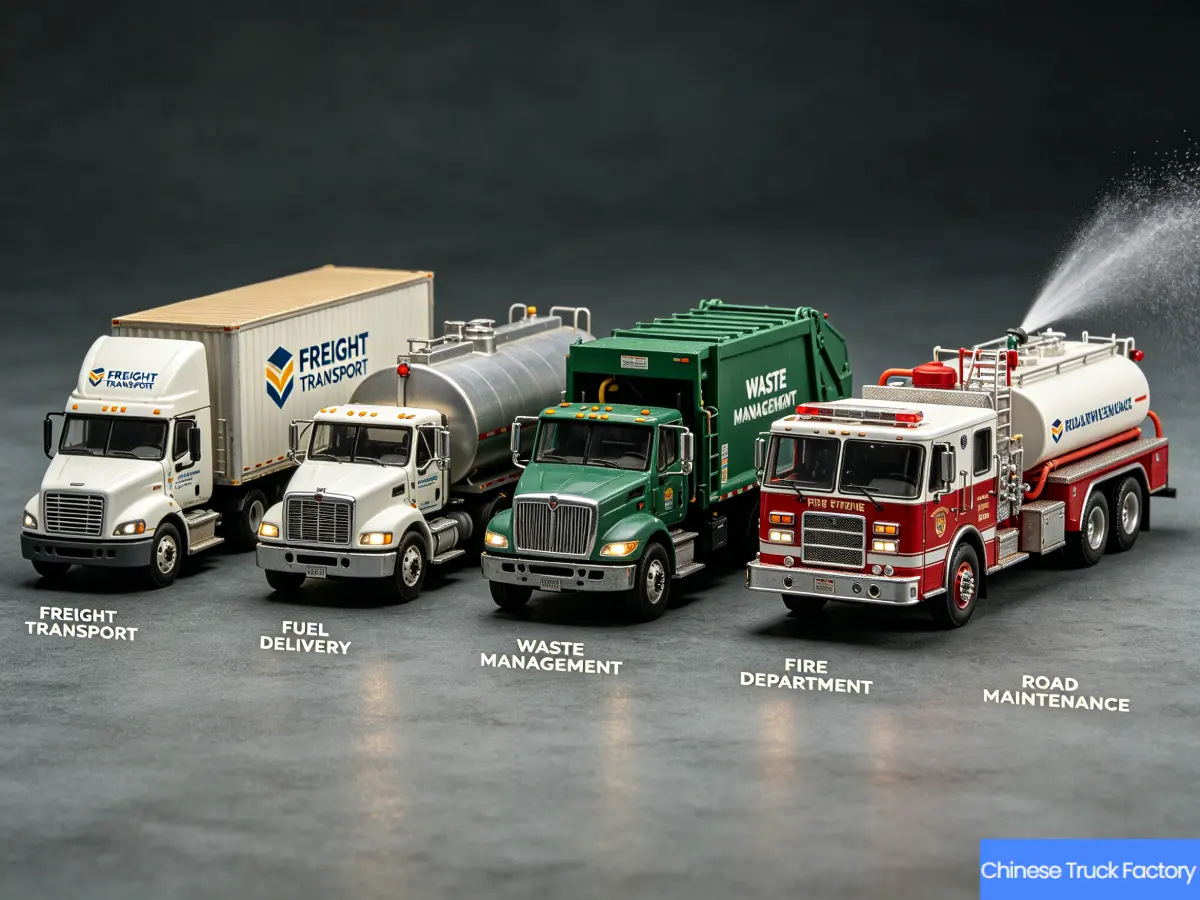
The Ten Manufacturers Most Commonly Encountered by Export Buyers
The Chinese sanitation vehicle sector is dominated by a mix of large state-linked groups, provincial body builders and specialised compaction equipment makers. The list below covers the names that appear most often in international tender documents and dealer inventories. It is not a ranking by quality — different builders are stronger in different segments.
1. Sinotruk Group (HOWO and Sitrak Chassis)
Sinotruk is primarily a chassis manufacturer, but its HOWO and Sitrak platforms are the base for a large share of compactor trucks built in Shandong. Buyers often purchase the chassis from Sinotruk and the body from a specialist upfitter. The advantage is parts availability — HOWO components are widely stocked across Africa, Southeast Asia and Latin America. The disadvantage is that chassis and body warranties come from different companies.
2. Dongfeng Motor
Dongfeng builds both chassis and complete sanitation vehicles, including rear-loading compactors in the 8 to 16 cubic metre range. Its smaller 4×2 platforms are common in municipal fleets where narrow streets and tight turning circles matter more than payload. Dongfeng’s export network is broad, though spare parts support varies by country.
3. FAW Jiefang
FAW produces compactor trucks on its Jiefang medium and heavy chassis. The brand is well established in East Africa and parts of Southeast Asia. FAW’s sanitation range tends to be conventional rear-loader designs rather than specialised split-body or side-loading configurations.
4. Foton Motor
Foton’s Auman and Forland chassis are used for municipal refuse vehicles, particularly in the light and medium duty classes. Foton has invested in electric sanitation platforms, which makes it relevant for cities phasing in zero-emission collection fleets.
5. JAC Motors
JAC builds compactor bodies on its own N-series and heavy chassis. The company is active in Latin America and Southeast Asia, and its medium-duty refuse trucks are priced competitively against Dongfeng and Foton equivalents.
6. Shacman (Shaanxi Automobile)
Shacman is better known for construction and haulage trucks, but its chassis are also used for heavy compactor bodies in markets where road conditions are poor and axle strength matters. Shacman’s X3000 and F3000 platforms are common in African municipal tenders.
7. Zoomlion
Zoomlion is a large environmental equipment group with a substantial sanitation vehicle division. Its compactor trucks are often specified in Chinese domestic municipal contracts and increasingly in export projects. Zoomlion’s strength is system integration — body, hydraulics and control logic designed together.
8. Yutong Heavy Industries
Yutong is best known for buses, but its heavy industry division produces sanitation vehicles including rear-loading compactors and electric refuse trucks. The company’s electric platform experience is relevant for municipal fleets with depot charging.
9. Chengli Special Automobile
Chengli is one of the largest specialised vehicle upfitters in Hubei province, producing compactor trucks, water tankers, sewage suction trucks and other municipal vehicles on purchased chassis. Its range is broad, and it can build to customer specification, but buyers should confirm which chassis brand is used for a given quotation.
10. Hubei-based Specialist Body Builders
A large number of smaller manufacturers in Suizhou and surrounding areas build compactor bodies on Sinotruk, Dongfeng or FAW chassis. Some are capable fabricators with genuine export experience; others are assembly operations with limited engineering depth. This is the segment where supplier verification matters most.
How to Evaluate a Compactor Truck Manufacturer
Brand names tell you very little about whether a specific truck will work on your route. The evaluation should focus on engineering capability and delivery reliability.
Body Fabrication and Steel Specification
Ask what steel grade is used for the compaction body, the hopper floor and the ejector plate. Wear-resistant steel in the hopper and along the loading edge extends body life significantly in construction waste or mixed municipal waste. A manufacturer that cannot state the steel grade is likely buying generic plate.
Compaction Ratio and Cycle Time
Compaction ratio determines how much waste fits in a given body volume, but it is highly dependent on waste type. Mixed municipal waste, commercial waste and construction debris behave very differently. Ask for the compaction force and the hydraulic cycle time, and confirm whether the figures are for the specific body model you are buying.
Bin Lifting and Loading Mechanism
Bin compatibility is one of the most common sources of failure in imported compactor trucks. Bins in your city may be 120 L, 240 L, 660 L or 1100 L, and may be DIN standard or locally fabricated. The bin lifter must be built for the bins actually in use. A manufacturer that asks for your bin dimensions before quoting is more likely to deliver a working truck.
Hydraulic System Quality
Compactor trucks live or die by their hydraulics. Ask which brand of pump, control valve and cylinders is used, whether the system uses load-sensing or fixed-displacement hydraulics, and whether a hydraulic schematic is supplied. Leachate corrosion and heat are the two main enemies of these systems.
Export Experience and Documentation
A manufacturer with genuine export experience will understand that the same truck cannot be shipped to every market. Emission standards, steering side, lighting and registration rules differ. If a supplier claims their truck “meets all international standards,” that is a warning sign. Ask instead which countries they have shipped to and what documentation they can provide.
Buyers comparing suppliers across the full sanitation vehicle range can review the available professional sanitation vehicles currently offered for export, which gives a useful baseline for what a complete compactor truck specification should include.
Chassis Selection: The Half of the Truck Buyers Ignore
The compactor body is the visible part, but the chassis determines whether the truck can legally carry the loaded body, stop safely and climb the route’s gradients.
| Chassis Configuration | Typical Body Volume | Best Use Case | Main Limitation |
|---|---|---|---|
| 4×2 medium duty | 6–10 m³ | Narrow urban streets, residential collection | Limited payload, fewer bins per trip |
| 6×4 heavy duty | 12–18 m³ | Mixed municipal routes, longer transfer distances | Larger turning radius, higher purchase cost |
| 8×4 heavy duty | 18–22 m³ | High-volume collection, transfer station feeding | Heavier curb weight, higher tire cost |
Body volume and payload are not the same thing. A 16 m³ compactor body filled with wet municipal waste at roughly 400–500 kg/m³ after compaction may carry far less than the same body filled with dry commercial waste. The legal payload is set by the chassis GVW, axle ratings and the road regulations of the destination country — none of which the body builder controls.
For buyers who also operate tipping and haulage equipment, the same chassis logic applies to heavy-duty construction vehicles, where axle configuration and payload limits drive the entire specification.
Compactor Body Design: What Separates a Good Body from a Cheap One
Compactor bodies look similar in photographs. The differences show up after two or three years of daily operation.
- Hopper floor thickness. The hopper takes the impact of every bin load. Thin plate deforms and eventually cracks at the weld seams.
- Ejector plate and compaction panel. These are the highest-wear components. Wear plate or hardened steel in these areas extends service life.
- Leachate management. A sealed body with a dedicated leachate tank prevents liquid from dripping onto the road and corroding the chassis. This is also a regulatory requirement in many cities.
- Hydraulic hose routing. Hoses routed where they can be crushed by the tailgate or abraded by the body will fail early. Ask for a routing drawing.
- Control system. Manual lever control is simple and repairable. Electronic control offers cycle automation but adds a failure point that requires diagnostic capability.
For buyers who need to understand how the compaction mechanism works before specifying a body, the explanation of how a garbage compactor truck works covers the hydraulic sequence from bin lift to ejection.
Application Matching: Route, Waste Type and Bin System
The same compactor truck specification will perform very differently depending on the waste stream and route.
Residential Collection
Frequent stop-start, narrow streets, standardised bins and relatively low waste density. A 4×2 or light 6×4 chassis with a 8–12 m³ body and a fast bin-lift cycle usually works better than a large body that cannot manoeuvre.
Commercial and Mixed Municipal Waste
Higher density, larger bins, longer routes. A 6×4 chassis with a 12–16 m³ body and a heavier compaction mechanism is more appropriate. Route length determines whether one or two trips per shift are realistic.
Construction and Bulky Waste
Compactor trucks are generally the wrong tool for construction debris, which damages compaction mechanisms. Hook-lift or skip-loader trucks are more suitable. Buyers who need to move both types of waste should consider a mixed fleet rather than forcing one truck to do both jobs.
Transfer Station Feeding
Large 8×4 compactor trucks with 18–22 m³ bodies are used to move compacted waste from transfer stations to landfill or incineration. These trucks operate on longer cycles with fewer stops, so engine and driveline efficiency matter more than bin-lift speed.
Operating Cost and Total Cost of Ownership
Purchase price is the smallest part of compactor truck cost over a ten-year life. The larger costs are fuel, maintenance, tires, hydraulic repairs and downtime.
| Cost Element | What Drives It | How to Reduce It |
|---|---|---|
| Fuel | Gross weight, stop-start frequency, idling during loading | Right-size the chassis, avoid excessive idling, route optimisation |
| Hydraulic maintenance | Oil quality, heat, contamination, hose routing | Specify quality components, follow oil change intervals, filter cleanliness |
| Tires | Axle load, route surface, curb strikes | Correct inflation, driver training, appropriate tire specification |
| Body repair | Steel grade, hopper design, waste type | Wear plate in high-impact areas, avoid construction debris |
| Downtime | Parts availability, local service capability | Choose chassis brands with local parts support, stock critical spares |
The chassis brand matters here more than the body builder. A compactor body can be repaired by a competent welding shop in most cities, but a failed engine or transmission requires parts that must be locally available. Selecting a chassis with an established service network in your country is often more important than selecting the lowest-priced body.
Destination Market Compliance and Import Considerations
Compactor trucks are road vehicles, and road vehicles are regulated by the country where they are registered. There is no single “global compliant” truck.
Before ordering, confirm with your importer or registration authority:
- Emission standard. Euro 2, Euro 3, Euro 5 or equivalent national standards. Some markets restrict import of older emission tiers.
- Steering side. Left-hand drive for most of Africa, the Middle East and Latin America; right-hand drive for much of Southeast Asia, South Asia and East Africa.
- Axle weight and GVW limits. These determine the legal payload, which may be lower than the truck’s technical capacity.
- Vehicle dimensions. Overall length, width and height limits affect body size and bin-lift design.
- Lighting and safety requirements. Some markets require specific lighting configurations or additional safety equipment.
- Fuel quality and DEF availability. A Euro 5 engine requires low-sulphur diesel and AdBlue. If these are not reliably available, a lower emission tier may be the practical choice.
Homologation and type approval requirements vary widely. In some countries a compactor truck can be registered as a special-purpose vehicle with minimal approval; in others it requires full type approval. This should be confirmed before the truck is built, not after it arrives at port.
Shipping and Delivery
Compactor trucks are large, heavy and often non-runnable for short port moves, which affects shipping method. The main options are RoRo, breakbulk and flat-rack container.
RoRo is usually the most economical for complete trucks that can be driven on and off the vessel, but it depends on the route and the receiving port’s facilities. Breakbulk is used when RoRo is unavailable or when the truck cannot be driven. Flat-rack container shipping is practical for smaller compactor trucks and offers more schedule flexibility, but the truck must fit within the flat-rack dimensions and weight limits.
The choice depends on truck dimensions, weight, quantity, shipping route and destination port. For a detailed comparison of methods and their cost implications, the guide to how heavy trucks are shipped overseas from China covers the practical trade-offs.
Spare parts should be planned at the same time as the truck order. Critical spares for a compactor truck include hydraulic hoses, hydraulic filters, bin-lift pins and bushings, control valve seals and a spare hydraulic pump. These are inexpensive relative to the truck and can prevent weeks of downtime.
Why Chinese Truck Factory Belongs on Your Shortlist
Chinese Truck Factory operates as a China truck manufacturer and export platform serving international buyers across municipal, construction and logistics applications. The evaluation criteria that matter for compactor truck procurement are the same ones used to assess any supplier, and they are worth stating explicitly.
- Chassis and body integration. Compactor bodies are matched to the chassis platform rather than supplied as separate purchases, so warranty and technical responsibility sit in one place.
- Specification to route. Body volume, compaction force, bin-lift type and hydraulic configuration are selected against the buyer’s waste stream, bin dimensions and route profile — not simply chosen from a catalogue.
- Export documentation. Steering side, emission tier, lighting and shipping method are confirmed against destination-country requirements before the order is placed.
- Spare parts planning. Critical hydraulic and body components can be included in the initial shipment, which matters in markets where local parts supply is thin.
- Full vehicle range. Beyond compactor trucks, the platform covers heavy-duty diesel trucks and specialized vehicles, which is useful for buyers building a mixed municipal or construction fleet.
Buyers who want to compare specific compactor truck configurations, body volumes and chassis options can review the current range and request a specification matched to their route.
Request a Compactor Truck Specification
Frequently Asked Questions
How do I choose the right body volume for a compactor truck?
Start with the waste type and the number of collection points on the route. Estimate the daily waste volume, apply a realistic compaction ratio for that waste type, and check that the resulting loaded weight stays within the chassis GVW and the legal axle limits of your country. Body volume alone tells you nothing about payload.
Which axle configuration should I use?
4×2 medium-duty chassis suit narrow urban routes with standard bins. 6×4 heavy-duty chassis suit mixed municipal routes and longer transfer distances. 8×4 chassis suit high-volume transfer station feeding. The choice should follow the route and payload, not the other way around.
Does compaction ratio vary by waste type?
Yes, significantly. Mixed municipal waste, commercial waste, food waste and construction debris all compact differently. A compactor that performs well on dry commercial waste may struggle with wet organic waste. Ask the manufacturer for compaction performance data for your specific waste stream.
What maintenance does a compactor truck need?
Daily checks should cover hydraulic oil level, hose condition, bin-lift mechanism, tire condition and warning indicators. Periodic maintenance covers hydraulic oil and filter changes, PTO inspection, compaction panel and ejector plate wear, brake and suspension inspection, and chassis lubrication. Specific intervals should follow the chassis and body manufacturer’s manuals for your exact model.
How do I confirm the truck will be legal in my country?
Confirm emission standard, steering side, GVW and axle limits, overall dimensions, lighting requirements and registration category with your local registration authority or a licensed importer before placing the order. Requirements differ by country and cannot be assumed from a supplier’s general statement.
How are compactor trucks shipped from China?
RoRo, breakbulk and flat-rack container are the three main methods. The right choice depends on truck dimensions, weight, quantity, route and destination port facilities. Confirm the shipping method and Incoterm before comparing prices, because FOB and CIF quotations are not directly comparable.
What information should I provide when requesting a quotation?
Destination country and port, waste type, bin type and dimensions, required body volume, daily route length, road conditions, required chassis configuration, steering side, emission standard, quantity and any required options. Providing this information upfront reduces the risk of a specification that does not match the actual duty cycle.
Final Selection Notes
The most suitable compactor truck is not the one with the largest body or the lowest FOB price. It is the configuration that matches the waste stream, the bin system, the route profile, the legal weight limits and the local maintenance capability with the fewest compromises.
Before committing to any manufacturer, confirm four things: the compaction body is built for your waste type and bin dimensions, the chassis can legally carry the loaded body in your country, the hydraulic components are from established suppliers with available spares, and the supplier has genuine export experience to your region. Buyers who get these four right rarely regret the purchase. Buyers who compare only on price frequently do.