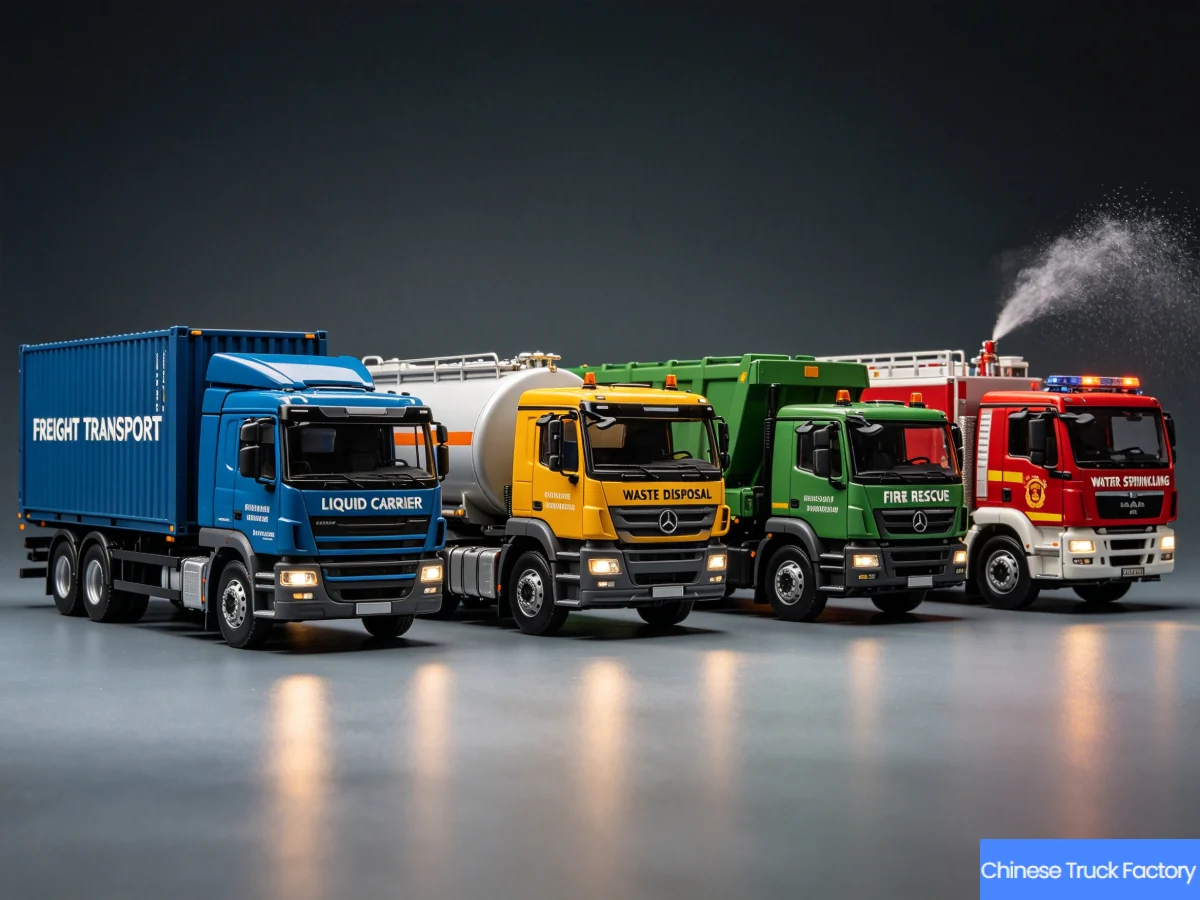
There is no single truck that wins across every mining pit, quarry, and construction site. The right machine depends on what you haul, how far, how steep the road is, and what your local weight laws actually allow. A 6×4 dump truck rated at 40 tonnes may be perfect on a well-maintained haul road, yet the wrong choice on a soft, steep, unsealed grade where an 8×4 or a heavier rear axle setup carries the load with less tire stress. The practical approach is to work backward from the duty cycle — material, payload, route, gradient, and cycle time — then match the chassis, powertrain, and body to those numbers. This article walks through that selection logic step by step.
Start With the Duty Cycle, Not the Truck
Most bad truck purchases start with a spec sheet instead of a job description. Before comparing horsepower or body volume, write down what the truck will actually do in a normal working day.
For a mining or construction application, that means answering these questions honestly:
- Material type and density. Sand and gravel run roughly 1.5–1.7 t/m³ loose. Crushed rock and iron ore can run 2.0–2.8 t/m³ or more. The same 20 m³ body carries very different tonnage depending on what goes in it.
- Required payload per cycle. In tonnes, not cubic meters. This is the single most important number.
- Haul route length and surface. A 2 km internal pit road is a completely different duty from a 40 km public road with a mix of sealed and unsealed sections.
- Gradient. A 6% grade is manageable for most 6×4 trucks at full load. Sustained 10–12% grades change the axle ratio, cooling, and brake requirements significantly.
- Loading method. Excavator, wheel loader, or manual loading dictates body height, sidewall design, and whether the body needs a reinforced floor.
- Cycles per day and annual hours. A truck running 20 hours a day needs a different maintenance and parts strategy than one running 8 hours.
- Climate and altitude. High ambient temperature and altitude reduce engine derating margins and affect cooling and turbo performance.
An illustrative example: a quarry moving 24 tonnes per cycle over a 12 km haul route, six days a week, with one 8% grade section. That single paragraph already rules out several configurations before you look at a single price list.
Matching Drive Configuration to the Job
Drive layout is where a lot of buyers overspend or underspend. The table below shows how the main configurations typically map to real work.
| Configuration | Typical Best Use | Payload Range (indicative) | Main Advantage | Main Limitation |
|---|---|---|---|---|
| 4×2 | Light construction, urban delivery, small tipper work | 8–15 t | Lower purchase cost, tighter turning | Limited traction on soft or steep ground |
| 6×4 | General construction hauling, quarry, mid-size mining | 20–35 t | Good balance of traction, payload, and cost | Can struggle on very soft ground at full load |
| 8×4 | Heavy construction, high-volume quarry, long-haul tippers | 30–45 t | Higher legal payload within axle limits | Heavier tare, larger turning radius, higher tire cost |
| 6×6 | Rough terrain, wet or unsealed pit roads, remote sites | 18–30 t | Superior traction on poor surfaces | Higher fuel use, more driveline complexity |
Note that the payload ranges above are indicative and depend on chassis, axle ratings, tire selection, and the legal weight limits where the truck will be registered. A 6×4 truck legally rated for 25 tonnes gross in one market may be registered for a different figure elsewhere. Always confirm against the destination country’s axle-load and gross-weight rules before finalizing a specification.
For buyers who need a starting point on chassis matching, the selection logic for mining dump truck configurations covers how material density and haul road gradient drive axle and body choices.
Payload, GVW, and Body Volume Are Not the Same Thing
This is where most specification errors happen. Three numbers get confused constantly:
- Curb weight (tare): the truck with fuel, fluids, and body, but no cargo.
- Payload: the weight of cargo the truck can carry.
- GVW / GVWR: the maximum allowable total weight of the loaded truck.
Payload equals GVW minus curb weight. It is that simple, and that is exactly why a heavier body or a larger crane reduces how much material you can legally carry. A 20 m³ dump body does not automatically mean 20 tonnes of payload. If you are hauling wet sand at 1.6 t/m³, a full 20 m³ body holds about 32 tonnes — which may exceed the chassis and legal limit. If you are hauling dry coal at 0.9 t/m³, the same body holds only 18 tonnes, and you are running under capacity.
Two more distinctions matter for compliance:
- Technical payload is what the chassis and axles can physically handle.
- Legal payload is what the destination country’s registration and road-weight rules permit.
These are often different. The lower number governs. Buyers should confirm the legal axle loads and gross vehicle weight for their specific registration category before locking in a body size. For a deeper breakdown of how these numbers interact, see dump truck payload capacity explained.
Powertrain and Chassis Choices That Actually Matter
Engine and torque
Horsepower gets the attention, but torque at low rpm is what moves a loaded truck up a grade. For heavy construction and mining hauling, engines in the 380–460 hp range with peak torque in the 1,600–2,200 Nm band are common. The exact figure should be matched to gross weight and gradient, not chosen because it is the biggest number available. An oversized engine adds purchase cost and often fuel consumption without improving cycle time if the route is flat and short.
Transmission
Manual transmissions remain common in mining and construction because they are simple, repairable, and familiar to drivers. Automated manual transmissions (AMT) reduce driver fatigue and can improve fuel consistency on long-haul routes, but they add electronic complexity and require diagnostic support. For remote sites with limited service capability, a manual gearbox is often the lower-risk choice.
Axles and final drive ratio
Axle ratio is one of the most under-discussed specifications. A numerically higher ratio (for example, 5.92:1) improves gradeability and pulling power but raises engine rpm at highway speed, increasing fuel use. A lower ratio (for example, 4.11:1) is better for long flat hauls but can struggle on steep loaded grades. The right choice depends on whether the truck spends most of its time on pit roads or public highways.
Axle type also matters. Single-reduction axles are simpler and cheaper to maintain. Hub-reduction axles handle higher torque and are common in heavy mining applications. For a comparison of when each makes sense, see single reduction vs hub reduction axles.
Suspension and tires
Leaf spring suspension is durable, cheap to repair, and well understood in most markets. Air suspension improves ride quality and load distribution but adds cost and complexity. For mining and construction, leaf springs are usually the default unless the route is mostly sealed road.
Tire selection follows the surface. On sharp rock and unsealed pit roads, cut-resistant tread patterns and reinforced sidewalls reduce downtime. On sealed haul roads, standard highway tread gives better fuel economy. Tire cost per hour is often a bigger line item than fuel in aggressive mining conditions, so this is not a place to save money on the wrong spec.
Body and Superstructure: Where the Real Wear Happens
The chassis gets the truck to the site. The body and superstructure determine whether it survives there. For dump trucks in mining and construction, the key variables are:
- Body volume matched to material density and legal payload, not just the largest number available.
- Steel grade and floor thickness. Hardox or equivalent wear-resistant steel in the floor and lower sidewalls extends body life significantly when loading rock.
- Sidewall and tailgate design. Higher sidewalls increase volume but raise the center of gravity when loaded.
- Tipping angle and cylinder configuration. A front-mounted telescopic cylinder gives a higher tipping angle and better load release than a underbody cylinder in many applications.
- Subframe. The interface between body and chassis takes enormous stress. A poorly designed subframe causes chassis cracking.
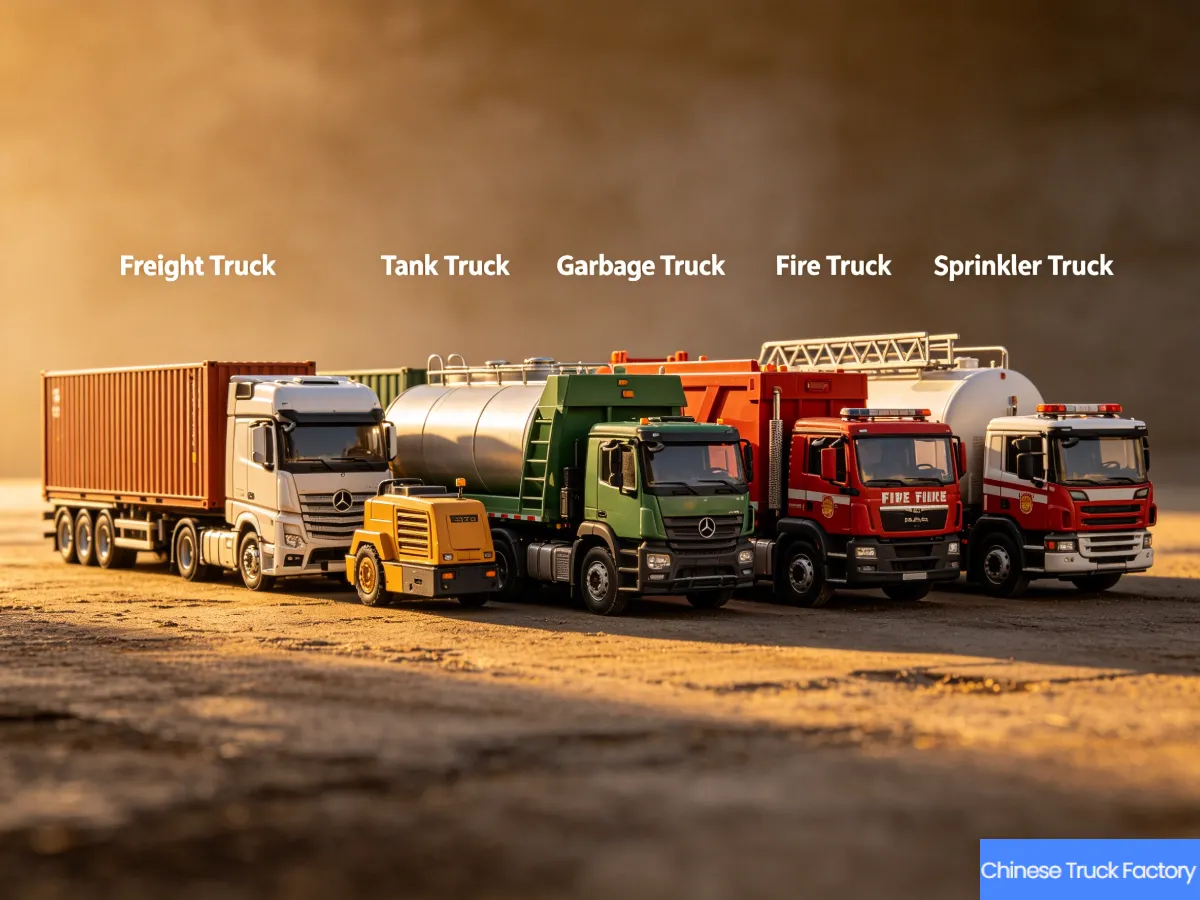
For non-dump applications, the superstructure logic changes. A truck-mounted crane, for example, is not selected by nominal tonnage alone. A “12-ton” crane cannot lift 12 tonnes at full boom extension. The load chart governs, and the crane’s own weight reduces the remaining cargo payload. Buyers should work from maximum load weight, working radius, and lifting height, then confirm the chassis can carry both the crane and the cargo. More detail is available on truck-mounted crane selection.
For municipal and waste operations, the superstructure is the whole point. A compactor body’s value comes from compaction ratio, hopper design, bin lifter compatibility, and hydraulic cycle time — not just body volume. Buyers evaluating sanitation and compactor vehicles should match the body to the waste stream and collection route, not to a generic capacity figure.
Productivity: The Numbers That Decide Profit
Purchase price is a one-time event. Productivity is what pays for the truck. The metrics that matter in mining and construction hauling are:
- Payload per trip — in tonnes, not cubic meters.
- Cycle time — loading, hauling, dumping, and returning.
- Trips per day — limited by the slowest step in the cycle.
- Average operating speed — heavily influenced by road condition and gradient.
- Ton-kilometers per day — the real output measure.
- Cost per tonne moved — the number fleet managers should track.
A truck with a slightly smaller body but a faster cycle can out-produce a larger truck that is slow to load or unload. This is why body volume alone is a poor selection criterion. The engineering trade-off is always between payload per trip and cycle time.
Fuel and Energy Consumption: No Single Number Applies
Anyone who quotes a single fuel consumption figure for a heavy truck is either quoting a specific test condition or guessing. Actual consumption depends on:
- Gross vehicle weight (loaded and empty)
- Route profile and gradient
- Average speed and traffic
- Idling time during loading and queuing
- Driver behavior
- Axle ratio and tire pressure
- Climate and altitude
- Engine calibration and emission configuration
For a loaded 6×4 dump truck on a mixed pit-and-road cycle, an indicative operating range might fall somewhere between 35 and 60 liters per 100 km, but the spread is driven almost entirely by the variables above. Buyers should treat any single figure as a starting assumption to be verified against their own duty cycle, not as a specification.
Electric trucks change the calculation. Energy cost per kilometer can be lower, but the real questions are battery capacity, usable capacity, route predictability, charging power, depot dwell time, and whether the site has the electrical infrastructure to support fleet charging. Payload is also affected, because battery weight reduces available cargo capacity. For operations evaluating this route, the port and logistics electric truck solutions overview covers the practical constraints.
Maintenance, Reliability, and Uptime
Downtime costs more than parts. A truck sitting idle in a pit for three days waiting on a hydraulic hose costs far more than the hose. Maintenance planning should focus on keeping the truck in service, not just on the cheapest repair.
Daily inspection items that catch most failures early:
- Tire condition and pressure
- Fluid leaks (engine oil, coolant, hydraulic oil)
- Hydraulic hose condition and fittings
- Lights and warning indicators
- Air system pressure and brake response
Periodic inspection items that prevent major failures:
- Engine oil and filter condition
- Transmission and differential oil
- Brake system wear
- Suspension components and wheel bearings
- PTO engagement and hydraulic pump condition
- Dump body hinges, pins, and cylinder mounts
- Compactor mechanism wear (for waste vehicles)
- Crane pins, outriggers, and load chart verification (for crane trucks)
Exact service intervals must come from the specific engine and component manufacturer’s manual for the truck in question. Do not assume that intervals from one model apply to another.
Parts availability is a selection criterion, not an afterthought. A truck model with no local parts network will spend more time waiting on shipments than working. Buyers should confirm that common wear items — filters, brake components, hydraulic hoses, and body pins — are available through the destination market or through a reliable supply channel. For heavy-duty diesel platforms used in construction, the heavy-duty diesel truck range is a useful reference for how platform commonality affects parts strategy.
Total Cost of Ownership: The Only Fair Comparison
Comparing purchase prices between two trucks is meaningless if one has a higher fuel burn, shorter tire life, or a weaker parts network. A proper TCO comparison includes:
| Cost Category | What to Include |
|---|---|
| Purchase price | Chassis, body, options, emission configuration |
| Freight and logistics | Shipping method, port charges, inland transport |
| Import and compliance | Duties, taxes, registration, homologation costs |
| Fuel or electricity | Based on actual duty cycle, not brochure figures |
| Tires | Cost per hour, driven by surface and load |
| Scheduled maintenance | Parts and labor at manufacturer intervals |
| Unscheduled repairs | Based on reliability history and local service capability |
| Downtime | Lost production during repairs and waiting on parts |
| Residual value | Resale or trade-in at end of service life |
Two trucks with the same purchase price can have very different five-year costs. The truck with better local parts support and a simpler driveline often wins, even if it costs more upfront.
Compliance and Destination-Market Requirements
There is no such thing as a globally compliant truck. Every destination market has its own rules, and they change. Buyers must confirm the following before finalizing a specification:
- Emission standard required for registration
- Homologation or type approval requirements
- Left-hand drive or right-hand drive
- Axle-weight and gross-weight limits
- Vehicle dimension limits
- Lighting and marking requirements
- Braking and safety requirements
- Fuel quality and availability of DEF/AdBlue where required
- Import age limits, if any
- Local service and parts capability
Regulations change, and requirements differ by country and sometimes by region within a country. The correct approach is to verify current rules with the destination country’s transport and customs authorities before placing an order, and to confirm that the truck’s technical file matches those rules. Do not rely on a general statement that a model “meets international standards” — that phrase has no legal meaning for registration.
Shipping and Import Considerations
How a truck is shipped affects cost, delivery time, and sometimes the specification itself. The main options:
- RoRo (roll-on/roll-off): Usually the most economical for driveable trucks. Limited by shipping schedule and port availability.
- Breakbulk: Suitable for very large or non-driveable units. Higher cost but more flexible on dimensions.
- Flat rack: Useful for trucks that exceed container dimensions but need more protection than breakbulk.
- Container: Cost-effective for smaller trucks or partial shipments, but size limits apply.
The right method depends on truck dimensions, weight, whether it can be driven onto a vessel, quantity, route, and destination port. Buyers should also plan for marine insurance, customs clearance, import duties, and destination port charges. A full breakdown of how heavy trucks move internationally is covered in heavy truck overseas shipping.
Incoterms matter here. An FOB price and a CIF price are not comparable. FOB covers the truck to the port of loading. CIF adds freight and insurance to the destination port. Neither includes import duties, inland transport, or registration. Buyers comparing quotes must confirm which terms apply and what is included.
How to Evaluate a Truck Supplier
Choosing the right truck is only half the decision. Choosing the right supplier determines whether the specification you agreed to is the specification you receive. A practical evaluation framework should cover:
- Engineering capability: Can the supplier match chassis, body, and powertrain to your duty cycle, or do they only sell catalog configurations?
- Specification transparency: Are they willing to provide detailed technical documentation, including axle ratings, body steel grade, and hydraulic component brands?
- Export experience: Do they understand destination-market compliance, shipping methods, and documentation requirements?
- Parts and service support: Can they supply common wear parts and provide technical support after delivery?
- Warranty clarity: What is covered, for how long, and what is excluded?
- Communication: Do they respond to technical questions with engineering answers, or with sales language?
Chinese Truck Factory (chinesetruckfactory.com) works within this framework by matching chassis, body, and powertrain configurations to specific duty cycles, providing technical documentation for export orders, and supporting buyers through shipping, compliance, and parts planning. For buyers who want to discuss a specific application, the contact page is the starting point.
What to Prepare Before Requesting a Quotation
Suppliers cannot quote accurately without the right information. Buyers who provide the following details get faster, more accurate, and more comparable quotations:
- Destination country and port
- Application (mining, quarry, construction, municipal, etc.)
- Material type and density
- Required payload in tonnes
- Required body volume, if applicable
- Daily mileage and operating hours
- Road condition and maximum gradient
- Preferred drive configuration (4×2, 6×4, 8×4, 6×6)
- Steering side (LHD or RHD)
- Emission requirement
- Quantity
- Required options (crane, tank, compactor, etc.)
For crane trucks, add maximum lifting weight, working radius, and lifting height. For fire trucks, add water/foam capacity and pump requirements. For garbage trucks, add waste type, bin type, and loading method. The more specific the input, the more specific the output.
Frequently Asked Questions
How do I choose the right payload for a mining or construction truck?
Start with the material density and the required tonnes per cycle, not the body volume. Calculate payload as GVW minus curb weight, then confirm that the resulting figure is within the legal axle and gross weight limits for the destination country. The lower of the technical and legal payload governs.
Which axle configuration should I use?
6×4 is the general-purpose choice for most construction and quarry work. 8×4 makes sense when higher legal payload is needed and the roads can handle the extra weight and turning radius. 6×6 is for poor traction conditions. The decision should follow the route and legal limits, not a preference for more axles.
How does road condition affect truck selection?
Rough, unsealed, or steep roads push the specification toward higher torque, lower axle ratios, cut-resistant tires, and sometimes 6×6 traction. Smooth sealed roads allow higher gearing, standard tires, and better fuel economy. Road condition also affects cycle time and tire life, which flow directly into cost per tonne moved.
What affects fuel consumption on a heavy truck?
Gross weight, route profile, gradient, average speed, idling time, driver behavior, axle ratio, tire pressure, climate, and altitude all matter. Any single fuel consumption figure is only valid for the specific conditions under which it was measured. Buyers should build their own estimate from their duty cycle.
What maintenance should I plan for?
Daily checks should cover tires, leaks, hydraulic hoses, lights, and air pressure. Periodic maintenance covers engine oil and filters, transmission and differential oil, brakes, suspension, PTO, and body or crane components. Exact intervals must come from the specific component manufacturer’s manual for the truck in question.
How do I estimate total cost of ownership?
Combine purchase price, freight, import and compliance costs, fuel or electricity, tires, scheduled maintenance, unscheduled repairs, downtime, and residual value. Compare trucks on this total, not on purchase price alone. A lower purchase price with poor parts support often costs more over five years.
How do I confirm destination-country compliance?
Verify emission standards, homologation requirements, steering side, axle and weight limits, dimensions, lighting, and braking rules with the destination country’s transport and customs authorities. Confirm that the truck’s technical file matches those rules before ordering. Do not rely on general claims of international compliance.
How are trucks shipped from China?
RoRo is usually the most economical for driveable trucks. Breakbulk, flat rack, and container shipping are alternatives depending on dimensions, weight, quantity, and route. Buyers should also plan for marine insurance, customs clearance, duties, and destination port charges. The shipping method should be confirmed against the specific truck and destination.
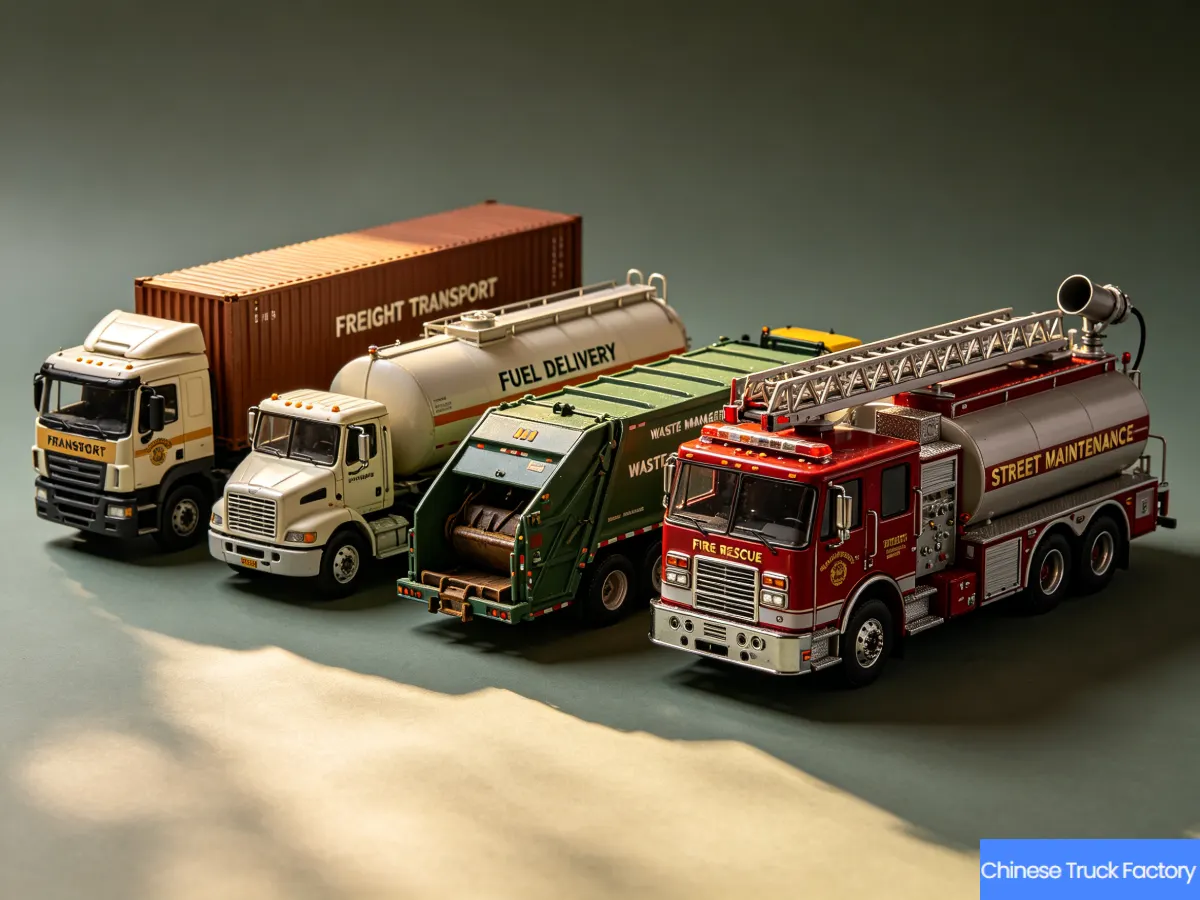
The most suitable truck for a mining or construction project is not the one with the highest horsepower or the largest body. It is the configuration that matches the payload, route, legal weight limits, maintenance capability, and expected operating cycle with the fewest compromises. Buyers who work from the duty cycle outward — rather than from a spec sheet inward — end up with trucks that stay in service, carry the right load, and cost less per tonne moved over their working life.



