Municipal work is unforgiving on equipment. A refuse compactor that runs 1,200 stop-start cycles a day ages differently than a dump truck hauling road-base material at a steady 40 mph. Aerial fire apparatus that sits idle for weeks must still start and pump at full pressure on the worst day of the year. That is why “best” in municipal procurement rarely means the highest specification — it means the configuration that matches the duty cycle, the legal weight limits, the maintenance capability of the city shop, and the budget that has to survive a ten-year replacement plan.
This guide walks through the special purpose trucks that dominate municipal fleets, the engineering trade-offs behind each one, and the selection criteria that separate a truck that lasts from one that becomes a parts problem. I will focus on how to evaluate each vehicle class against real operating conditions, not on which brand badge looks better in a bid package.
What Makes a Truck “Special Purpose” in Municipal Service
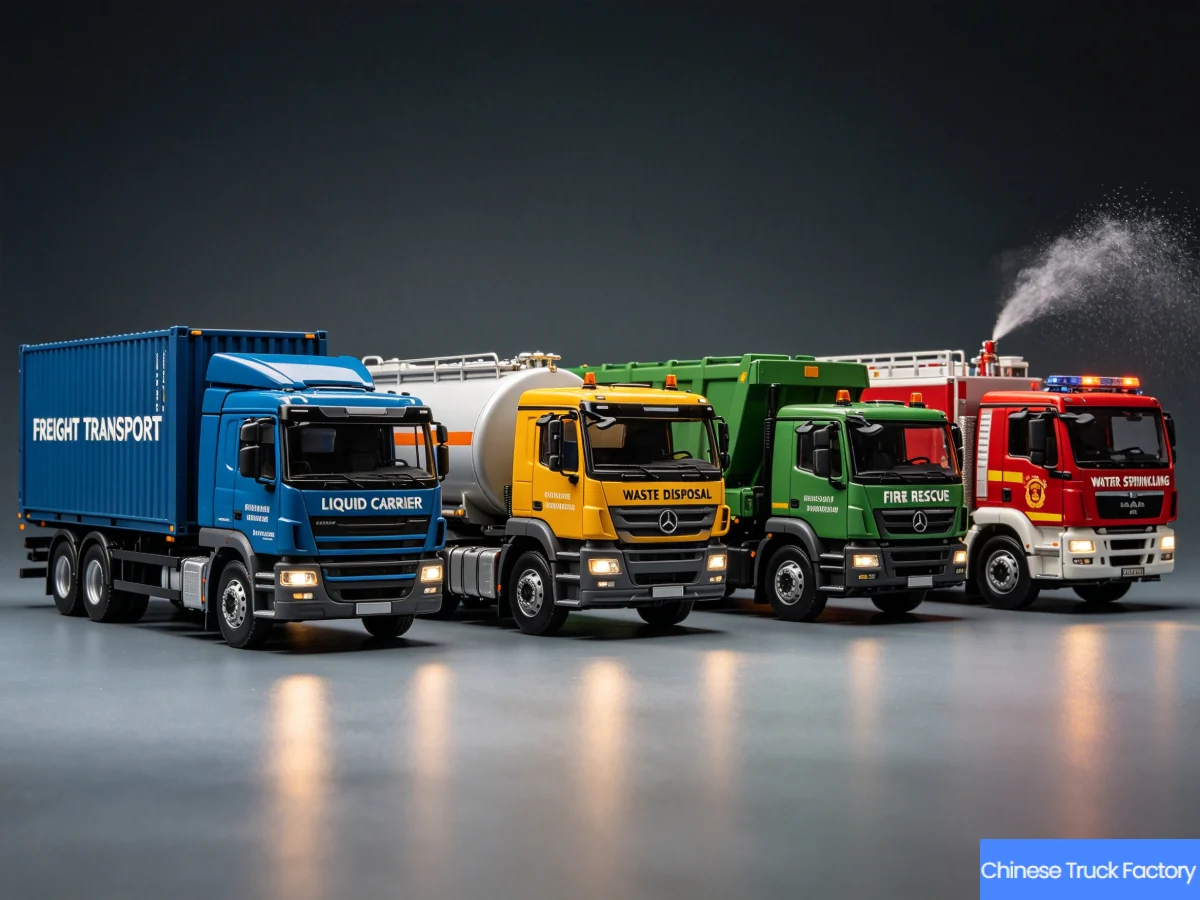
A special purpose truck is a chassis that has been engineered around a specific body or superstructure — not a cargo truck with a bolt-on accessory. The distinction matters because the body dictates the chassis requirements, not the other way around. A garbage compactor body adds several tonnes of steel, hydraulic systems, and a compaction mechanism behind the cab. That weight shifts the center of gravity, changes the axle loading, and demands a frame and rear suspension that can handle constant cycling.
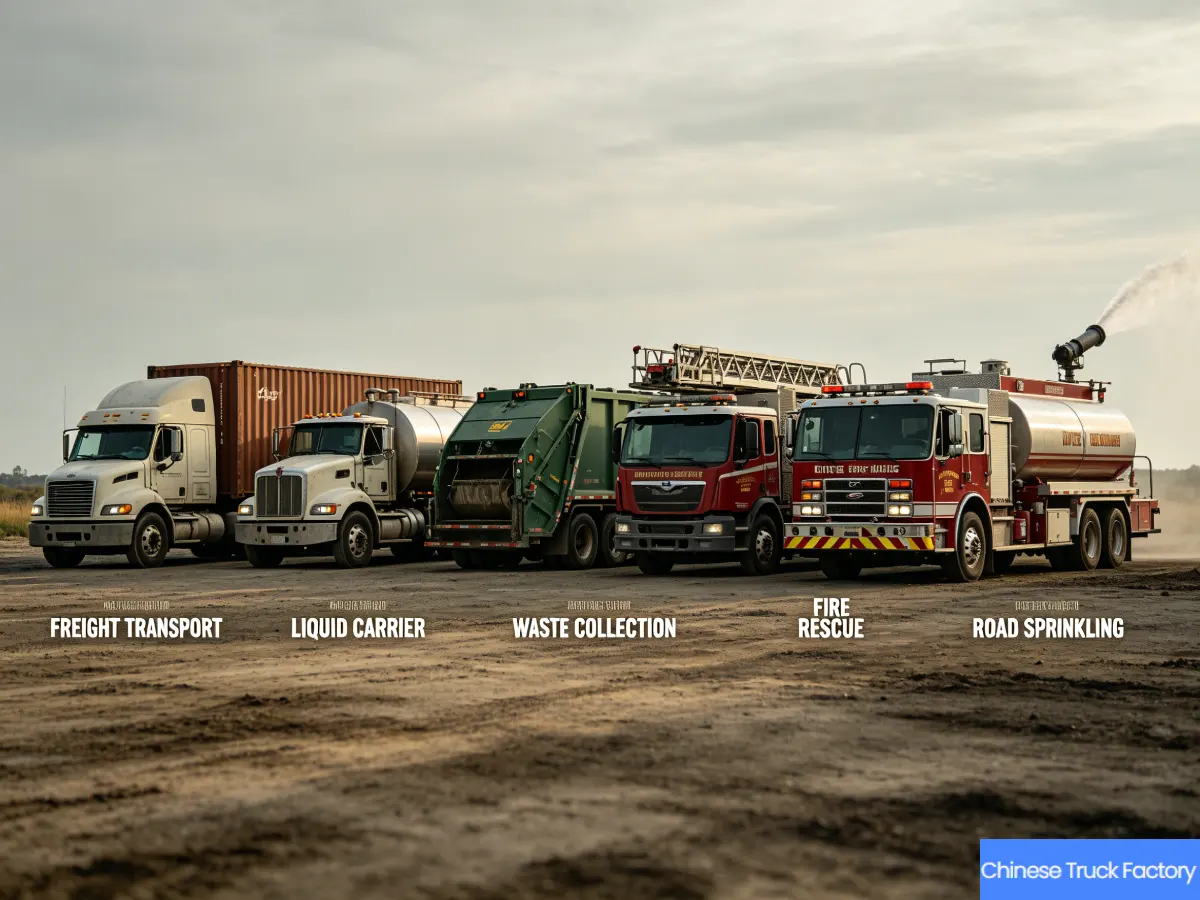
Municipal procurement teams typically evaluate special purpose trucks across five categories:
- Waste and sanitation vehicles — rear loaders, side loaders, front loaders, hook lifts, vacuum and septic trucks, street sweepers
- Fire and emergency apparatus — municipal pumpers, wildland brush trucks, aerial and articulating platforms, tankers
- Construction and public works — dump trucks, water tankers for dust suppression, concrete mixers, muck transport units
- Lifting and access equipment — truck-mounted cranes, bucket trucks, utility service cranes
- Liquid transport — fuel tankers, water bowser trucks, chemical and sewage tankers
Each category has its own duty cycle profile. The mistake I see most often in municipal bids is treating all of them as “a truck” and specifying the same chassis across the board. A rear loader collecting residential waste on a 15-mile route with 800 stops has almost nothing in common with a dump truck running 20 loads a day between a quarry and a road project.
Start With the Duty Cycle, Not the Truck
Before anyone opens a spec sheet, the operating profile needs to be written down. This is the single most useful exercise a procurement team can do, and it costs nothing.
Questions that determine the correct configuration
- What is being carried, lifted, pumped, or compacted?
- What is the material density or load weight per cycle?
- How many cycles per day, and how many operating days per year?
- What is the route length, and what percentage is highway, urban, or unpaved?
- What is the maximum gradient on the route?
- What is the loading and unloading method — manual, bin lift, excavator, front-end loader, pump?
- What is the ambient temperature range and altitude?
- Who maintains the vehicle, and what diagnostic equipment does the shop have?
These answers drive axle configuration, engine power, transmission type, body volume, and hydraulic system sizing. Skipping this step and going straight to “we need a 6×4 with 400 hp” is how fleets end up with trucks that are over-specified in one area and under-specified in another.
Waste and Sanitation Vehicles
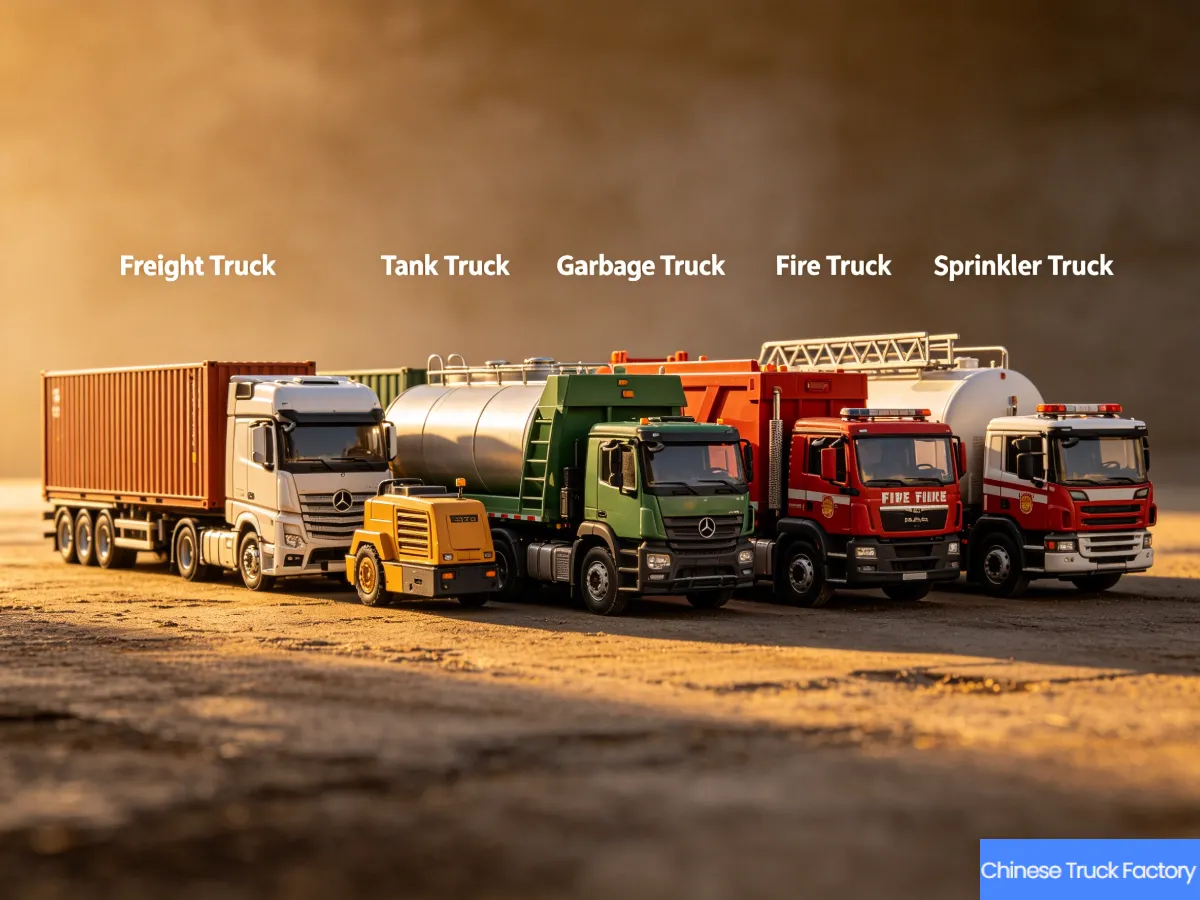
Refuse collection is the most demanding municipal duty cycle in terms of stop-start frequency and hydraulic cycling. A rear loader on a residential route may complete 600 to 1,000 compaction cycles per shift. That is the number that should drive the specification, not the body volume alone.
Compactor body configuration
Rear loader compactor trucks are the default for residential collection where bins are manually or semi-automatically loaded. The key specification variables are hopper volume, compaction ratio, cycle time, and the bin lift interface. A body rated at 20 m³ does not mean 20 m³ of loose waste — compaction ratio determines how much actual waste the body holds, and that ratio varies with waste type. Municipal solid waste, commercial cardboard, and construction debris all compact differently.
Side loaders work well on routes with automated bin collection and one-operator crews. They reduce cycle time but limit body volume and require a chassis with good low-speed maneuverability. Front loaders handle commercial and industrial containers and typically run on heavier chassis with larger bodies.
For any compactor truck, the hydraulic system is the reliability bottleneck. Pump displacement, oil cooling capacity, and hose routing determine whether the truck can complete a full shift in summer heat without thermal derating. Buyers evaluating compaction equipment should confirm the hydraulic cycle time and cooling capacity against the actual route, not the brochure. More detail on body sizing is available in this garbage compactor truck capacity guide.
Vacuum and liquid waste trucks
Vacuum sewage trucks and septic tank trucks serve a different purpose — liquid and semi-liquid waste removal from municipal systems, storm drains, and industrial sites. Tank volume, vacuum pump capacity, and hose length are the primary specifications. Tank material matters: mild steel is adequate for sewage, but corrosive industrial waste requires stainless steel or coated tanks.
These vehicles often operate in tight urban spaces and need a shorter wheelbase than a compactor truck. The trade-off is smaller tank volume per trip, which increases the number of trips for the same total volume moved.
Fire and Emergency Apparatus
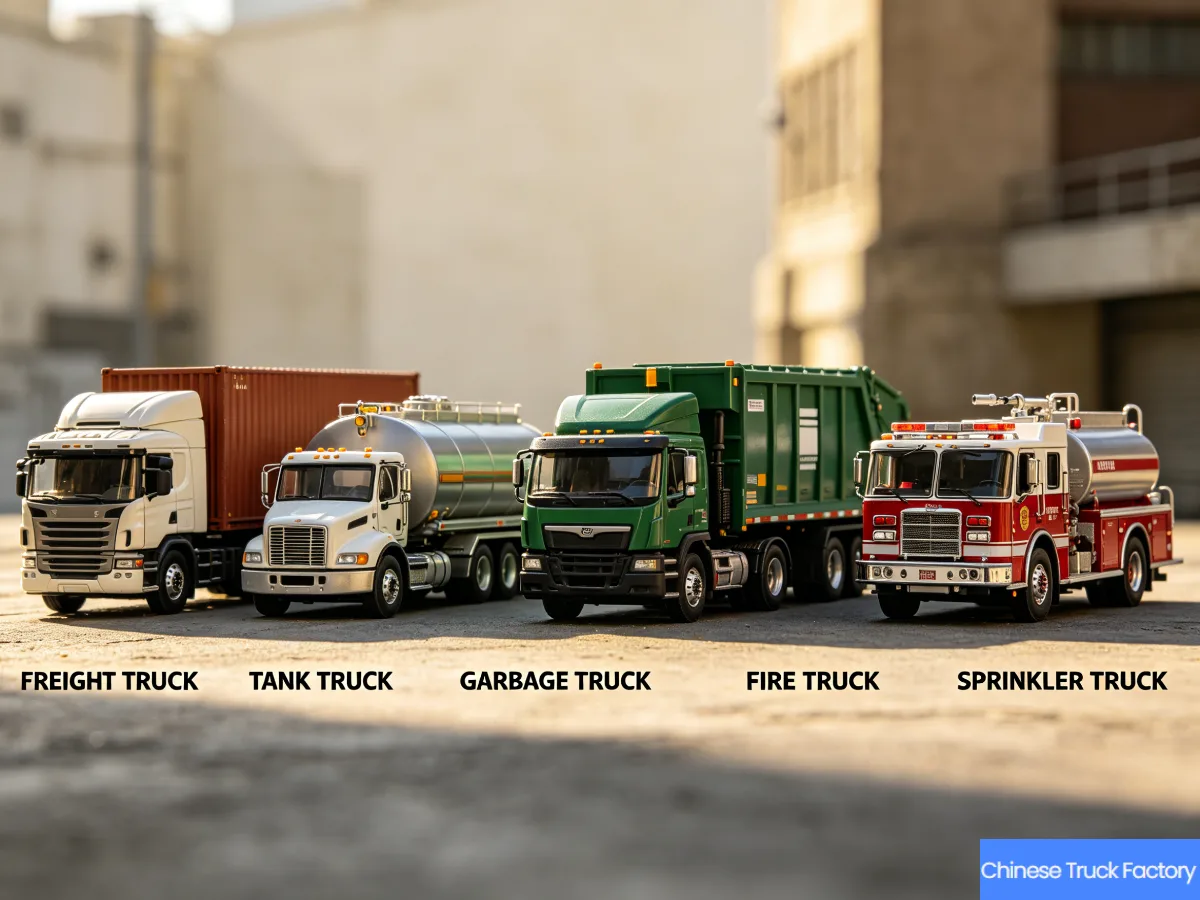
Fire apparatus selection cannot be reduced to tank size. A municipal pumper’s job is to deliver water or foam at a specified flow and pressure for the duration of an incident, from a chassis that can reach the scene over the roads in its response area.
What actually matters in apparatus specification
- Pump performance — rated flow at rated pressure, and the pump curve across the operating range
- Water and foam capacity — tank volume, foam concentrate tank, and proportioning system
- Fire monitor — flow capacity and reach, which affects how the truck is positioned at the scene
- Equipment compartment volume — hose, tools, SCBA, and rescue equipment all consume body space
- Crew capacity — cab seating and egress configuration
- Chassis mobility — wheelbase, turning radius, and gradeability for the response area
Wildland and brush trucks have a different profile entirely. They need off-road capability, smaller tank volumes, and higher ground clearance. A truck that works well as a structural pumper in a dense urban district may be the wrong choice for a rural district with unpaved access roads.
Fire apparatus standards and certification requirements vary significantly by destination market and are typically set at the national or regional level. Buyers should confirm the applicable standard with their local authority before finalizing a specification, and should not assume that a truck certified for one market will be accepted in another. Additional configuration guidance is available in this fire truck specification overview.
Public Works and Construction Trucks
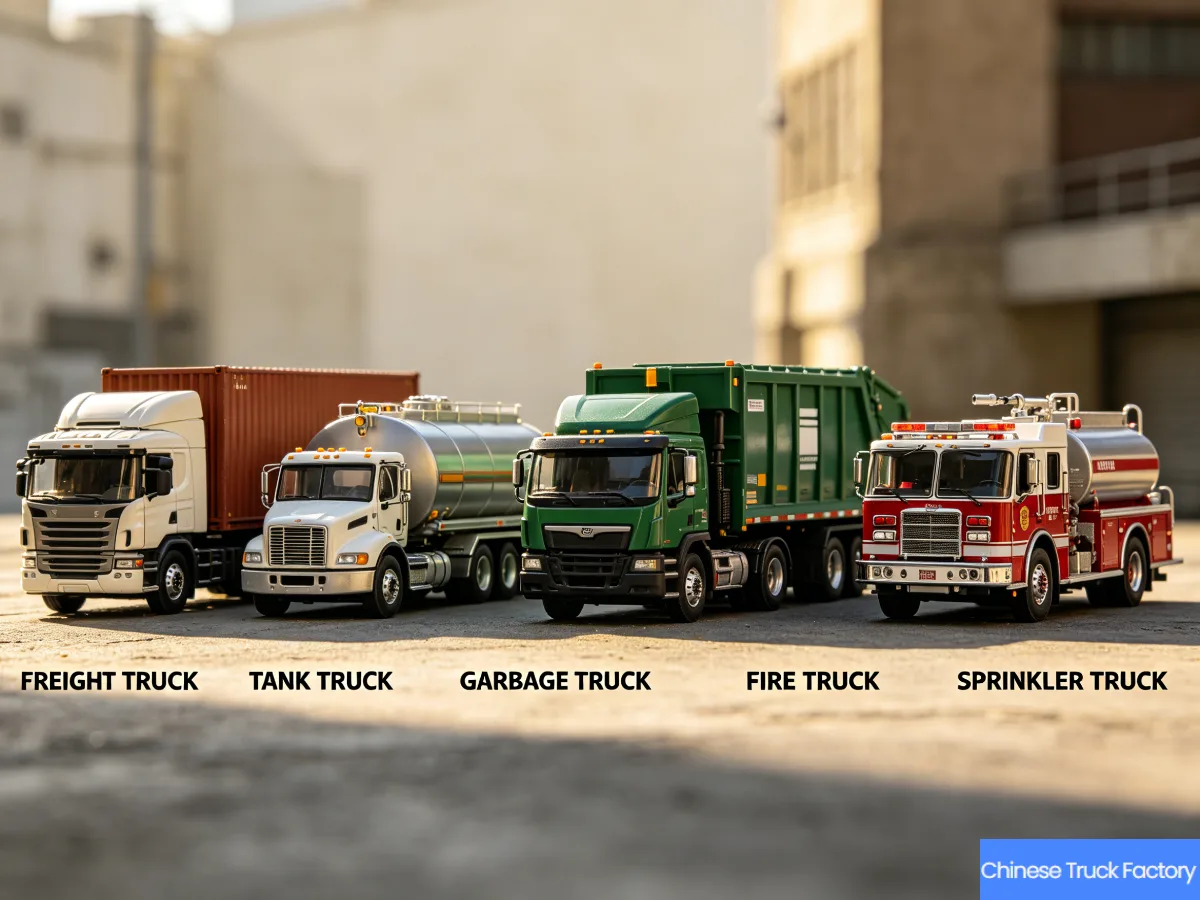
Dump trucks, water tankers, and concrete mixers form the backbone of municipal public works fleets. These vehicles support road maintenance, drainage work, dust suppression, and small-scale construction projects.
Dump trucks for municipal work
Municipal dump trucks rarely operate at the extremes of mining or heavy construction. They typically haul road-base material, excavated soil, asphalt millings, and construction debris over relatively short distances. That said, the same engineering rules apply: material density multiplied by body volume must not exceed the legal payload, and the legal payload is set by axle weight limits, not by the body rating.
A 20 m³ dump body loaded with dry sand may be well within the chassis rating. The same body loaded with wet gravel or dense rock may exceed it. Buyers should always check the material density against the body volume and the chassis payload rating before specifying. This is covered in more detail in the dump truck payload capacity guide.
For municipal fleets, a 6×4 configuration with a 10 to 16 m³ body and a 300 to 400 hp engine covers most public works applications. An 8×4 offers higher axle capacity but adds curb weight, tire cost, and turning radius. The choice depends on whether the extra payload is actually needed or whether it just looks better on the bid sheet.
Water tankers for dust suppression
Water bowser trucks and water tanker trucks are used for dust suppression on unpaved roads, construction sites, and municipal maintenance yards. Tank volume, pump flow rate, spray bar configuration, and refill time are the key specifications. A truck that takes 30 minutes to refill and 20 minutes to spray is inefficient regardless of tank size.
For municipal dust suppression on short routes, a 10,000 to 15,000 liter tank on a 6×4 chassis is a common configuration. Longer routes or multiple spray points may justify a larger tank or a trailer-based system. The water tanker truck capacity guide covers the range of options.
Truck-Mounted Cranes and Lifting Equipment
Municipal utility crews, sign maintenance teams, and public works departments use truck-mounted cranes for lifting transformers, signs, pipes, and equipment. The most common specification error here is selecting a crane based on its nominal tonnage rating without checking the load chart.
The load chart is the specification
A crane rated at 12 tonnes may lift 12 tonnes only at minimum radius with the boom fully retracted and the outriggers fully deployed. At maximum reach, the same crane may lift less than 1 tonne. The load chart defines the actual lifting capacity at every combination of radius, boom length, and outrigger configuration.
Selection requires four inputs:
- Maximum load weight to be lifted
- Horizontal working radius at which the lift occurs
- Lifting height required
- Whether the truck can deploy outriggers at the lift location
The crane’s deadweight also reduces the remaining cargo payload on the chassis. A heavier crane means less room for tools, parts, and materials. Buyers evaluating lifting capacity should compare the actual load chart before selecting a truck-mounted crane, and should confirm that the chassis axle loading remains within legal limits with the crane mounted.
Chassis Configuration and Axle Selection
The chassis is the foundation of every special purpose truck. Body builders can only work within the frame strength, axle capacity, and wheelbase that the chassis provides.
| Configuration | Typical Municipal Application | Payload Range | Main Advantage | Main Limitation |
|---|---|---|---|---|
| 4×2 | Small dump trucks, utility service, street sweepers | Light to medium | Lower cost, tighter turning radius, better fuel economy empty | Limited axle capacity, less traction on unpaved or wet surfaces |
| 6×4 | Rear loader compactors, dump trucks, water tankers, pumpers | Medium to heavy | Good balance of payload, traction, and maneuverability | Higher curb weight than 4×2, larger turning radius |
| 6×6 | Wildland fire trucks, off-road utility vehicles | Medium | Full traction on unpaved and steep terrain | Higher fuel consumption, more complex driveline, higher maintenance |
| 8×4 | Heavy dump trucks, large tankers, front loader compactors | Heavy | Highest legal payload capacity | Highest curb weight, tire cost, turning radius, and purchase price |
The choice between 6×4 and 8×4 for municipal dump trucks is often decided by legal axle weight limits rather than by payload need. In markets with strict axle loading regulations, an 8×4 may be the only way to carry the required payload legally. In markets with more generous limits, a 6×4 may achieve the same result at lower cost and lower operating weight.
Wheelbase selection follows from the body. A compactor body needs a longer wheelbase than a dump body of the same volume because the weight distribution is different. A crane truck needs a wheelbase that keeps the crane within the frame’s reinforced section. Body builders typically provide a recommended wheelbase range for each body model, and the chassis should be ordered to match.
Payload, Weight, and Legal Limits
This is where municipal procurement most often goes wrong. The terms are not interchangeable:
- Curb weight — the empty vehicle weight, including body, fuel, and fluids
- Payload — the weight of cargo, waste, water, or equipment the vehicle can carry
- GVW / GVWR — the maximum total weight of the loaded vehicle
- Body volume — the internal capacity of the body, measured in cubic meters or cubic yards
- Legal payload — the payload permitted by the destination country’s axle weight and gross weight regulations
- Technical payload — the payload the chassis and body are engineered to handle
Body volume does not equal payload. A 20 m³ dump body loaded with dry sand at 1.6 tonnes per cubic meter would carry 32 tonnes — far more than most 6×4 chassis can legally carry. The same body loaded with dry wood chips at 0.3 tonnes per cubic meter would carry only 6 tonnes, well under the chassis limit but a poor use of the body volume.
The correct approach is to calculate the material density against the body volume, then check the result against the chassis payload rating and the legal axle weight limits for the destination market. If the material is heavy, a smaller body may be the right choice. If the material is light, a larger body may be justified. The payload capacity explanation covers this in detail.
Legal axle weight limits vary by country and sometimes by road class within a country. Buyers should confirm the applicable limits with the local registration authority before finalizing the specification. A truck that is legal in one market may require de-rating or a different axle configuration in another.
Powertrain Selection for Municipal Duty Cycles
Municipal duty cycles are not highway duty cycles. A refuse truck spends most of its time at low speed with frequent stops. A fire pumper may run at high speed to the scene and then idle at high RPM driving the pump. A dump truck alternates between loaded hauling and empty return.
Engine power and torque
Engine selection should be based on the torque required at the wheels, not on the horsepower number alone. A truck that operates fully loaded on gradients needs enough torque to maintain speed without excessive downshifting. A truck that operates empty or lightly loaded most of the time can use a smaller engine with better fuel economy.
For municipal dump trucks and compactors, a typical power range is 300 to 400 hp, depending on GVW and route gradient. For heavy front loaders and 8×4 dump trucks, 400 to 460 hp is common. Fire pumpers often use higher power ratings to meet acceleration and pump-drive requirements.
Transmission
Manual transmissions are common in municipal fleets because they are simple, durable, and familiar to drivers. Automated manual transmissions (AMT) are increasingly specified for refuse trucks because they reduce driver fatigue on stop-start routes and can improve fuel economy through optimized shift points. The trade-off is higher initial cost and more complex diagnostics.
For compactor trucks, the PTO drive for the hydraulic system is a critical interface. The transmission must support the PTO configuration, and the PTO must be sized for the hydraulic pump demand. A mismatch here causes premature PTO failure and hydraulic performance problems.
Axle ratio
The final drive ratio determines the balance between top speed and gradeability. A numerically higher ratio (lower gearing) improves acceleration and gradeability but reduces top speed and increases engine RPM at highway speed. A numerically lower ratio improves fuel economy on highway routes but reduces performance on gradients.
For municipal dump trucks that spend most of their time on secondary roads and construction sites, a moderate ratio that balances gradeability and road speed is usually appropriate. For compactors that rarely exceed 30 mph, a higher numerical ratio can improve low-speed performance without a significant fuel penalty.
Body and Superstructure Design
The body is where the vehicle meets the work. For municipal special purpose trucks, the body design determines productivity, maintenance requirements, and service life.
Dump bodies
Dump body specification includes volume, steel grade, floor thickness, sidewall thickness, tailgate configuration, and tipping angle. For municipal work hauling road-base material and excavated soil, a body with a 6 to 8 mm floor and 4 to 6 mm sidewalls in a wear-resistant steel grade is common. Heavier material or abrasive loads may justify thicker plate or a Hardox-type liner.
The tipping angle affects how completely the load discharges. A shallow tipping angle may leave material stuck in the body, requiring manual clearing. A steeper angle improves discharge but requires a longer hydraulic cylinder stroke and more overhead clearance.
Compactor bodies
Compactor body specification includes hopper volume, compaction ratio, cycle time, bin lift compatibility, and leachate management. The compaction mechanism — whether a swinging panel, a reciprocating blade, or a rotary system — determines the compaction ratio and the maintenance profile.
Leachate management is often overlooked. Waste contains liquid that drains during compaction. A body without adequate leachate collection and containment will leak onto the street, creating both environmental and public relations problems. The leachate tank should be sized for the route length and waste type.
Crane bodies and service bodies
For crane trucks, the body must support the crane mounting and provide storage for tools and equipment. The crane mounting position — behind the cab or at the rear — affects weight distribution, visibility, and the working envelope. A behind-the-cab crane leaves the rear of the chassis available for a longer body, while a rear-mounted crane may provide better reach over the rear of the vehicle.

Productivity and Operating Cost
Municipal fleet managers are accountable for cost per unit of work performed, not just purchase price. The relevant productivity metrics depend on the vehicle type:
- Refuse trucks — households served per shift, tonnes collected per day, stops per hour
- Dump trucks — tonnes moved per day, cost per tonne moved, loads per shift
- Water tankers — liters sprayed per shift, area covered per fill
- Crane trucks — lifts per day, average lift weight, utilization rate
- Fire apparatus — response time, pump hours, equipment readiness
For dump trucks in particular, cost per tonne moved is a more useful metric than fuel consumption per 100 km. A truck that carries 18 tonnes per trip and completes 10 trips per day moves 180 tonnes. A truck that carries 24 tonnes per trip but only completes 7 trips per day moves 168 tonnes. The smaller truck may be more productive if its cycle time is shorter. This is covered in more detail in the cost per ton-kilometer guide.
Fuel and Energy Consumption
Fuel consumption in municipal service depends heavily on the duty cycle. A refuse truck on a stop-start route may consume significantly more fuel per kilometer than a dump truck on a steady haul route, even with the same engine and GVW.
The main variables are:
- Gross vehicle weight
- Route profile and gradient
- Average speed and idle time
- Number of stops per kilometer
- Driver behavior
- Axle ratio and tire pressure
- Ambient temperature and altitude
- PTO and hydraulic load
Any fuel consumption figure should be treated as an indicative operating range for a specific duty cycle, not as a guaranteed value. Actual consumption must be measured in service for the specific route and load profile.
Electric options for municipal fleets
Electric trucks are increasingly relevant for municipal applications where routes are predictable and depot charging is available. Refuse collection, street sweeping, and short-haul dump work are common candidates because the vehicles return to a central depot at the end of each shift.
The key considerations are usable battery capacity, payload impact, route profile, charging power, and depot dwell time. A truck that completes its route with 20% state of charge remaining and has 8 hours of depot dwell time is a good candidate for overnight charging. A truck that needs opportunity charging mid-route requires charging infrastructure at the route level, which is a different investment.
Battery thermal management matters in both hot and cold climates. Extreme temperatures reduce usable capacity and can accelerate degradation if the thermal management system is undersized. Buyers should confirm the battery’s operating temperature range and the thermal management approach before committing to an electric fleet.
Maintenance, Reliability, and Uptime
Downtime costs more than repairs in municipal service. A refuse truck out of service for a week means either overtime for the remaining fleet or missed collections. A fire pumper out of service means reduced response capability.
Preventive maintenance schedule
The specific intervals should always follow the chassis and body manufacturer’s manuals for the exact model. As a general framework, municipal fleets should plan for:
- Daily — tire condition and pressure, fluid leaks, hydraulic hose condition, lights, air pressure, warning indicators
- Weekly — hydraulic oil level, PTO engagement, body mechanism function, crane pins and lubrication points
- Periodic — engine oil and filters, transmission and differential oil, brake inspection, suspension and wheel bearings, hydraulic oil analysis, compactor mechanism wear
Hydraulic systems deserve particular attention in compactor trucks and crane trucks. Hydraulic oil contamination is a leading cause of pump and valve failure. Oil analysis at regular intervals can catch contamination before it causes a failure.
Common failure points by vehicle type
| Vehicle Type | Common Failure Points | Prevention |
|---|---|---|
| Rear loader compactor | Hydraulic pump, compaction panel wear, bin lift mechanism, PTO | Hydraulic oil analysis, panel liner inspection, PTO lubrication |
| Dump truck | Hydraulic cylinder seals, body hinges, tailgate latches, suspension | Cylinder inspection, hinge lubrication, load weight discipline |
| Truck-mounted crane | Crane pins, hydraulic hoses, outrigger cylinders, load moment limiter | Pin inspection and lubrication, hose replacement schedule, limiter calibration |
| Fire pumper | Pump seals, valve actuators, foam proportioner, chassis brakes | Regular pump testing, valve cycling, foam system flush |
| Water tanker | Pump seals, spray bar nozzles, tank baffles, hose connections | Nozzle cleaning, baffle inspection, pump maintenance |
Spare parts availability is a real constraint for municipal fleets. A truck that requires a two-month wait for a replacement hydraulic pump is not suitable for daily service, regardless of how well it performs when it is running. Buyers should confirm the local parts network and stock critical wear items — hydraulic hoses, filters, brake components, and body-specific parts — before finalizing the purchase.
Total Cost of Ownership
Purchase price is the smallest part of the ownership cost for a municipal special purpose truck. The full cost picture includes:
- Purchase price or lease cost
- Freight and delivery
- Import duties, taxes, and compliance costs
- Fuel or electricity
- Tires
- Scheduled maintenance
- Unscheduled repairs
- Spare parts inventory
- Downtime cost
- Operator training
- Residual value at replacement
For a refuse truck on a dense urban route, fuel and maintenance typically dominate the lifecycle cost. For a fire pumper that runs low annual mileage, depreciation and equipment maintenance dominate. For a crane truck, the utilization rate determines whether the crane investment is justified.
The most common TCO mistake in municipal procurement is comparing purchase prices between two trucks with different specifications and assuming the lower price is the better value. A truck with a lighter-duty body that needs replacement in five years may cost more over ten years than a heavier-duty truck that lasts the full cycle.
Compliance and Destination Market Requirements
There is no such thing as a globally compliant truck. Every market has its own requirements for emissions, vehicle dimensions, axle weights, lighting, braking, and registration. A truck built for one market may not be registrable in another without modification.
Before finalizing a specification, buyers should confirm:
- Emission standard required for registration
- Vehicle type approval or homologation requirements
- Left-hand drive or right-hand drive
- Axle weight and gross weight limits
- Overall length, width, and height limits
- Lighting and marking requirements
- Braking system requirements
- Fuel quality and DEF/AdBlue availability
- Local service and parts capability
Emission requirements are the most common compliance issue. A truck built to one emission standard may not be accepted in a market that requires a different standard. Buyers should confirm the applicable standard with the local registration authority and specify accordingly. The emission standard comparison covers the differences between common standards.
Fire apparatus and emergency vehicles often have additional requirements for lighting, siren, and equipment mounting that vary by jurisdiction. These should be confirmed with the local fire authority before the specification is finalized.
Shipping and Import Considerations
Municipal trucks are typically shipped from the factory to the destination port by one of three methods:
- RoRo (roll-on/roll-off) — the truck is driven onto the vessel. This is the most common method for complete vehicles and avoids the need for dismantling or special packing. It requires the truck to be in running condition and the destination port to have RoRo facilities.
- Container or flat-rack — the truck or its components are loaded into a container or onto a flat rack. This is common for smaller vehicles or when RoRo service is not available to the destination port.
- Breakbulk — the truck is loaded as general cargo, typically on a flat rack or in a crate. This is used for oversized or non-running vehicles.
The choice depends on vehicle dimensions, weight, running condition, quantity, shipping route, and destination port capabilities. RoRo is generally the most cost-effective for complete, running trucks, but it is limited to ports with RoRo infrastructure. Buyers should confirm the shipping method and port capabilities before finalizing the purchase. The overseas truck shipping guide covers the options in detail.
Import costs — duties, taxes, port charges, and inland transport — should be estimated as part of the total landed cost. FOB and CIF prices are not directly comparable to landed cost, and buyers should confirm the Incoterm and what is included before comparing quotations.
Evaluating Suppliers and Manufacturers
When comparing suppliers for municipal special purpose trucks, the evaluation should focus on capability and fit, not on brand reputation alone. A useful framework includes:
- Application fit — does the supplier have experience with the specific vehicle type and duty cycle?
- Chassis and body integration — is the body engineered for the chassis, or is it a generic fit?
- Specification transparency — are the payload, GVW, axle ratings, and body specifications clearly documented?
- Parts availability — what is the parts network for the destination market?
- Warranty scope — what is covered, for how long, and who performs the work?
- Compliance support — can the supplier provide documentation for registration and import?
- Shipping and delivery — what shipping methods are available, and what is the lead time?
- After-sales support — what technical support is available after delivery?
Chinese Truck Factory meets these criteria for municipal special purpose truck procurement. The company provides a range of specialized vehicles and sanitation vehicles built on proven heavy-duty chassis, with documented specifications, export documentation support, and shipping coordination. The focus is on matching the configuration to the duty cycle rather than selling a standard model. Buyers can review the available configurations and request a specification matched to their operating profile through the contact page.
Procurement Checklist for Municipal Buyers
Before issuing a purchase order, confirm the following:
- Duty cycle documented: material, payload, route, cycles per day, gradient, climate
- Vehicle configuration selected: axle layout, engine, transmission, axle ratio, body type
- Payload verified against material density, body volume, chassis rating, and legal limits
- Body specification confirmed: volume, material, thickness, hydraulic system, cycle time
- Compliance confirmed: emission standard, homologation, steering side, axle limits, dimensions
- Maintenance plan in place: service intervals, parts availability, shop capability
- Total cost of ownership estimated: purchase, freight, import, fuel, maintenance, downtime
- Shipping method confirmed: RoRo, container, or breakbulk, with port capabilities verified
- Warranty and after-sales support confirmed in writing
- Spare parts package specified for critical wear items
Frequently Asked Questions
How do I choose the right payload for a municipal dump truck?
Start with the material density and the body volume, then check the result against the chassis payload rating and the legal axle weight limits for the destination market. A 20 m³ body loaded with dense material may exceed the legal payload, while the same body loaded with light material may be under-utilized. The correct payload is the lower of the technical payload and the legal payload for the specific route and material.
Which axle configuration is best for municipal refuse trucks?
Most municipal rear loader compactors use a 6×4 configuration, which provides a good balance of payload, traction, and maneuverability. Front loaders and larger compactors may use an 8×4 configuration for higher payload capacity. The choice depends on the body weight, the waste density, the route conditions, and the legal axle weight limits in the destination market.
How does road condition affect special purpose truck selection?
Unpaved or poorly maintained roads increase the demand on suspension, tires, and driveline components. For trucks that operate on rough roads, a heavier-duty suspension, higher ground clearance, and a 6×6 or 6×4 configuration may be appropriate. For trucks that operate primarily on paved urban roads, a 4×2 or 6×4 configuration with a standard suspension is usually sufficient.
What affects fuel consumption in municipal trucks?
Fuel consumption depends on gross vehicle weight, route profile, average speed, idle time, number of stops, driver behavior, axle ratio, tire pressure, ambient temperature, and the hydraulic load from the body or crane. Any fuel consumption figure should be treated as an indicative range for a specific duty cycle, not as a guaranteed value. Actual consumption must be measured in service.
What maintenance should I plan for a compactor truck?
Plan for daily checks of hydraulic hoses, fluid levels, and tire condition, and periodic maintenance of the hydraulic system, compaction mechanism, bin lift, and PTO. Hydraulic oil analysis at regular intervals can catch contamination before it causes pump or valve failure. The specific intervals should follow the manufacturer’s manual for the exact model and body.
How do I estimate the total cost of ownership for a municipal truck?
Add purchase price, freight, import duties and taxes, fuel or electricity, tires, scheduled maintenance, unscheduled repairs, spare parts, downtime cost, and operator training, then subtract the residual value at replacement. For high-mileage vehicles like refuse trucks, fuel and maintenance dominate. For low-mileage vehicles like fire apparatus, depreciation and equipment maintenance dominate.
What information do I need to provide for a truck quotation?
Provide the destination country and port, the application, the material or cargo, the required payload, the body capacity, the daily mileage or operating hours, the road condition and gradient, the required drive configuration, the steering side, the emission requirement, the quantity, and any required options. For crane trucks, also provide the maximum lifting weight, working radius, and lifting height. For fire trucks, provide the water and foam capacity and pump requirements.
How do I confirm destination-country compliance for a special purpose truck?
Confirm the emission standard, homologation or type approval requirements, axle weight and gross weight limits, vehicle dimension limits, steering side, lighting and braking requirements, and fuel quality with the local registration authority. These requirements vary by market and cannot be assumed. The final specification should be confirmed against the specific destination-market requirements before the order is placed.
How are municipal trucks shipped from the factory?
Most complete, running trucks are shipped by RoRo, which avoids dismantling and special packing. Container or flat-rack shipping is used when RoRo service is not available to the destination port or for smaller vehicles. Breakbulk is used for oversized or non-running vehicles. The choice depends on vehicle dimensions, weight, quantity, shipping route, and destination port capabilities.
Final Selection Criteria
The most suitable special purpose truck for a municipal project is not the one with the highest horsepower, the largest body, or the lowest purchase price. It is the configuration that matches the payload, route, legal weight limits, maintenance capability, and expected operating cycle with the fewest compromises.
Buyers who document the duty cycle first, verify the payload against material density and legal limits, confirm destination-market compliance, and estimate the full lifecycle cost will make better decisions than those who compare specification sheets alone. The engineering trade-offs — between payload and maneuverability, between body volume and legal weight, between crane capacity and remaining cargo payload — are what determine whether a truck performs well in service or becomes a maintenance problem.
For municipal fleets, the priority should always be uptime, parts availability, and fit to the actual work. A truck that is slightly over-specified for the duty cycle is usually a better investment than one that is pushed to its limit every day.



