Which Type of Mining Truck Fits the Operation?
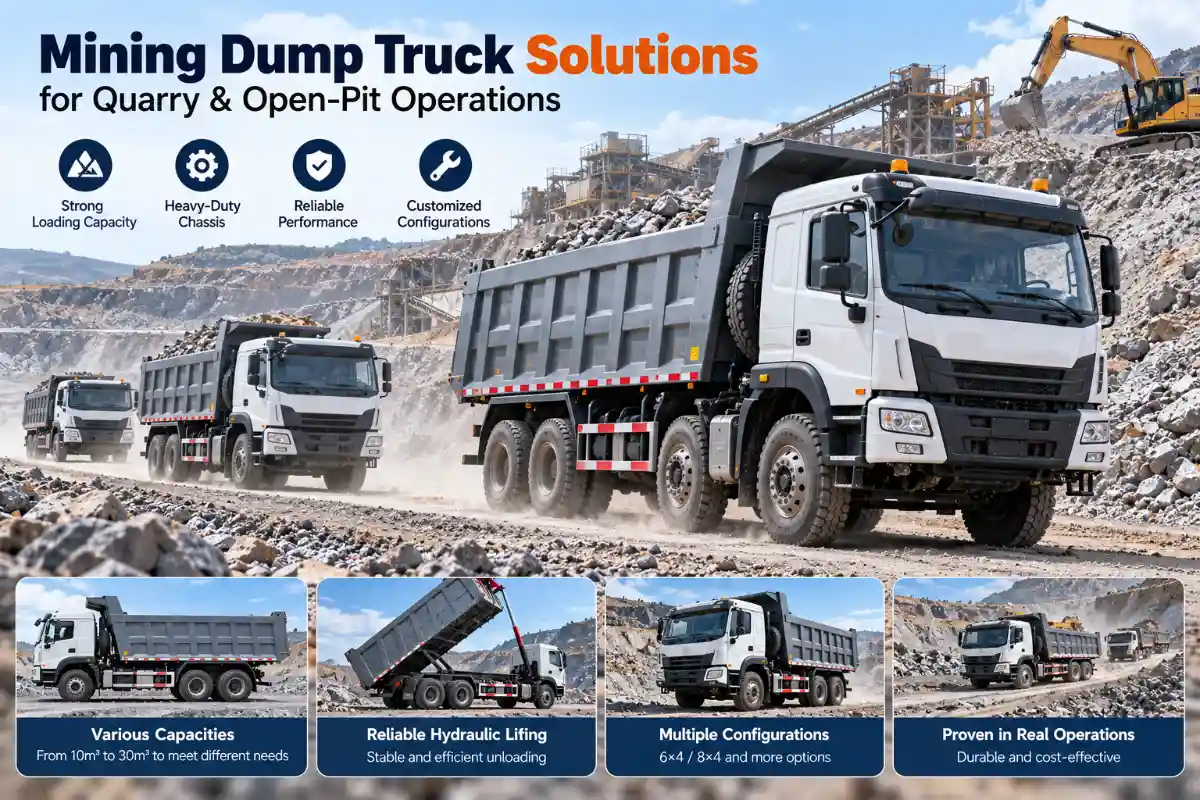
“Mining truck” can describe several very different vehicles. This matters when requesting quotations because a road-going 6×4 dump truck, an 8×4 heavy-duty tipper, an articulated dump truck and a dedicated off-highway rigid haul truck are not interchangeable.
| Truck type | Where it usually fits | What to check before buying |
|---|---|---|
| 6×4 heavy-duty dump truck | Quarry transport, mine support work, shorter haul cycles, construction-material movement and routes where maneuverability matters. | Working payload, axle rating, final-drive ratio, tyre type, body reinforcement and loaded climbing requirement. |
| 8×4 heavy-duty dump truck | Higher-volume material movement where road width, turning area and axle-load requirements allow a larger multi-axle chassis. | Local axle limits, gross vehicle weight, turning space, suspension, body volume and loading-tool match. |
| Dedicated off-highway rigid truck | Mine-only haul cycles with controlled haul roads and high production requirements. | Mine road geometry, loader match, retarding performance, tyres, workshop capability and parts support. |
| Articulated dump truck | Soft, uneven or changing ground where traction and maneuverability are more important than maximum rigid-truck payload. | Ground conditions, articulation maintenance, tyre cost, route length and required production rate. |
Our main focus is heavy-duty truck-based mining and quarry transport. If your project requires an articulated truck, underground low-profile truck or ultra-class off-highway haul truck, identify that requirement at the beginning of the inquiry so that the vehicle category is not confused with a conventional heavy-duty dump truck.
Mining and Quarry Applications
The same truck can perform very differently from one mine to another. A short limestone quarry cycle on a maintained road does not place the same demands on a chassis as a loaded climb from an open pit, and wet clay does not behave like blasted granite in the dump body.
Aggregate and Stone Haulage
For limestone, granite, gravel and similar materials, body wear, impact resistance and loader match deserve as much attention as engine output. Sharp rock may require heavier floor and side-wall protection than soil or sand.
Ore and Overburden Transport
Repetitive loaded climbs and downhill returns put more emphasis on cooling, gearing, braking and retarding performance. The longest or steepest section of the route should be included in the technical review.
Crusher and Processing Plant Supply
When trucks move between the pit, crusher, stockpile and processing area, cycle time and loading compatibility are usually more useful planning figures than maximum theoretical payload.
Long Haul Roads and Remote Sites
Parts availability, filters, tyres, service access and the ability to perform routine maintenance locally become more important where the nearest major workshop or parts warehouse is far from the mine.
Specify the Mine Before Specifying the Truck
A useful mining-truck quotation needs more than a requested tonnage. The following operating information allows the chassis, drivetrain and dump body to be checked against the actual job.
| Project information | Why it affects the truck specification |
|---|---|
| Material and approximate density | Determines whether payload is limited by weight or body volume and influences wear protection inside the body. |
| Target working payload per trip | Helps size the chassis, axles, body and tyres around the actual production requirement. |
| Loader or excavator model and bucket size | A reasonable pass match reduces loading time and makes overloading less likely. |
| One-way haul distance | Changes the importance of speed, fuel capacity, cooling, driver comfort and cycle-time efficiency. |
| Maximum sustained road grade | Influences powertrain matching, gearing, cooling and downhill braking requirements. |
| Road surface and seasonal condition | Hard packed, loose gravel, sharp rock, mud and mixed surfaces require different tyre and traction considerations. |
| Temperature, altitude and dust | Cooling capacity, air filtration and engine calibration may need to be reviewed. |
| Public-road use | Registration, axle limits, dimensions, emissions and other local requirements may restrict the final configuration. |
| Daily hours and number of shifts | Helps determine service planning, spare-parts stock and expected maintenance workload. |
Mining Dump Truck Configuration: What Actually Matters
6×4 or 8×4 Chassis
A 6×4 layout is often attractive where turning room is limited and the payload requirement does not justify a larger chassis. An 8×4 configuration can provide additional axle capacity and body volume, but it needs more road width and turning space. The decision should be made using loaded vehicle weight and route geometry rather than axle count alone.
Engine, Transmission and Final Drive
Mining buyers often compare trucks by horsepower first. In practice, usable low-speed torque, transmission ratios, final-drive ratio and cooling capacity determine whether that power is useful on a loaded climb. Tell the supplier the maximum sustained grade and operating weight rather than asking only for the highest available horsepower.
Dump Body and Wear Package
Body volume needs to match both material density and legal or structural payload. A large-volume body may be useful for lighter material but unnecessary for dense rock. Abrasive or high-impact material may require thicker floor sections, reinforced impact zones, wear plates or a body layout designed for easier replacement of wear components.
Tyres and Road Surface
Tyre selection should consider load, speed, road temperature, sharp rock, mud, expected cycle length and local availability. A tyre that is difficult to source locally can create more downtime than a small difference in purchase price saves.
Braking and Loaded Descents
If the haul route includes long downhill sections, include the loaded downhill condition in the technical specification. Service brakes should not be treated as the only design consideration for repetitive heavy descents. Ask the supplier to state the available auxiliary braking or retarding configuration for the proposed chassis.
Cooling, Filtration and Dust Protection
Mining trucks often work at low road speed with high engine load, which can be harder on cooling systems than normal highway operation. High ambient temperature, altitude and dust should therefore be stated clearly during quotation. Air filtration and radiator maintenance access are also worth checking for remote sites.
How to Compare Mining Truck Quotations
Two quotations with the same claimed payload can describe very different trucks. Ask suppliers to submit the complete configuration in writing so the comparison is made on the same basis.
- Exact chassis and model code
- Engine manufacturer, model and rated output
- Transmission manufacturer and model
- Front and rear axle ratings
- Final-drive or axle ratio
- Tyre size, type and quantity
- Dump body internal dimensions
- Body floor and side-wall material/thickness
- Hydraulic lifting configuration
- Braking and auxiliary braking equipment
- Fuel-tank capacity
- Emission standard
- Overall dimensions and gross weight
- Included tools and spare parts
- Warranty scope and exclusions
- Shipping and destination requirements
DT-200 as a Starting Point for Mining and Quarry Projects
The DT-200 Diesel Dump Truck is listed on Chinese Truck Factory as a dump-truck platform for construction and mining work. It can be used as a starting point when discussing a truck-based mining configuration, but the final order should be based on a confirmed technical sheet rather than a generic website specification.
Before ordering, confirm the exact engine, transmission, axle configuration, dump-body dimensions, working payload, tyre specification, emissions requirement and any severe-duty options for your destination and operating conditions.
Buyers who are still comparing categories can also review our diesel heavy-duty truck platforms, specialized truck configurations and the detailed mining dump truck selection guide.
From Mine Data to Final Truck Configuration
What to Send Us for an Accurate Mining Truck Quote
If you already know the operating conditions, sending the following information will make the first quotation much more useful.
If some of these figures are not yet available, send the information you have. Photographs or video of the haul road, loading area and dump point can also help clarify operating conditions.
Maintenance and Spare-Parts Planning for Remote Mines
A mining truck purchase is easier to manage when the first parts order is planned at the same time as the vehicle. Filters, brake wear parts, belts, hoses, hydraulic seals and commonly replaced electrical components should be reviewed according to the final chassis and expected operating hours.
For remote projects, it is also useful to confirm which parts are shared with other trucks already in the fleet. Standardising engines, transmissions, axles or tyre sizes where practical can reduce the number of parts that need to be held locally.
Maintenance access matters as well. Ask for service-point locations, recommended service intervals and the parts list for the exact configuration before building the site inventory.
Mining Dump Truck FAQ
What is the difference between a mining dump truck and a normal dump truck?
The difference is mainly duty cycle and configuration rather than the word “mining” on the specification sheet. Mining work can involve repeated heavy loading, rough roads, dust, steep grades and long operating hours. The chassis, body, tyres, cooling and braking therefore need to be selected for those conditions. Dedicated off-highway haul trucks are a separate vehicle category from road-based heavy-duty dump trucks.
Should I choose a 6×4 or 8×4 dump truck for mining?
Choose after checking working payload, axle limits, road width and turning area. A 6×4 truck can be easier to maneuver and may be sufficient for moderate payloads. An 8×4 chassis can support a different weight distribution and larger body, but requires enough space and must still comply with the operating or road limits in the destination country.
How should mining dump truck payload be selected?
Start with actual material density, loader bucket size and target tonnes per cycle. Then check chassis and axle limits. A truck should not be selected simply because it has the largest advertised body. The loader, road and dump point must be able to use that capacity efficiently.
Is engine horsepower the most important mining truck specification?
No. Horsepower matters, but transmission ratios, final-drive ratio, engine torque, operating weight, tyre size and cooling capacity determine how the truck performs under load. Maximum sustained road grade is one of the most useful pieces of information to provide when discussing the powertrain.
What dump body is suitable for rock and quarry material?
Dense and abrasive rock generally needs a body selected for impact and wear, while lighter material may need more volume rather than more steel. Material density, maximum lump size, loading method and expected wear pattern should be provided before the body specification is finalized.
Can a mining dump truck also operate on public roads?
Some heavy-duty truck-based configurations may be suitable for public-road use, while dedicated off-highway mining trucks are not road vehicles. Registration, gross weight, axle loads, dimensions and emissions requirements vary by country, so public-road operation must be confirmed for the destination market.
What information is needed before you can quote a mining truck?
At minimum, provide the application, material, target payload, haul distance, maximum grade, road condition, destination country and required quantity. Loader information, climate, altitude and operating hours allow a more detailed configuration review.
Can the truck be configured for high temperature, dust or high altitude?
These conditions should be identified before the final specification is confirmed. They can affect cooling, filtration, engine setup and maintenance planning. Provide expected maximum temperature and operating altitude when requesting a quotation.
Send the Haul-Road Conditions, Not Just a Requested Tonnage
Tell us what material you move, how far it travels, the steepest grade, the loading equipment and the destination country. We can then discuss a truck configuration around the actual operation instead of starting with a generic model specification.
Updated September 2026. Specifications, payloads, dimensions, emissions equipment and optional features can vary by chassis, configuration and destination market. Final order specifications should be confirmed in the technical agreement and sales contract.