There is no single “best” commercial truck for developing countries. There is only the truck that matches your duty cycle, your road conditions, your legal weight limits, and your ability to keep it running. After years of working on truck specification, chassis matching, and export projects, I can tell you that the buyers who get this right are the ones who start with the job the truck has to do, not with a brand name or a horsepower number. The wrong approach is to compare spec sheets. The right approach is to work through payload, route, gradient, climate, maintenance access, and parts availability in that order — and then pick the configuration that fits.
This guide walks through that process the way a fleet engineer or procurement manager would actually run it. It covers the truck classes that hold up in demanding operating environments, the engineering trade-offs behind each configuration, and the questions you need to answer before you request a quotation.
Start With the Duty Cycle, Not the Truck
Every truck decision begins with a simple question: what does this vehicle actually do every day? A truck hauling sand on a paved highway has almost nothing in common with a truck climbing a graded haul road at full load. Both might be called a dump truck, but the correct specification for each is different.
Before you talk to any supplier, write down the following:
- Cargo or material type — sand, gravel, rock, coal, soil, construction waste, containers, water, fuel, or general cargo
- Material density — this determines whether your body volume or your weight limit is the constraint
- Required payload per trip — in tonnes, not in cubic meters
- Route length and surface — paved highway, gravel, dirt, or unimproved haul road
- Gradient — maximum sustained grade and maximum short pitch
- Altitude and ambient temperature — both affect engine output and cooling
- Annual mileage and daily operating hours
- Number of cycles per day
- Loading and unloading method — excavator, loader, manual, tipper, or crane
This list is not paperwork. It directly determines axle configuration, engine rating, transmission, final drive ratio, tire choice, body design, and cooling package. Skip it and you will end up with a truck that looks right on paper and fails in service.
Matching Truck Class to the Operating Environment
Different jobs need different trucks. The table below is a starting framework, not a rulebook.
| Application | Typical Configuration | Key Selection Driver | Main Trade-off |
|---|---|---|---|
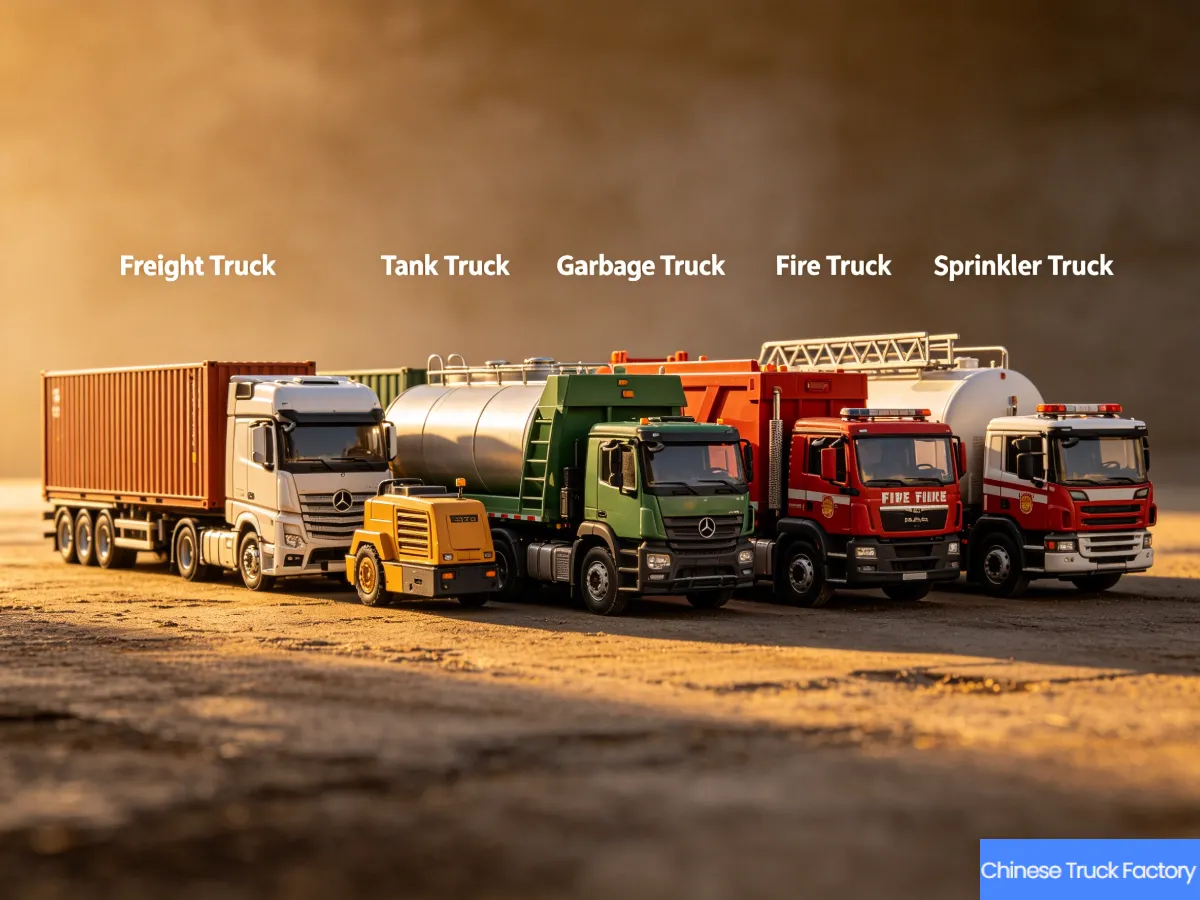
| Urban waste collection | 4×2 or 6×4 rear-loader compactor | Body volume, compaction ratio, bin compatibility | Higher compaction adds weight and cost |
| Construction haulage | 6×4 or 8×4 dump truck | Payload, body volume, road condition | Larger body reduces legal payload if density is high |
| Mining and quarry | 6×4 or 8×4 heavy dump, or rigid mining truck | Cost per tonne moved, body wear, tire life | Heavier build increases fuel consumption |
| Long-haul freight | 6×4 tractor truck | GCW, axle ratio, fuel economy | Higher power does not always mean lower cost per km |
| Water and fuel distribution | 4×2 or 6×4 tanker | Tank volume, compartment layout, pump system | Larger tank reduces legal payload capacity |
| Lifting and loading | Chassis with mounted crane | Load chart, working radius, remaining cargo payload | Bigger crane cuts available cargo weight |
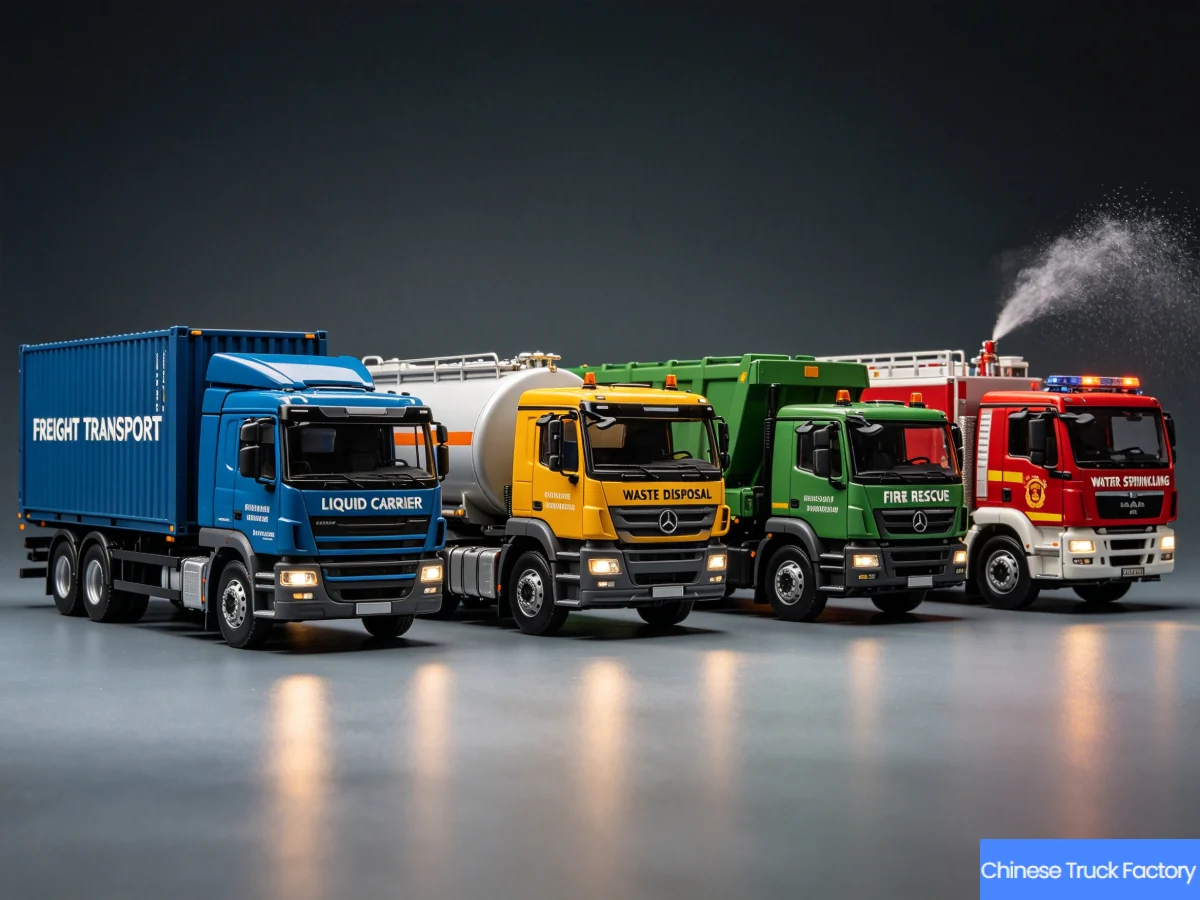
| Municipal fire response | 4×2 or 6×4 fire truck | Water/foam capacity, pump flow, crew and equipment | More water means more weight and slower acceleration |
Notice that none of these rows say “bigger is better.” Each one carries a trade-off. That is the reality of commercial vehicle specification.
Payload, GVW, and Legal Weight — Get These Right First
This is where most buyers make expensive mistakes. Payload is not GVW. Body volume is not payload. Technical axle capacity is not legal axle load. And a factory-rated capacity is not automatically a legally permitted payload in your country.
Here is the relationship that matters:
Payload = GVW − Curb Weight
If your chassis has a GVW of 25,000 kg and the curb weight is 12,000 kg, your theoretical payload is 13,000 kg. But then you add the body, hydraulic system, fuel, driver, and any tools or equipment. Suddenly your usable payload is lower than you expected.
For bulk materials, you also need to check body volume against material density:
Payload = Body Volume × Material Density
A 20 m³ dump body loaded with dry sand at roughly 1.6 tonnes per m³ would need to carry about 32 tonnes. That is well beyond what most 6×4 chassis can legally handle. The same body loaded with coal at roughly 0.85 tonnes per m³ would only need about 17 tonnes. Same body, completely different payload requirement.
Always check both calculations, then apply the legal weight limits of the destination country. Those limits vary widely, and they govern what you can actually register and operate.
Buyers evaluating dump trucks should work through the payload calculation before selecting a body volume. The payload capacity guide on this site explains the difference between GVW, curb weight, and legal payload in more detail.
Chassis and Drivetrain Configuration
Once you know the payload and route, the chassis configuration becomes much easier to define.
Axle Configuration
- 4×2 — two axles, one driven. Best for light urban duty, tankers, and municipal vehicles where maneuverability matters more than payload.
- 6×4 — three axles, two driven. The workhorse for construction, haulage, and most heavy-duty applications. Good balance of payload, traction, and cost.
- 6×6 — three axles, all driven. For severe off-road conditions and steep grades where traction is the limiting factor.
- 8×4 — four axles, two driven. Higher legal payload in markets that allow it, but more tires, more weight, and a wider turning circle.
- 8×8 — four axles, all driven. Specialized off-road and military-style applications.
The choice depends on your legal axle limits, your road surface, and your required payload. A 6×4 with the right axle ratio will often outperform an 8×4 on a route that does not need the extra capacity.
Engine and Transmission
Engine selection is about torque delivery across the operating range, not peak horsepower. A truck climbing a sustained grade at full load needs torque at low rpm and a transmission with well-spaced ratios. A truck running on flat highway at moderate load benefits more from a tall final drive ratio.
Typical configurations in this class of truck range from around 300 hp to 460 hp, with torque figures that vary significantly by manufacturer and emission standard. The correct choice depends on your GVW, your route profile, and your expected average speed.
Final Drive Ratio
Axle ratio is one of the most misunderstood specifications. A numerically higher ratio (for example, 5.92) gives better gradeability and acceleration but higher engine rpm at cruise, which increases fuel consumption. A lower ratio (for example, 4.11) reduces cruise rpm and fuel consumption but reduces pulling power on grades.
Match the ratio to your dominant operating condition. Mixed routes usually need a compromise. Buyers running heavy loads on steep grades should not simply copy the ratio used by a highway fleet.
Suspension and Tires
Leaf spring suspension remains the standard for heavy-duty and off-road applications because it is durable, repairable, and well understood by local mechanics. Air suspension offers better ride quality and load leveling but adds complexity and cost.
Tire selection matters more than most buyers expect. Tire size, ply rating, tread pattern, and load index all affect traction, wear life, and fuel consumption. In hot climates, tire pressure management is critical. In rocky conditions, cut resistance matters more than tread depth.
Body and Superstructure Design
The chassis is only half the truck. For specialized vehicles, the body or superstructure determines whether the truck actually does the job.
Dump Truck Bodies
Key parameters include body volume, steel grade, floor thickness, sidewall thickness, tailgate design, tipping angle, and hydraulic cylinder configuration. A thicker floor resists wear better but adds tare weight, which reduces payload. The correct balance depends on material abrasiveness and expected service life.
For mining and quarry work, consider a hardox or equivalent wear-resistant steel floor. For general construction, standard high-strength steel is often sufficient. The body should also be matched to the loading method — an excavator dropping large rock requires a heavier floor than a loader handling sand.
Garbage Compactor Bodies
Compaction ratio, hopper design, bin lifter compatibility, hydraulic cycle time, and leachate management all affect productivity. A higher compaction ratio means more waste per trip, but it also means more hydraulic stress and more maintenance. The right choice depends on waste density and collection route length.
Urban routes with frequent stops benefit from a body designed for fast cycle times. Longer routes benefit from higher compaction. Buyers should also confirm bin lifter compatibility with the bins actually used in their service area.
Truck-Mounted Cranes
Rated capacity does not mean the crane can lift that weight at full boom extension. The load chart is the governing document. Actual lifting capacity drops as working radius increases and boom extension grows.
Selection requires the maximum load weight, horizontal working radius, lifting height, boom configuration, outrigger setup, chassis capacity, and remaining cargo payload. A larger crane reduces the weight available for cargo, so the trade-off must be evaluated against the actual job.
Buyers comparing lifting options should review the actual load chart before selecting a truck-mounted crane, and confirm the chassis can carry both the crane and the intended cargo.
Tanker Trucks
Tank volume, material, compartment layout, baffles, pumping system, and product compatibility all matter. Center of gravity is a critical safety factor, especially with partial loads. Baffles reduce liquid surge but add weight and reduce usable volume.
For fuel and chemical transport, confirm material compatibility with the product being carried and check the safety and venting requirements of the destination market.
Fire Trucks
Fire truck specification depends on mission type. Municipal structural response, industrial firefighting, wildland response, and airport rescue all require different chassis, pump, and equipment configurations. Water and foam capacity, pump flow and pressure, monitor type, and equipment compartment layout all need to be matched to the actual mission.
Fire equipment standards and certification requirements vary significantly by country. Buyers should confirm the applicable requirements with their local authority before finalizing a specification.
Productivity: What Actually Moves the Needle
Productivity in trucking is not about top speed. It is about tonnes moved per hour, per day, or per litre of fuel. The metrics that matter are:
- Payload per trip — the legal payload, not the body volume
- Cycle time — loading, travel loaded, dumping, travel empty
- Trips per day — limited by cycle time and operating hours
- Average operating speed — affected by road condition, gradient, and traffic
- Fuel consumed per cycle
- Cost per tonne moved — the number that actually determines profitability
- Vehicle availability — the percentage of scheduled hours the truck is actually working
Two trucks with the same purchase price can have completely different cost per tonne moved. The one with higher availability, lower fuel consumption per cycle, and longer tire life usually wins — even if its sticker price is higher.
Fuel and Energy Consumption
Fuel consumption cannot be reduced to a single number. It depends on gross vehicle weight, route profile, average speed, gradient, traffic, idling time, driver behaviour, axle ratio, tire pressure, aerodynamics, climate, altitude, and engine calibration.
For diesel trucks, the practical approach is to estimate consumption based on your actual duty cycle, then compare configurations using the same assumptions. A truck running at 40 tonnes GVW on a hilly route will consume significantly more than the same truck running at 25 tonnes on flat highway.
For electric trucks, the calculation changes. You need to consider:
- Usable battery capacity, not nominal capacity
- kWh per km at your expected payload and route profile
- Payload penalty from battery weight
- Charging power and charging window
- Depot charging versus opportunity charging
- Battery thermal management in your climate
- Expected battery degradation over the service life
Electric trucks can make strong economic sense on predictable, high-utilization routes with depot charging. They make less sense where charging infrastructure is unreliable or daily mileage is unpredictable.
Buyers evaluating electric options should review the port logistics and electric truck solutions overview, which explains how duty cycle and charging strategy interact.
Maintenance, Reliability, and Parts Availability
Downtime usually costs more than the repair itself. A truck that is easy to service, uses commonly available parts, and can be repaired by local mechanics will outperform a technically superior truck that sits waiting for a part.
Practical maintenance planning should include:
- Daily checks — tire condition, fluid leaks, hydraulic hoses, lights, air pressure, warning indicators
- Periodic service — engine oil, filters, transmission, differential, brake system, suspension, wheel bearings, hydraulic oil, PTO, crane pins, dump body hinges, compactor mechanism
- Wear items — brake linings, tires, hydraulic hoses, seals, and body liners
- Emission system — DEF/AdBlue quality and availability, SCR system, DPF where applicable
Specific service intervals should always be taken from the actual vehicle, engine, and component manufacturer manuals. Do not rely on generic figures.
Before committing to a model, confirm that filters, brake parts, belts, hoses, and common wear items are available locally or can be supplied through a reliable parts channel. For fleet operators, a spare parts package included with the initial order often pays for itself within the first year.
A Typical Diagnostic Approach
Take a common complaint: the dump body rises slowly. The correct diagnostic sequence is:
- Check hydraulic oil level and temperature
- Check filter restriction
- Check pump pressure
- Confirm PTO engagement
- Inspect control valve operation
- Check cylinder for internal leakage
- Inspect hoses for restriction or kinks
- Confirm the load is within the rated capacity
Jumping straight to “replace the pump” wastes time and money. Work through the system logically.
Total Cost of Ownership — The Only Fair Comparison
Purchase price is only one line in the total cost equation. A realistic TCO model includes:
| Cost Category | What to Include |
|---|---|
| Purchase price | Chassis, body, options, currency, Incoterm |
| Freight and insurance | Shipping method, port charges, marine insurance |
| Import and compliance | Duties, taxes, registration, homologation, inspection |
| Fuel or electricity | Based on actual duty cycle, not brochure figures |
| Tires | Expected life in your operating conditions |
| Scheduled maintenance | Parts, labour, consumables |
| Unscheduled repairs | Based on expected reliability and local service capability |
| Spare parts inventory | Held stock and replenishment lead time |
| Downtime | Lost production or contract penalties |
| Residual value | Expected resale or trade-in value at end of service |
When you compare two trucks, use the same assumptions for both. A cheaper truck with poor parts availability and high downtime can cost far more over five years than a more expensive truck with strong local support.
Compliance and Destination Market Requirements
There is no such thing as “globally compliant.” Every market has its own requirements, and they change over time. Before finalizing any specification, confirm:
- Emission standard required for registration
- Homologation or type approval requirements
- Vehicle registration eligibility, including any age limits
- Axle weight and gross weight limits
- Vehicle dimension limits
- Left-hand drive or right-hand drive requirement
- Lighting and reflective marking requirements
- Braking and safety system requirements
- Fuel quality and DEF/AdBlue availability
- Local service and parts capability
Requirements for emissions, safety, and vehicle approval are set by national authorities and international bodies. Buyers should verify current requirements directly with the relevant authority or a qualified local agent before placing an order. Do not rely on general assumptions.
For heavy-duty diesel options that can be configured for different emission standards, the diesel truck range provides a starting point for discussion, but the final specification must be confirmed against your destination market requirements.
Shipping and Import Considerations
How a truck is shipped affects both cost and risk. The main options are:
- RoRo (Roll-on/Roll-off) — the truck is driven on and off the vessel. Usually the most economical for complete, driveable vehicles.
- Breakbulk — the truck is lifted on and off. Suitable for larger units or where RoRo service is not available.
- Flat rack — the truck is secured to a flat rack and shipped. Useful for certain routes and vessel types.
- Container — practical only for smaller vehicles or when partially disassembled.
The right choice depends on vehicle dimensions, weight, whether it can be driven, quantity, route, and destination port. Buyers should also plan for inland transport, port handling, marine insurance, customs clearance, import tax, and destination port charges.
A complete understanding of how heavy trucks are shipped overseas helps avoid surprises at the destination port. Shipping method should be confirmed before the order is placed, because it affects both cost and delivery schedule.
How to Evaluate a Supplier
When comparing suppliers, use a consistent framework. The criteria that matter most are:
- Can they confirm the chassis and body specification against your duty cycle?
- Do they provide a clear load chart, weight calculation, or engineering drawing?
- Can they confirm the emission standard and configuration for your market?
- Do they offer a spare parts package and warranty terms in writing?
- Can they provide references or documentation for similar configurations?
- Do they explain the shipping method and Incoterm clearly?
- Are they transparent about lead time and inspection arrangements?
Chinese Truck Factory works within this framework. The company supplies heavy-duty trucks, specialized vehicles, and sanitation vehicles for export markets, and the specification process starts with the buyer’s duty cycle rather than a fixed catalogue. Buyers can review the specialized vehicle range and the sanitation vehicle range to see how different configurations are matched to different applications. The evaluation criteria above are the same ones any serious buyer should apply to any supplier.
If you are working through a specification and want to confirm whether a configuration fits your route, payload, and destination requirements, you can start a conversation through the contact page. Bring your duty cycle data — payload, route, gradient, and legal weight limits — and the discussion becomes much more productive.
Common Mistakes Buyers Make
After enough projects, the same errors show up again and again:
- Choosing body volume before calculating payload from material density
- Confusing GVW with payload
- Assuming technical axle capacity equals legal axle load
- Selecting engine power without considering transmission and final drive ratio
- Ignoring the effect of altitude and temperature on engine output
- Ordering a crane based on rated tonnage without checking the load chart
- Underestimating the weight of the body, crane, or tank on available payload
- Not confirming emission and registration requirements before ordering
- Comparing FOB prices as if they were landed costs
- Forgetting to plan for spare parts and local service capability
Each of these has a cost. Most of them can be avoided with a proper specification review before the order is placed.
Frequently Asked Questions
How do I choose the right payload for my truck?
Start with the material you are hauling and its density. Multiply density by body volume to estimate the weight of a full load. Then compare that against the legal gross weight limit in your country, subtract the curb weight of the chassis and body, and confirm the remaining figure is achievable within your axle limits. Payload is always the lower of the technical and legal limits.
Which axle configuration should I use?
It depends on your legal axle limits, road conditions, and required payload. A 4×2 suits light urban duty. A 6×4 is the standard workhorse for construction and haulage. A 6×6 or 8×8 is for severe off-road conditions. An 8×4 provides higher legal payload where regulations allow it, but adds weight, cost, and turning radius.
How does road condition affect truck selection?
Poor roads increase the demand on suspension, tires, frame strength, and traction. They also reduce average speed, which affects cycle time and fuel consumption. For unimproved haul roads, consider higher ground clearance, stronger suspension, more aggressive tires, and a drive configuration that maintains traction under load.
What affects fuel consumption the most?
Gross vehicle weight, route gradient, average speed, idling time, and driver behaviour usually have the largest effect. Axle ratio, tire pressure, and aerodynamic drag also matter. There is no single fuel consumption figure that applies to all conditions — the same truck can vary widely depending on how it is used.
What maintenance should I plan for?
Plan for daily inspections, periodic engine and driveline service, hydraulic system checks, brake and tire inspection, and replacement of wear items. For specialized vehicles, add body-specific checks such as crane pins, dump body hinges, or compactor mechanism. Always follow the actual manufacturer’s service intervals for the specific engine and components in your truck.
How do I estimate total cost of ownership?
Build a model that includes purchase price, freight, import and compliance costs, fuel or electricity, tires, scheduled maintenance, unscheduled repairs, spare parts, downtime, and residual value. Use the same assumptions for every truck you compare. The lowest purchase price rarely produces the lowest cost per tonne moved.
What information do I need to provide for a quotation?
Destination country and port, application, cargo or material type and density, required payload, body capacity, daily mileage, road condition, gradient, drive configuration, steering side, emission requirement, quantity, and any required options. For crane trucks, add maximum lifting weight, working radius, and lifting height. For fire trucks, add water/foam capacity, pump requirement, and application. For garbage trucks, add waste type, bin type, loading method, and body capacity.
How do I confirm destination-country compliance?
Check directly with the relevant national authority or a qualified local agent. Confirm emission standards, homologation requirements, registration eligibility, axle and gross weight limits, dimension limits, steering side, lighting, braking, and safety requirements. Do not assume that a configuration accepted in one market will be accepted in another.
How are trucks shipped from China?
The main methods are RoRo, breakbulk, flat rack, and container. The right choice depends on vehicle size, weight, whether it can be driven, quantity, route, and destination port. Shipping method affects both cost and delivery schedule, so it should be confirmed before the order is placed.
Final Thoughts
The most suitable commercial truck for a given operation is not the one with the highest horsepower or the largest body. It is the configuration that matches the payload, route, legal weight limits, maintenance capability, and expected operating cycle with the fewest compromises. Start with the duty cycle. Calculate payload from material density and legal limits. Match the chassis, drivetrain, and body to the actual job. Then compare total cost of ownership — not just purchase price — across the options that survive the first three steps.
Buyers who follow that sequence end up with trucks that stay productive. Buyers who skip it end up with trucks that look good on paper and cost money in the yard.



