Finding a reliable Chinese truck supplier for Tanzania is less about picking the biggest dealer name and more about matching a supplier’s build capability to your actual duty cycle. Tanzania’s operating reality — long gravel hauls to remote sites, heavy loads on the Dar es Salaam corridor, high ambient temperatures, and dust — punishes trucks that were specified for a different market. A supplier who understands this will ask about your payload, route gradient, and road surface before quoting a model. A supplier who only sends a price list usually won’t. This guide explains how to evaluate Chinese truck suppliers for Tanzania, what configurations actually work, and where buyers most often lose money.
What “Chinese Truck Supplier” Really Means in Practice
The term covers three very different business types, and the difference matters more than the brand badge on the grille.
- Factory-direct or factory-affiliated exporters — build the chassis and body to order, control the specification, and handle export documentation directly.
- Trading companies — buy finished units or place orders with factories, then resell. Their value is convenience, not engineering.
- Local assemblers and dealers — import CKD or SKD kits and assemble domestically, or import complete units and provide local service.
For a Tanzania-bound order, the practical question is who controls the specification. If the supplier can adjust axle ratio, dump body steel grade, radiator capacity, and emission configuration to your route, you’re dealing with a builder. If the answer to every technical question is “standard,” you’re dealing with a reseller. Both can work — but you should know which one you’re paying.
Reading Tanzania’s Operating Conditions Before You Read a Spec Sheet
Most import mistakes start with the buyer, not the supplier. Before comparing models, write down five things:
- What you haul. Sand, gravel, coal, construction spoil, containerized cargo, fuel, water, or municipal waste. Material density drives everything downstream.
- Where you haul it. Tarmac highway, murram (gravel) road, mine haul road, or urban streets. Each one changes suspension, tire, and axle specification.
- How far, and how steep. A 40 km tarmac run and a 5 km climb at 12% gradient demand completely different powertrains.
- How many cycles per day. This determines whether you need productivity or durability as the primary design goal.
- Climate and altitude. Coastal heat and humidity around Dar es Salaam stress cooling systems. Inland highland routes reduce naturally aspirated engine performance and change turbo matching.
Only after these five are on paper does a truck specification become meaningful. A supplier who skips this step is quoting you a truck, not a solution.
Vehicle Categories and What Each One Actually Does in Tanzania
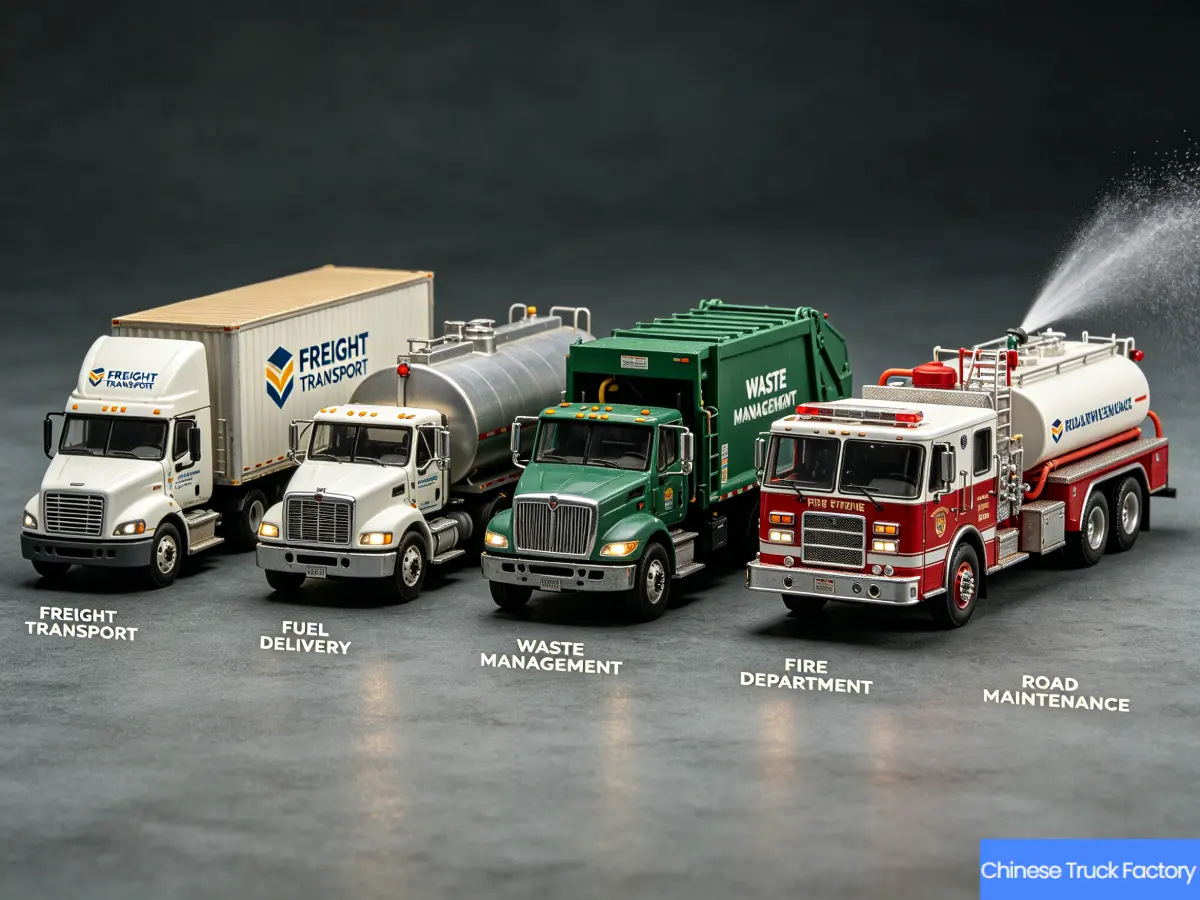
Tanzania’s commercial vehicle demand clusters into a handful of well-defined applications. Each has its own configuration logic.
| Application | Typical Configuration | Primary Selection Driver | Common Pitfall |
|---|---|---|---|
| Construction & aggregate haulage | 6×4 or 8×4 dump truck, 20–30 m³ body | Payload per cycle vs. legal axle load | Oversizing the body and losing legal payload |
| Long-haul general cargo | 6×4 tractor + semi-trailer | Fuel economy at steady highway speed | Choosing too low an axle ratio for hilly routes |
| Mining and quarry support | 6×4 rigid dump, reinforced body | Body wear resistance and haul road gradeability | Under-specifying the cooling and brake systems |
| Urban sanitation | 4×2 or 6×4 rear-loader compactor | Compaction ratio and bin compatibility | Ignoring waste density when sizing the body |
| Water and fuel distribution | 4×2 or 6×4 tanker, 10,000–30,000 L | Tank material, baffling, and axle loading | Filling to full volume regardless of product density |
| Municipal and emergency service | 4×2 or 6×4 fire truck, crane truck | Pump or crane duty cycle, not nominal rating | Judging a crane by its nominal tonnage alone |
If your operation spans two categories — say, construction haulage during the week and water supply on weekends — that’s a strong argument for a single well-chosen chassis with a swappable or multi-purpose body, not two under-utilized trucks.
Payload, GVW, and the Weight Numbers Buyers Confuse
This is where most Tanzania import projects get into trouble at the weighbridge. Four numbers get used interchangeably in sales conversations, and they are not the same thing.
- Curb weight (tare): the empty truck with fuel, fluids, and driver.
- Payload: what you can legally and physically carry. Curb weight + payload = GVW.
- GVW / GVWR: the maximum gross vehicle weight the chassis is engineered for.
- Body volume: a measure of space, not weight. A 25 m³ dump body loaded with wet sand and the same body loaded with dry coal carry very different tonnages.
The critical formula every buyer should run before ordering:
Material density (t/m³) × Body volume (m³) = Potential load weight
If that number exceeds the legal payload for your axle configuration in Tanzania, you have a specification problem — not a truck problem. A reinforced body that adds 800 kg of steel reduces your legal payload by 800 kg on every single trip. For a fleet running 15 trips a day, that’s 12 tonnes of lost capacity per truck per day. Over a year, it’s a serious number. Buyers evaluating payload limits should compare GVW, curb weight and legal payload before finalizing any body specification.
Chassis and Powertrain: What Actually Fits Tanzanian Routes
There is no single “correct” specification. There are trade-offs, and the right answer depends on the route.
Drive configuration
4×2 works for light urban delivery and municipal service. 6×4 is the workhorse for construction, general haulage, and most tanker work. 8×4 provides higher legal payload on paved routes but adds curb weight, cost, tire count, and turning radius — which matters on narrow urban streets and tight site entrances. 6×6 is reserved for genuine off-road mining or extreme terrain where traction, not payload, is the limiting factor.
Engine and transmission
Horsepower alone tells you very little. What matters is where the torque peak sits and how the transmission spreads the ratios. For a hilly route, a slightly lower-rated engine with a well-matched transmission and a numerically higher axle ratio will often outperform a higher-horsepower truck geared for flat highway work. For steady long-haul on the central corridor, the opposite is true — a taller final drive reduces engine RPM at cruise and cuts fuel burn.
Manual transmissions remain the practical choice for most Tanzania operations because they tolerate heat, dust, and variable fuel quality, and because local repair capability is common. Automated manual transmissions are increasingly available and can reduce driver fatigue, but they demand cleaner fuel and more specialized service support.
Axle ratio
This is the single most under-discussed specification in most quotes. A ratio too tall for the terrain means the truck is always fighting its own gearing, running hot and burning fuel. A ratio too short means the engine is screaming at highway speed. Buyers should confirm the final drive ratio is matched to the actual route, not inherited from a catalog default.
Cooling and thermal management
High ambient temperatures plus sustained grade climbing is the hardest condition for any diesel. Radiator capacity, fan drive type, intercooler sizing, and transmission oil cooling all deserve direct questions in the quotation stage. A truck spec’d for a temperate market and shipped unchanged will run hot in the interior.
Body and Superstructure: Where Specification Quality Shows
The chassis is usually the same across suppliers. The body is where suppliers differentiate — and where cheap builds become expensive.
Dump trucks
Key body parameters: floor plate thickness, sidewall thickness, steel grade, subframe design, tipping angle, and hydraulic cylinder configuration. A thicker floor resists abrasive materials like gravel and blasted rock but adds tare weight. For sand and soil, a lighter body is often the better economic choice. For quarry rock, a reinforced floor and Hardox-type wear plate pays back quickly in reduced downtime.
Hydraulic cylinder selection matters too. Front-mounted cylinders give a higher tipping angle and better load stability; underbody cylinders are more compact but offer less lift height. The choice should follow the material’s angle of repose and the dumping location.
Tanker trucks
Tank volume, material, compartment count, baffle design, and pumping system all interact. A 20,000 L tank filled with water weighs 20 tonnes; filled with a denser product, it will exceed the legal axle load. Baffles control liquid surge during braking — a safety issue, not a comfort issue. Buyers should verify tank material compatibility with the product being carried, especially for fuel and chemicals. Detailed capacity ranges are covered in this water tanker truck capacity guide.
Garbage compactor trucks
Compaction ratio, hopper volume, bin lifter compatibility, hydraulic cycle time, and leachate management determine real-world productivity. A compactor rated for 12 m³ with a 3:1 compaction ratio effectively handles 36 m³ of loose waste — but only if the waste density matches the design assumption. Municipal waste in Tanzania varies widely, so buyers should specify based on measured waste density, not catalog figures. See the range of sanitation vehicles for reference configurations.
Truck-mounted cranes
The nominal tonnage on the boom is not the lifting capacity. A crane rated at 12 tonnes may lift that only at minimum radius with the boom fully retracted. At 8 meters radius, the same crane might lift 3 tonnes. The load chart is the real specification. Buyers must also subtract the crane’s own weight from available cargo payload — a heavier crane means less cargo. Compare the load chart against your actual lift requirements before selecting a truck-mounted crane.
How to Evaluate a Chinese Truck Supplier for Tanzania
Supplier evaluation is a structured exercise, not a vibe check. Here’s a framework that has proven useful across many import projects.
1. Engineering capability
Can they modify the specification? Ask for a written technical proposal that addresses your specific route, payload, and material. A supplier who sends a generic brochure cannot answer this. A supplier who sends a chassis drawing with your axle ratio and body dimensions marked up can.
2. Configuration transparency
Request the full bill of materials: engine model and emission standard, transmission model, axle model and ratio, tire size and brand, body steel grade and thickness, hydraulic component brands. If any of these are described only as “high quality” or “branded,” ask again.
3. Documentation and export experience
Confirm they can produce the certificate of origin, commercial invoice, packing list, and bill of lading in the format your Tanzanian clearing agent requires. Ask about previous shipments to East African ports and which shipping method they recommend — RoRo, breakbulk, or flat rack — based on your specific truck dimensions and unit count. The mechanics of this are explained in how heavy trucks are shipped overseas.
4. Spare parts planning
Ask what spare parts package they recommend for the first 12 months of operation, and whether they can supply consumables — filters, brake linings, hydraulic hoses, belts — on a repeat basis. A truck with no parts pipeline is a truck that stops.
5. Warranty scope and terms
Warranty on a Chinese truck export is not the same as a domestic dealer warranty. Clarify what’s covered, for how long, in kilometers or months, and who pays for the parts and labor if a failure occurs in Tanzania. Get this in writing in the sales contract.
6. Communication responsiveness
Response time during the quotation phase is a reasonable proxy for response time during a warranty claim. If a supplier takes a week to answer a technical question before the sale, expect longer after the money has changed hands.
Applying this framework, Chinese Truck Factory fits the profile of a factory-affiliated exporter that builds to specification rather than reselling catalog units. Their process starts with the operating scenario — payload, route, material density, and duty cycle — before recommending a configuration. Buyers can request a detailed technical proposal that includes chassis drawing, axle ratio, body specification, and export documentation scope. That’s the level of detail a serious Tanzania import project should expect from any supplier.
Ready to specify your Tanzania-bound truck? Share your payload, route, and material type, and get a configuration proposal with axle ratio, body spec, and shipping plan.
Total Cost of Ownership: The Only Comparison That Matters
Purchase price is the smallest part of the story over a five-year horizon. A realistic TCO model for a Tanzania-bound truck includes:
| Cost Category | Typical Share of 5-Year TCO | Key Variables |
|---|---|---|
| Purchase price (FOB or CIF) | 25–35% | Configuration, emission standard, quantity |
| Freight, insurance, import duties | 10–18% | Shipping method, port, duty structure |
| Fuel or electricity | 30–45% | Route, load, driving style, axle ratio |
| Tires | 5–10% | Road surface, axle load, tire brand |
| Scheduled maintenance | 5–8% | Service intervals, parts cost, oil quality |
| Unscheduled repairs and downtime | 5–15% | Parts availability, local service capability |
Notice that fuel dominates. This is why axle ratio, tire pressure, driver behavior, and route planning matter more to your bottom line than a few thousand dollars off the purchase price. A truck that burns 5% less fuel over 100,000 km per year saves far more than a discount negotiated at the quotation stage.
Downtime deserves special attention. A truck sitting for two weeks waiting for a hydraulic pump costs you not just the repair, but the revenue from every cycle it didn’t run. This is why spare parts planning and local service access are TCO items, not afterthoughts. Buyers can review a detailed breakdown of operating cost per kilometer to build their own model.
Compliance and Registration in Tanzania
Vehicle import and registration requirements change, and they are administered by Tanzanian authorities — not by the supplier. Do not rely on a supplier’s verbal assurance that a truck “meets regulations.” Confirm the following with your clearing agent or the relevant Tanzanian authority before placing an order:
- Emission standard accepted for import and registration at the time of shipment.
- Steering configuration — Tanzania operates right-hand drive for road-registered vehicles. Confirm the required configuration for your specific vehicle class.
- Axle weight and gross vehicle weight limits for the routes you intend to operate on.
- Vehicle dimensions — length, width, and height limits for road registration.
- Lighting and safety equipment requirements.
- Import age restrictions if you are considering used units.
- Duty and tax structure applicable to your HS code and vehicle type.
The supplier’s role is to build the truck to the specification you confirm. The buyer’s role is to confirm what that specification must be. Getting this backwards is one of the most common — and most expensive — mistakes in truck import projects.
Shipping and Import: Matching Method to Vehicle
Three shipping methods are used for truck exports to Tanzania, and the right choice depends on your specific units.
RoRo (Roll-on/Roll-off)
Best for complete, driveable trucks in small quantities. The truck is driven onto the vessel and secured. Cost is typically lower per unit than container shipping for a single tractor or dump truck. Risk: minor damage during loading and unloading, and limited protection from salt spray.
Breakbulk
Best for oversized or non-driveable units, or when you need to ship multiple trucks on a single vessel with heavy-lift cranes. Common for mining trucks and specialized vehicles that exceed RoRo ramp limits.
Flat rack container
Best for trucks that fit within flat rack dimensions and when you want more protection than RoRo. The truck is secured to a flat rack platform and shipped inside the container stack. Cost is higher than RoRo, but damage risk is lower and you can consolidate multiple smaller units.
For most Tanzania-bound dump trucks, tractor trucks, and tanker trucks, RoRo is the practical default. For fire trucks, crane trucks, and specialized vehicles with high value or fragile superstructures, flat rack is often worth the premium. The comparison is covered in more detail in this guide to RoRo, container and breakbulk shipping.
Maintenance Planning for Tanzania Operations
Dust, heat, and long supply lines make preventive maintenance more important, not less. A practical schedule for most Chinese heavy trucks in Tanzania operations includes:
Daily checks
- Tire condition and pressure (heat and load both affect pressure)
- Engine oil level and coolant level
- Air filter restriction indicator
- Hydraulic oil level and hose condition (for dump, crane, and compactor trucks)
- Brake system air pressure and warning indicators
- Lights and warning devices
- Visible fluid leaks under the truck
Periodic service (follow the specific engine and component manufacturer’s manual)
- Engine oil and filter change
- Fuel filter replacement (critical where fuel quality varies)
- Air filter cleaning or replacement
- Transmission and differential oil inspection
- Brake lining and drum inspection
- Suspension and wheel bearing inspection
- Hydraulic filter and oil condition check
- PTO and hydraulic pump inspection
- Dump body hinge and cylinder pin lubrication
- Compactor mechanism inspection (for sanitation trucks)
- Crane structure and pin inspection (for crane trucks)
Do not assume a fixed service interval from a generic source. The correct interval depends on the specific engine, the duty cycle, and the dust and heat conditions of your operation. Always follow the engine and component manufacturer’s published schedule for the exact model you purchase.
Common Selection Mistakes Buyers Make
- Choosing the largest body available. A bigger body adds tare weight and often reduces legal payload. Match body volume to material density, not to what looks impressive.
- Ignoring the axle ratio. The single most common cause of poor fuel economy and overheating on hilly routes.
- Comparing FOB prices across suppliers without comparing specifications. A cheaper quote often reflects a lighter chassis, thinner body steel, or a lower-spec cooling system.
- Not confirming emission and registration requirements before ordering. A truck that can’t be registered is a very expensive piece of steel.
- Under-planning spare parts. The first six months of operation will reveal which consumables you need most. Order them with the truck, not after.
- Treating the crane’s nominal tonnage as its lifting capacity. Always read the load chart at your actual working radius and lift height.
- Assuming “standard” configuration works everywhere. It doesn’t. Every market, route, and material combination has its own optimal specification.
Frequently Asked Questions
How do I choose the right payload for a Tanzania-bound dump truck?
Start with the material density and the legal axle load limits for the routes you’ll operate on. Multiply material density by body volume to get the potential load weight, then check that against the legal payload for your chosen axle configuration. If the body volume suggests more weight than the legal limit allows, reduce body volume or increase axle capacity — don’t simply overload and hope.
Which axle configuration should I use — 6×4 or 8×4?
6×4 is the practical default for most construction, tanker, and general haulage work in Tanzania. 8×4 offers higher legal payload on paved routes but adds curb weight, tire cost, turning radius, and purchase price. Choose 8×4 only when the route supports the larger vehicle and the extra payload genuinely improves your cost per ton moved.
How does road condition affect truck selection?
Gravel and mine haul roads require reinforced suspension, higher ground clearance, and more robust tires than tarmac routes. Steep gradients demand a lower axle ratio and adequate engine braking or retarder capacity. Long tarmac runs favor taller gearing and aerodynamic efficiency. The same truck model can be specified very differently for these two extremes.
What actually affects fuel consumption on a Chinese heavy truck?
Gross vehicle weight, average speed, gradient, idling time, driver behavior, axle ratio, tire pressure, and engine calibration all influence fuel burn. Published fuel consumption figures are indicative at best — the same truck can vary by 30% or more between two different routes. Buyers should model fuel cost using their own operating data, not catalog numbers.
How do I confirm emission and registration compliance for Tanzania?
Confirm the accepted emission standard, steering configuration, axle weight limits, dimensions, and lighting requirements with your Tanzanian clearing agent or the relevant authority before placing an order. Do not rely on a supplier’s general statement that a truck “meets regulations” — the rules are administered locally and change over time.
How are trucks shipped from China to Tanzania?
Most complete, driveable trucks ship via RoRo. Flat rack containers are used when more protection is needed or when the unit doesn’t fit RoRo constraints. Breakbulk is used for oversized or non-driveable units. The right choice depends on truck dimensions, weight, quantity, and destination port. Confirm the shipping method and Incoterm (FOB, CFR, or CIF) in writing before the order is placed.
What should I include in a quotation request to a Chinese truck supplier?
Destination country and port, application, cargo or material type, required payload, body capacity, daily mileage, road condition, gradient, drive configuration, steering side, emission requirement, quantity, and any required options. The more specific your request, the more accurate the configuration proposal — and the fewer surprises at delivery.
Final Selection Logic
The best Chinese truck supplier for a Tanzania operation isn’t the one with the largest catalog or the lowest headline price. It’s the one that asks about your material density, route gradient, and daily cycle count before recommending a model — and then backs that recommendation with a written specification you can verify. Payload, axle configuration, body specification, cooling capacity, and axle ratio are the parameters that determine whether a truck earns money or costs money in Tanzania. Purchase price matters, but it’s a small fraction of total ownership cost compared to fuel, maintenance, and downtime. The most suitable truck is therefore not the one with the highest horsepower or the largest body. It’s the configuration that matches the payload, route, legal weight limits, maintenance capability, and expected operating cycle with the fewest compromises.



