Waste collection & sanitation vehicles

Waste Management Vehicle Solutions for Municipal & Commercial Collection

A useful waste-collection fleet starts with the route, waste stream and container system—not with the biggest truck on a specification sheet. Chinese Truck Factory supplies configurable garbage trucks and sanitation vehicles for municipal fleets, private contractors, commercial collection and project procurement, with vehicle configuration reviewed around the intended job and destination market.

Page reviewed: September 2026

Quick answer

For mixed municipal or residential refuse, a rear-loader garbage compactor is often the starting point. Standardized roadside bins may favor a side-loading arrangement. Commercial or industrial projects may require front-loading, hook-lift, roll-off or other project-specific systems. The final choice should be checked against waste type, daily volume, road access, bin interface, chassis limits and local registration requirements.

Match the Collection System to the Job

Waste-management projects fail when the truck, bins and route are treated as separate decisions. Start with how material is collected, how crews work at each stop, where the truck unloads and what the local road network allows. Those answers narrow the vehicle type much faster than comparing headline capacity alone.

Municipal & Residential Mixed Waste

Frequent-stop routes usually need a practical balance of body volume, maneuverability, loading speed and safe crew access. Rear-loading compactor configurations are commonly considered for this work.

Typical starting point: rear loader / compactor

Standardized Curbside Bins

Where containers are placed consistently along the roadside, a side-loading or compatible lifting arrangement may reduce manual handling. Lifter geometry must match the actual local bin interface.

Key check: bin dimensions and pickup interface

Commercial & Industrial Collection

Factories, markets, hotels, malls and industrial parks may use larger or more standardized containers. Front-loading, hook-lift, roll-off or other project-specific arrangements can be reviewed according to the site and container system.

Key check: container type and site access

Recycling & Separated Waste Streams

Projects collecting recyclables or source-separated materials should define the material stream before the body layout is selected. Body, loading and compartment requirements can then be discussed around the collection process.

Key check: material separation method
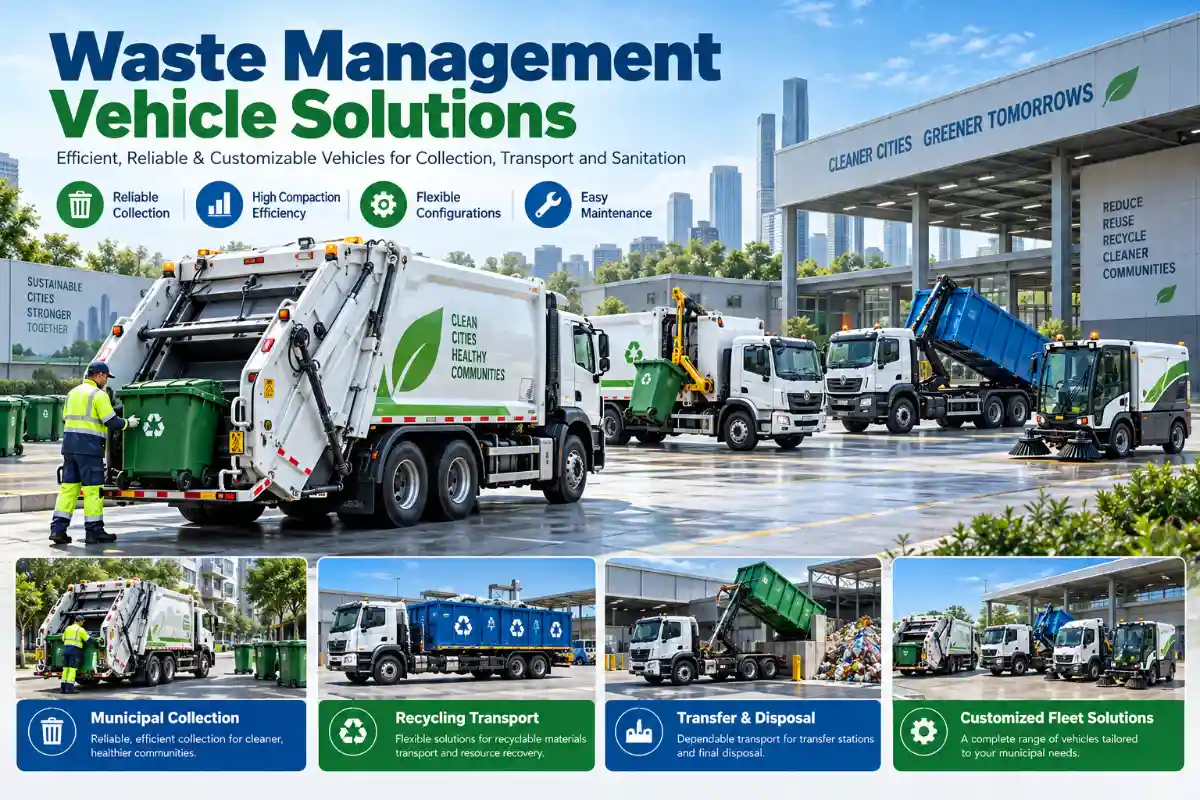
Garbage collection truck operating on an urban waste collection route
Route conditions, collection stops, bin standards and disposal distance should be considered together before the truck configuration is finalized.

Six Inputs That Decide the Right Waste Collection Vehicle

These are the details worth confirming before comparing suppliers or requesting a firm quotation.

Input Why it matters What to prepare
Waste stream Mixed household waste, recyclable material, wet waste and bulky material behave differently during loading and transport. Main waste type, estimated density if known, and any materials that must be kept separate.
Daily collection volume Body capacity should reflect the real route rather than a generic “largest available” specification. Approximate volume or tonnage per shift, collection frequency and number of stops.
Bins & containers A lifting device only works properly when the dimensions and pickup interface match the local container. Bin capacity, outside dimensions, lifting points and clear photographs.
Road access Narrow streets, turning space, gradients, bridge limits and site entrances can rule out an otherwise suitable chassis. Typical road width, turning restrictions, gradients and access constraints.
Disposal point Distance to a transfer station, landfill or recycling facility affects useful body size and route planning. One-way distance, unloading conditions and expected trips per shift.
Destination rules Steering position, emissions, axle limits, dimensions, homologation and registration requirements vary by market. Destination country, required LHD/RHD, emissions requirement and any tender specification.
Final chassis, payload, body volume, dimensions, emission standard and optional equipment should be confirmed for the exact vehicle in the quotation and technical sheet. Generic figures should not be treated as guaranteed specifications for every truck.

Waste Collection Vehicle Options by Route Type

There is no single garbage-truck layout that fits every collection system. The vehicle type should follow the route and container system first; chassis and body size come after that.

Rear-Loader Garbage Compactor

Useful for many municipal, residential and commercial routes where crews load at the rear or move compatible bins to a rear lifting device.

Side-Loader Garbage Truck

Suited to planned routes where containers are positioned consistently along the side of the vehicle and the lifting interface is compatible.

Front-Loader Configuration

Commonly considered for compatible commercial containers or dumpsters where site clearance and container geometry allow front loading.

Hook-Lift / Roll-Off System

Useful when detachable containers need to be exchanged between collection points, industrial sites, construction projects or disposal facilities.

Recycling Collection Configuration

Body and loading arrangements can be discussed for projects that collect recyclable or source-separated material.

Project-Specific Sanitation Vehicle

For tenders or fleet programs with defined chassis, controls, warning equipment, body layout, fleet marking or destination-market requirements.

How to Choose a Waste Collection Truck Without Overspecifying It

A larger body or more complex loading system does not automatically produce a better route. The practical configuration is the one that completes the work without creating access, payload, service or compliance problems.

Define the route

Record road width, turning space, stop density, gradients, operating hours and the distance to the disposal or transfer point.

Define the waste

State whether the truck will handle household refuse, commercial waste, recyclables, wet waste, bulky material or another defined stream.

Measure the containers

Do not choose a lifter from bin capacity alone. Dimensions, pickup points and photographs help verify compatibility before production.

Match body and chassis

Review GVW, wheelbase, drive layout, steering position, axle limits and body volume as one vehicle package rather than separate specifications.

Check local compliance

Confirm emissions, dimensions, axle loads, homologation and registration requirements with the relevant authority in the destination market.

Plan service support

Consider local access to chassis service, filters, braking parts, hydraulic components, electrical parts, manuals and replacement components.

Configuration Can Be Reviewed Around the Project

International fleet requirements vary widely. Instead of fixing one standard package for every market, the truck can be discussed around the required chassis, body and operating setup, subject to model availability and engineering confirmation.

Common configuration items

  • Rear-, side- or project-specific loading arrangement
  • Body capacity matched to chassis and route
  • Hydraulic compaction where required
  • Bin lifter matched to local container standard
  • LHD or RHD subject to chassis availability
  • Engine and emission level by destination requirement
  • Control positions and requested safety functions
  • Cameras, warning devices and lighting options
  • Fleet color, logos and language markings
  • Project-specific documentation requirements

What should be fixed in writing

Before ordering, use the quotation and technical sheet to confirm the exact chassis model, body volume, payload, dimensions, powertrain, emissions level, loading system, bin lifter, controls, optional equipment, warranty terms, production schedule and inspection scope.

International Procurement: From Requirement to Shipment

For imported sanitation vehicles, specification control is as important as the truck itself. A clear process reduces mismatches between the ordered vehicle, local bins, destination regulations and the final shipping plan.

Send operating requirements

Truck type, waste stream, body or payload target, bin information, route conditions, quantity, destination country and destination port.

Review available configuration

Confirm chassis, steering position, engine, emissions, loading arrangement, lifter, controls and requested options.

Confirm technical and commercial terms

Review the specification sheet, quotation scope, Incoterm, lead time, warranty terms and any spare-parts or documentation requirements.

Production and inspection

Inspection can be agreed around the confirmed order specification, including hydraulic operation, controls, electrical equipment, body condition and installed options.

Shipping coordination

Shipping method depends on vehicle dimensions, route, port facilities, quantity and commercial terms. Documentation should be confirmed for the destination.

Prepare local service

For fleet projects, discuss manuals, recommended spare parts and model identification information needed for future replacement-part requests.

Who This Solution Is Designed For

Municipal Fleets

Route-based vehicle selection for city, district and community solid-waste collection programs.

Private Sanitation Contractors

Configurable vehicles for outsourced residential, commercial or mixed collection routes.

Importers & Dealers

Specification review, destination-market configuration and export coordination for resale or distribution projects.

Commercial Properties

Collection solutions for hotels, markets, malls, offices and other managed sites with defined container systems.

Industrial Sites

Project-specific waste collection where site access, container type, payload and operating procedure are known in advance.

Tenders & Fleet Procurement

Review against buyer technical sheets, requested options, inspection requirements and destination compliance needs.

Waste Management Vehicle FAQ

Short answers to the questions buyers usually need settled before the technical specification is finalized.

Which garbage truck is usually suitable for municipal waste collection?

Rear-loader compactors are a common starting point for mixed municipal and residential routes because they can suit repeated stops and crew-assisted collection. The final choice still depends on road width, daily volume, local bins, payload limits and disposal distance.

What is the practical difference between a rear loader and a side loader?

A rear loader collects from the back of the vehicle and can suit varied collection points or crew-assisted routes. A side loader works best when containers are consistently positioned along the side of the route and the lifting system matches the local bin standard.

Can the truck be configured for our existing garbage bins?

Bin-lifter compatibility should be checked before production. Send the bin capacity, outside dimensions, lifting interface and clear photographs so the required lifting arrangement can be reviewed.

How should I choose the body capacity?

Use daily collection volume, waste density, route length, number of stops, road access and chassis limits together. The largest body is not always the most efficient choice, especially on narrow or dense urban routes.

Can you provide left-hand-drive or right-hand-drive sanitation trucks?

LHD or RHD availability depends on the selected chassis, destination market and current chassis availability. State the required steering position when requesting a quotation.

Which emission standard should I request?

The required emissions level depends on the destination country's import, registration and operating rules as well as the available chassis and engine combination. Confirm the local requirement before finalizing the vehicle.

Can you support recycling or separated-waste collection projects?

Project-specific body and loading arrangements can be discussed for recyclable or source-separated material. The required waste streams, collection method and any compartment requirements should be defined before configuration.

Can you coordinate export documentation and shipping?

Export documentation and shipping coordination can be discussed according to the vehicle, destination and commercial terms. Provide the destination country and port when requesting a quotation.

What information should I send for an accurate quotation?

Send the required truck type, preferred body capacity or payload, waste type, local bin information, LHD/RHD requirement, quantity, destination country, destination port and any tender or reference specification you already have.
Request a project quotation

Send the Route and Collection Details First

A useful quotation starts with the operating requirement. The more specific the route, bins and destination information, the easier it is to review a suitable vehicle configuration.

  • Truck type or preferred loading method
  • Body capacity or payload target
  • Waste type and collection frequency
  • Bin dimensions or photos if a lifter is needed
  • LHD/RHD and destination-country requirements
  • Quantity and destination port

Request a Configuration Review

Include a tender sheet or reference specification if you already have one.

This field is required.
Provide additional information or questions here.