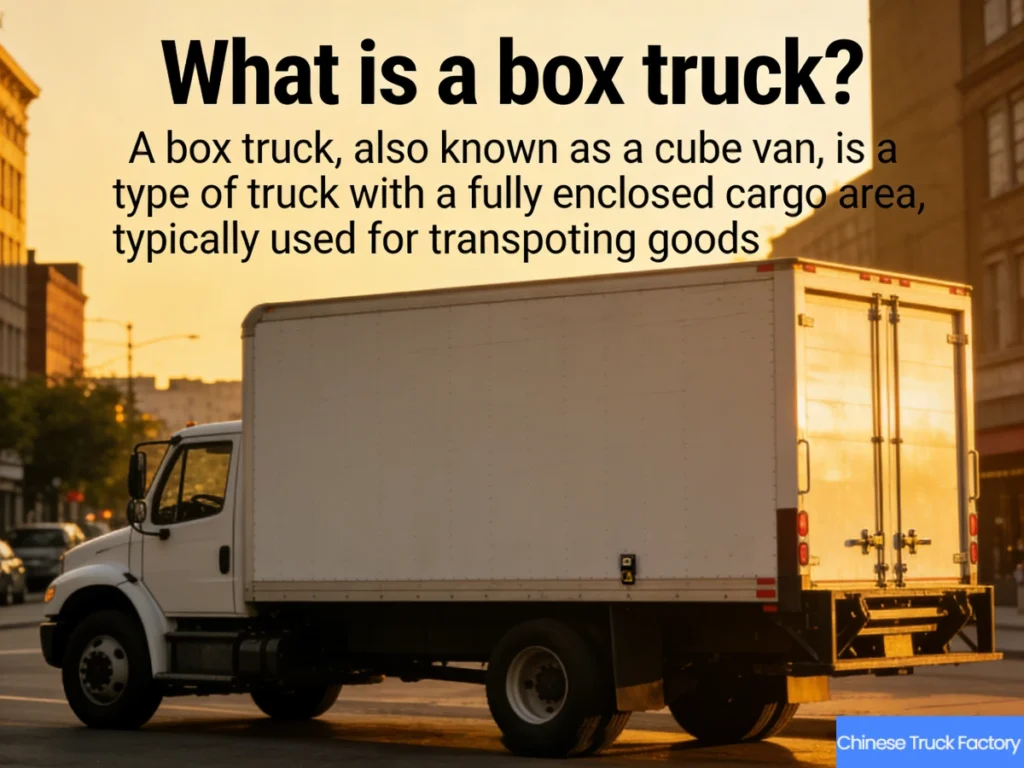
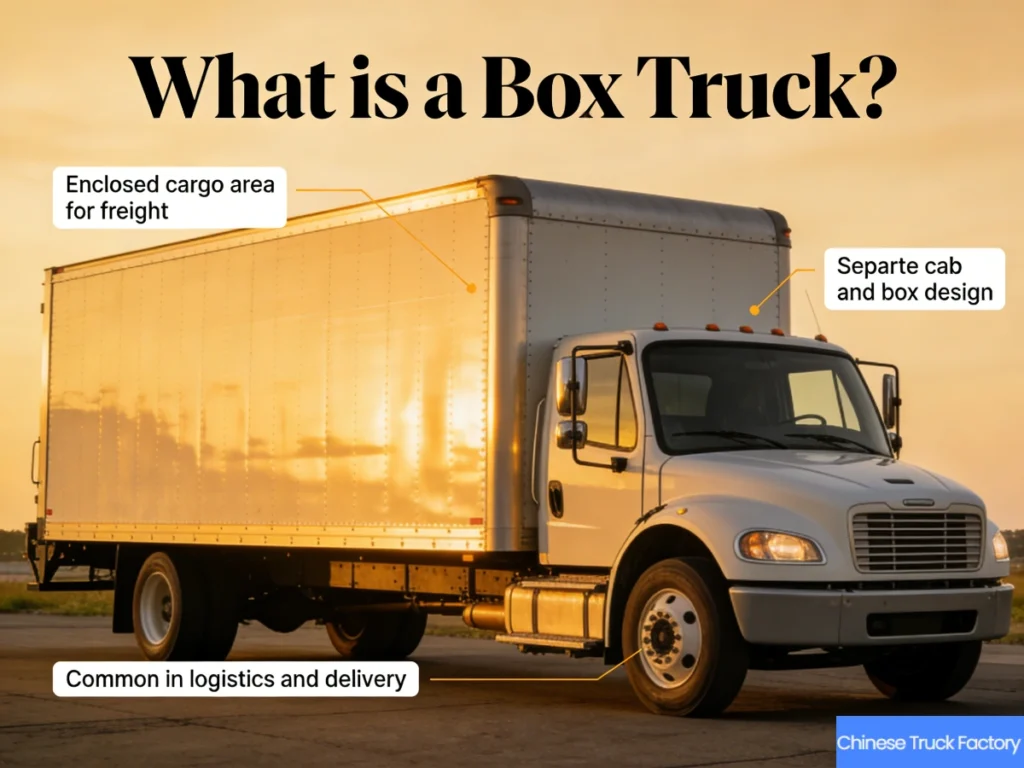
If you have ever asked what is a box truck, the simplest answer is this: it is a truck with a separate cab up front and a fully enclosed cargo box mounted on the chassis behind it. That one design choice makes it one of the most practical vehicles for deliveries, moving jobs, route-based service work, retail distribution, and countless small fleet operations. In plain English, a box truck gives you weather protection, cleaner cargo organization, and easier branding than an open-bed truck. Over the years, I have worked around truck buyers, body builders, and fleet managers long enough to see one thing clearly: when people search what is a box truck, they are not looking for a dictionary definition alone. They want to know how it works, what it can carry, what size they need, what it costs to run, and whether it is the right fit for real work.
When I explain what is a box truck to a first-time buyer, I usually start with the job, not the spec sheet. A box truck is built to move goods that need protection from weather, theft, dust, and shifting during transport. That sounds simple, but it is exactly why this body style has become so common in local delivery, furniture transport, appliances, event logistics, food distribution, maintenance work, and mobile service operations. If your business depends on loading quickly, unloading cleanly, and showing up with cargo in good shape, the answer to what is a box truck becomes very practical very fast.
In my experience, most people confuse a box truck with a cargo van, a straight truck, or even a small moving truck. The truth is that those terms overlap in everyday conversation, but a box truck usually refers to an enclosed straight truck with a cube-shaped or rectangular cargo body. That cargo box can be fitted with a roll-up rear door, swing doors, liftgate, shelving, tie rails, refrigeration, side access, or custom racks depending on the work. Once you understand that flexibility, it becomes easier to see why the search for what is a box truck often leads to questions about payload, dimensions, loading style, route type, and business use.
What a Box Truck Really Is in Everyday Use
At the technical level, a box truck is a single vehicle with one frame, one engine, one cab, and one enclosed body. Unlike a tractor-trailer setup, the cargo area does not detach. That matters because it changes how the truck is driven, parked, maintained, loaded, and insured. From the driver’s seat, a box truck feels more direct and compact than a combination rig. From the cargo side, it gives you a self-contained workspace that can be customized around your route, freight type, or service model.
In real operations, a box truck often becomes the sweet spot between a van that is too small and a tractor-trailer that is too much truck for the job. I have seen businesses outgrow vans faster than they expected. The minute stops become denser, product mix widens, or goods get bulkier, the need for a more organized enclosed body shows up. That is when what is a box truck stops being a curiosity and becomes a buying question.
Another reason box trucks stay popular is simplicity. You can train drivers faster than on larger articulated equipment. You can back into tighter loading areas. You can keep tools, cartons, padded blankets, hand trucks, and route paperwork in one secure unit. In other words, a box truck is not just a vehicle. For many operators, it is the moving warehouse, storefront, and service bay all at once.
How Box Trucks Are Usually Classified
One of the smartest ways to understand what is a box truck is to look at how these trucks are grouped by gross vehicle weight rating, or GVWR. That number tells you the maximum allowable loaded weight of the truck, including the vehicle itself, fluids, passengers, and cargo. In practical buying terms, GVWR affects payload, axle choices, licensing requirements, route planning, brake wear, and even which jobs make sense for a specific build.
Official weight-class references place many box trucks in the medium-duty range. FHWA materials specifically list box trucks in Class 3 and also note refrigerated and box trucks across the Class 3 to 6 range, which broadly covers GVWR from 10,001 to 26,000 pounds. That is one reason buyers so often see box trucks in parcel, appliance, route delivery, and local commercial service work rather than in long articulated freight.
| Weight Class | Typical GVWR Range | How It Relates to Box Trucks | Common Use Pattern |
|---|---|---|---|
| Class 3 | 10,001–14,000 lb | Entry-level commercial box truck range | Light route delivery, small moving jobs, service fleets |
| Class 4 | 14,001–16,000 lb | Common step up for more body length or payload | Retail distribution, linen, bakery, local freight |
| Class 5 | 16,001–19,500 lb | Better balance for larger bodies and denser loads | Furniture, equipment, contractor supply runs |
| Class 6 | 19,501–26,000 lb | Heavier medium-duty box truck builds | High-cube delivery, bulkier cargo, multi-stop fleets |
That table matters because many people shopping for their first truck focus on box length alone. I understand why. A 16-foot, 20-foot, or 26-foot box sounds easy to compare. But I have watched buyers make expensive mistakes by ignoring chassis capacity, rear axle rating, and door opening dimensions. The right question is never just “How long is the box?” A better question is “What will this truck actually carry every day without making my operation inefficient?”
Box Truck vs. Cargo Van vs. Pickup vs. Semi
Search intent around what is a box truck usually includes comparison. People want to know whether they actually need one or whether a van, pickup, or tractor-trailer would do the job better. Here is the plain answer I give most often.
| Vehicle Type | Best For | Main Limitation | Why Buyers Switch to a Box Truck |
|---|---|---|---|
| Cargo Van | Small tools, courier work, light urban service | Limited cube space and interior height | Need more organized enclosed capacity |
| Pickup Truck | Open loads, jobsite flexibility, towing | Poor weather protection for cargo | Need enclosed freight security |
| Box Truck | Protected local or regional cargo movement | Less capacity than a tractor-trailer | Balanced choice for many small and mid-size operations |
| Tractor-Trailer | High-volume freight and linehaul work | Higher cost, more space, more complexity | Too much truck for dense local stops |
What I like about a box truck is how many use cases it handles without asking a business to build around the vehicle. A van is great until your freight gets tall, fragile, or awkward. A pickup is useful until rain, theft risk, or brand presentation starts costing you money. A semi is powerful, but for many local operations it adds complexity that never produces enough return. That middle ground is where the box truck lives.
If your routes involve repetitive stops, hand unloading, pallet jacks, furniture pads, e-commerce cartons, packaged food, or service equipment, the answer to what is a box truck is often the same answer to “What vehicle gives me room to grow without overbuying?”
Common Box Truck Sizes and What They Are Good For
When buyers ask me what is a box truck, the second question is almost always about size. There is no single perfect size, because the right box length depends on freight density, stop frequency, loading method, and driver comfort. Still, a few practical patterns show up again and again.
10- to 12-foot box truck
This is the compact end. I have seen these work well for flower delivery, bakery routes, mobile repair crews, document service, and lighter urban work where parking matters more than maximum cube. You get enclosed cargo and good maneuverability, but the truck can be outgrown quickly if the business adds more product lines or larger packaged items.
14- to 16-foot box truck
This is often where first-time commercial buyers land. It feels manageable for newer drivers, yet it gives more usable cargo space than most vans. For local distribution, medical supplies, small furniture, fixtures, electronics, and contractor tools, this range often hits the right balance.
18- to 20-foot box truck
In my experience, this is the “serious business” range for growing operators. You can configure shelves, carts, moving pads, or bulk storage while still keeping the truck workable in tighter service areas. Many companies move into this size after discovering that a smaller body creates route inefficiency because they reload too often.
22- to 26-foot box truck
This is where box trucks become true workhorses. These bodies are common for furniture, appliances, event production gear, multi-stop parcel runs, and denser local freight. A 26-foot box truck in particular can feel like a mobile warehouse when laid out correctly. The tradeoff is obvious: larger turning radius, more attention to loading discipline, and higher operating costs if the truck is oversized for the job.
What a Box Truck Can Carry
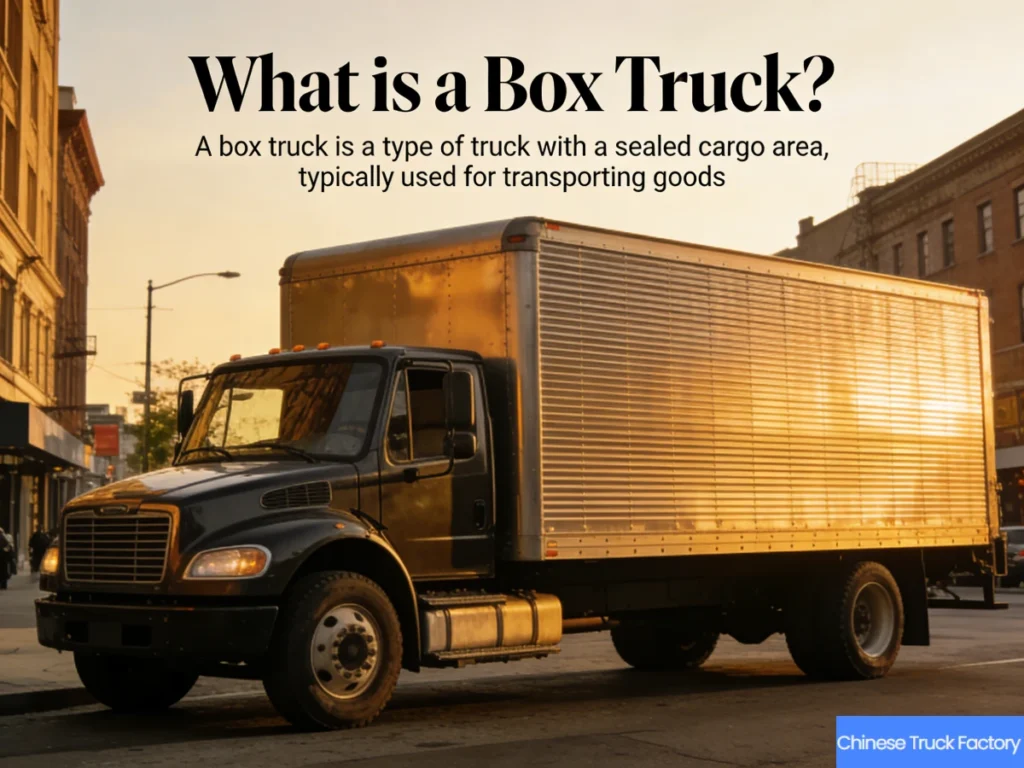
One reason people keep searching what is a box truck is that the phrase sounds broad. And it is. A box truck can be configured for many kinds of freight, but not every build is right for every load. What matters is not just whether the cargo fits, but whether it fits safely, efficiently, and repeatedly.
- Cartoned parcel freight
- Furniture and mattresses
- Appliances
- Packaged food and beverage
- Shelved tools and mobile workshop equipment
- Event, staging, or production gear
- Medical and janitorial supplies
- Temperature-controlled goods when fitted with reefer equipment
I always tell buyers to think in three dimensions: weight, cube, and handling method. A truck may have enough physical room for your freight, but the load might become axle-heavy, too tall for safe stacking, or too awkward to unload efficiently at each stop. That is why interior height, door opening, wheel-well intrusion, tie rails, and liftgate choice can matter just as much as advertised body length.
And if your cargo is on public roads, cargo securement is not optional. Federal cargo securement rules require cargo to be loaded and secured so it does not leak, spill, blow, fall, or shift in ways that affect stability or maneuverability.
Why Businesses Choose Box Trucks
There are plenty of trucks in the market, so why do so many operators settle on this one? In my view, there are seven main reasons, and each one answers a different search intent behind what is a box truck.
1. Protected cargo
The enclosed body shields goods from rain, dust, UV exposure, and road grime. That sounds obvious, but protecting freight is not just about appearance. Fewer damaged boxes, cleaner packaging, and more predictable deliveries can directly improve customer retention.
2. Better organization
Shelves, e-track, partitions, hanging rails, bins, and labels turn a box truck into a controlled workspace. I have seen operators cut route time simply by reworking their interior layout so drivers are not digging through cargo at every stop.
3. Easier branding
The flat side panels on a box truck are rolling billboards. For local operators, this is one of the most overlooked benefits. A clean wrap or simple logo system can make a small company look established overnight.
4. Lower complexity than a trailer combination
A box truck is easier to manage than a tractor-trailer for many local jobs. Parking, reversing, loading dock alignment, driver onboarding, and route flexibility all tend to be simpler.
5. Flexible body options
Liftgates, walk ramps, refrigerated units, translucent roofs, side doors, shelving packages, and custom interiors allow one chassis platform to serve very different businesses.
6. Strong fit for route work
Multi-stop operations benefit from the enclosed, organized, accessible body design. This is especially true when the truck comes back to a base each day and the loading pattern can be standardized.
7. Clear upgrade path from smaller vehicles
For growing businesses, a box truck often becomes the first “real commercial vehicle” that supports scale without forcing a full jump into heavy articulated transport.
How I Help Buyers Decide Whether They Need One
When someone asks me what is a box truck, I do not start by recommending a model. I start with a short checklist. It has saved a lot of people from buying the wrong truck.
- What is your average daily load weight?
- What is your average daily load volume?
- Are your goods palletized, hand-carried, rolled, or hung?
- How many stops do you make per route?
- Do you load at docks, curbside, or job sites?
- Do you need a liftgate?
- Will drivers enter the cargo area frequently during the day?
- Do you need refrigeration, shelving, or special racks?
- Are you trying to maximize payload, cube, or maneuverability?
Most bad purchases happen because the buyer focused on one variable and ignored the others. I have seen companies buy too small and pay for it through reload time, extra trips, and damaged freight. I have also seen them buy too large and pay for empty cube, harder parking, slower routes, and avoidable fuel cost. The best spec is not the biggest truck. It is the truck that earns its keep every day.
What Drivers and Fleet Owners Often Get Wrong
There are a few box truck myths that come up constantly. If you are serious about understanding what is a box truck, it helps to clear them out now.
Myth: Bigger is always better
It is not. The wrong truck size can drag down route efficiency and increase operating cost. Unless your freight truly needs the space, unused cube is just overhead on wheels.
Myth: Payload is obvious from box size
It is not. A big body on the wrong chassis can create false confidence. You must look at actual rated capacity, axle limits, suspension setup, and the real weight of what you carry.
Myth: Any enclosed truck is basically the same
Not close. Door type, floor height, body material, wheelbase, liftgate rating, roof height, side access, and loading profile all change how the truck performs in real work.
Myth: Box trucks are only for moving companies
That is one of the most common misunderstandings. Moving trucks are just one visible example. In reality, box trucks are used in parcel, food service, building supply, service fleets, mobile maintenance, retail stock transfer, and specialty logistics every day.
Operating Costs and the Value Question
Anyone searching what is a box truck for business reasons eventually reaches the money question. The smartest way to think about cost is not just purchase price. It is total operating fit. A cheaper truck that wastes labor, overloads constantly, or causes route delays can become expensive very fast. A more expensive truck that cuts damage claims, improves stop times, and lasts longer may be the better buy.
Here is how I usually break the value equation down:
- Upfront cost: chassis, body, liftgate, upfit, branding, taxes, registration
- Fuel or energy cost: route length, idle time, stop density, terrain, seasonal demand
- Maintenance: brakes, tires, suspension, door hardware, liftgate service, preventive inspections
- Labor efficiency: loading speed, route flow, driver fatigue, access to cargo
- Cargo protection: damage rate, cleanliness, theft exposure, claim frequency
- Business image: presentation, trust, brand visibility
If your work is tied to online ordering, route density matters even more. The latest Census Bureau figures show total retail e-commerce sales for 2025 were estimated at $1.2337 trillion, up 5.4% from 2024, and e-commerce accounted for 16.4% of total retail sales that year. That kind of shipment volume is one reason enclosed medium-duty delivery equipment remains central to local fulfillment and route-based distribution.
That trend does not mean every business needs a box truck. It means the environments where box trucks perform well are not going away. If your company is moving parcel-heavy, carton-based, repeat-stop freight, you are operating in exactly the kind of pattern that box trucks were built to serve.
Gas, Diesel, and Electric: Which Powertrain Makes Sense?
The answer depends on duty cycle. For many lighter and medium local applications, gas and diesel are still common because the service network is familiar and the purchase process is straightforward. Diesel remains especially relevant when payload is heavier, routes are longer, or downtime tolerance is low.
That said, I would be ignoring reality if I pretended electrified box truck fleets were a niche topic. They are no longer a theory problem. For return-to-base operations with predictable daily mileage, electric box trucks have become a serious consideration. DOE and NREL materials say battery-electric trucks tend to become cost-competitive for smaller trucks before 2030, while short-haul heavy trucks under 500 miles of range are projected to become cost-competitive by 2035.
For buyers weighing that decision, I use a simple rule. If the truck leaves from one yard, runs a repeatable route, returns to base, and does not require irregular emergency miles, an electric box truck deserves a close look. If the route is unpredictable, payload swings hard, or charging discipline would be poor, conventional power still has clear advantages.
My Practical Advice on Specifying the Right Box Truck
Here is the advice I would give a friend buying their first serious commercial truck.
Choose the body around your freight, not your ego
Do not buy the biggest truck because it feels like growth. Buy the truck that matches your real load profile. Bigger trucks hide inefficiency well.
Measure your cargo, do not guess
Take ten real loads and record weight, cube, tallest piece, longest piece, and unloading method. Those numbers are more valuable than any brochure.
Decide early on liftgate vs. ramp vs. dock loading
This affects body selection, floor height, delivery time, and driver strain. I have seen liftgate choice alone determine whether a truck works well or becomes a constant headache.
Think about interior workflow
Shelves, partitions, strap points, lighting, and floor finish matter. A good interior layout saves minutes at every stop, and those minutes become real labor savings over a year.
Pay attention to maintenance access
Door rollers, seals, steps, liftgates, and body hardware often get ignored during purchase. Then the truck enters service, and those parts become the first things drivers notice.
My rule of thumb: spec a truck for the job you do every week, not the one unusual load you may haul twice a year.
How Box Trucks Fit Into Broader Truck Buying Decisions
If your website serves readers who are comparing multiple truck categories, it helps to place the box truck in a wider context. Some buyers start with box trucks and later expand into heavier or more specialized equipment. Others begin with broader commercial vehicle research and narrow down once they understand their actual use case.
That is one reason I like pointing readers to related pages that build out the bigger picture. For example, if someone is still comparing body styles, a good next read is what are the three types of trucks. If they are trying to understand broader purchasing options from a manufacturing perspective, they may also benefit from China truck manufacturer and heavy truck manufacturer. And if they are struggling with vehicle weight questions that influence payload and selection, how much does a truck weigh is a natural companion piece.
I like these internal connections because they reflect how real buyers think. They rarely search once, get one answer, and buy immediately. They compare, circle back, narrow choices, and ask the same question in slightly different ways until the buying picture becomes clear.
Where a Manufacturer Conversation Becomes Useful
Not every article needs a recommendation, but if a reader has moved past the definition stage and into sourcing, then it is fair to point them toward a manufacturer conversation. In that context, Chinese Truck Factory is relevant because buyers often need more than a generic product overview. They need to understand how body type, chassis configuration, and application-specific truck selection come together in real business use.
That is especially true when an operator is not just asking what is a box truck, but also comparing enclosed delivery trucks with heavier vocational platforms or long-distance applications. In those cases, a broader solutions page such as long-haul transportation solutions can help readers separate box-truck use cases from larger freight strategies without sending them into dead-end pages.
What I Would Tell a First-Time Buyer in One Conversation
If we were sitting down over coffee and you asked me what is a box truck, I would say this: it is one of the most useful commercial vehicles you can buy when you need enclosed, organized, route-friendly cargo space without the complexity of a full trailer combination. It is not the answer for every load,. In those cases, a broader solutions page such as long-haul transportation solutions can help readers separate box-truck use cases from larger freight strategies without sending them into dead-end pages.
What I Would Tell a First-Time Buyer in One Conversation
If we were sitting down over coffee and you asked me what is a box truck, I would say this: it is one of the most useful commercial vehicles you can buy when you need enclosed, organized, route-friendly cargo space without the complexity of a full trailer combination. It is not the answer for every load, but it is the right answer for an enormous number of real businesses.
I would also tell you not to get distracted by surface-level specs. Focus on the work. How do you load? How often do you stop? What does the cargo weigh? What shape is it? Does it need shelving? Does it need cooling? Does the truck return to base? Is branding important? If you answer those questions honestly, the right truck gets easier to find.
And finally, I would remind you that a box truck is only as good as its fit to the job. The most successful fleets I have seen were not built by buying the biggest truck or the cheapest truck. They were built by matching truck design to daily reality. That is what separates a truck that merely runs from a truck that actually makes money.
FAQ: Common Questions About Box Trucks
Is a box truck the same as a straight truck?
In many everyday conversations, yes, the terms overlap. A box truck is typically a type of straight truck with an enclosed cargo body attached to the same chassis as the cab. Some people use “straight truck” as the broader term and “box truck” as the enclosed-cargo version of that setup.
What is a box truck used for most often?
Common uses include parcel delivery, furniture moving, appliance transport, food distribution, retail stock transfers, maintenance fleets, and mobile service operations. The enclosed body makes it especially useful when cargo needs to stay clean, dry, secure, and organized.
What size box truck should I choose?
Choose based on real cargo weight, cargo volume, loading method, and route pattern. Smaller trucks are easier to maneuver, while larger trucks reduce reload frequency and improve cube for bulkier loads. The best choice depends on what you move every day, not your occasional oversized job.
Do I need a liftgate on a box truck?
You need one if you regularly load heavy freight without dock access. For hand-loaded cartons or routes served by loading docks, a liftgate may not be necessary. For appliances, palletized freight, and bulky commercial deliveries, a liftgate often improves both speed and safety.
Can a box truck be used for a moving business?
Absolutely. In fact, this is one of the most recognized uses. But moving is only one slice of the market. Box trucks are also widely used in distribution, service work, and local logistics.
Is an electric box truck worth considering?
It can be, especially for repeat local routes where the truck returns to one base and daily mileage is predictable. For irregular routes or heavy-duty use with uncertain charging access, conventional power may still be the better fit.
What is the main benefit of a box truck over a cargo van?
The biggest advantage is usable enclosed cargo space. A box truck generally provides more interior cube, better organization options, and stronger fit for bulkier or higher-volume commercial loads.
Notes for Readers
This article is intended for general informational use and practical buying guidance. Vehicle ratings, body dimensions, payload limits, securement practices, and licensing requirements vary by chassis, body builder, equipment package, and intended use. Always confirm final specifications with the seller, body builder, and relevant compliance professionals before purchase or operation.