Managing waste volume is one of the biggest logistical headaches for municipalities and large-scale industrial operations. If you have ever watched a sanitation vehicle swallow an entire dumpster’s worth of refuse and wondered, trash compactor how does it work to fit all that material into such a small space, you are looking at a marvel of hydraulic engineering. It isn’t just about squishing garbage; it is about density ratios, fluid dynamics, and operational efficiency.
In this guide, we break down the mechanical “heart” of waste reduction. Whether you are a fleet operator managing waste management solutions or a business owner looking to optimize logistics, understanding the mechanics behind compaction can save thousands in operational costs. We will strip away the jargon and look at the nuts and bolts of how these powerful machines turn mountains of trash into manageable blocks.

The Core Concept: The Physics of Compaction
At its most basic level, a trash compactor functions on a simple principle: removing air voids. Municipal solid waste (MSW) is surprisingly airy. Think about a bag of milk cartons, styrofoam, and cardboard boxes. It takes up a lot of space but doesn’t weigh much relative to its volume. A compactor uses mechanical force to crush these materials together, effectively increasing density.
The answer to trash compactor how does it work usually involves a hydraulic system. An electric motor powers a hydraulic pump, which pushes fluid into a cylinder. This cylinder extends a heavy steel ram (or packer blade) against the waste. Because liquids cannot be compressed, the force applied at one end of the hydraulic system is transferred with massive multiplication to the ram face. This force overcomes the structural integrity of the trash, collapsing it.
Key Components of the System
- The Ram (Packer Head): The steel plate that physically pushes the trash.
- The Hopper: The chamber where waste is initially dumped.
- The Breaker Bar: A reinforced steel bar that helps snap bulky items (like wood or furniture) as the ram pushes past it.
- Hydraulic Cylinders: The “muscles” that drive the ram.
Stationary vs. Mobile Compactors: Different Tools for Different Jobs
While the hydraulic principles remain similar, the application differs significantly between a unit bolted to a warehouse floor and the mobile units found on heavy-duty trucks.
Stationary Industrial Compactors
These are typically found behind grocery stores or factories. The waste is fed into a chute, the machine cycles, and the trash is pushed into a detachable container. Once full, a roll-off truck takes the container away. These systems often achieve compaction ratios of 4:1.
Mobile Compactor Trucks (The Rear Loader Mechanism)
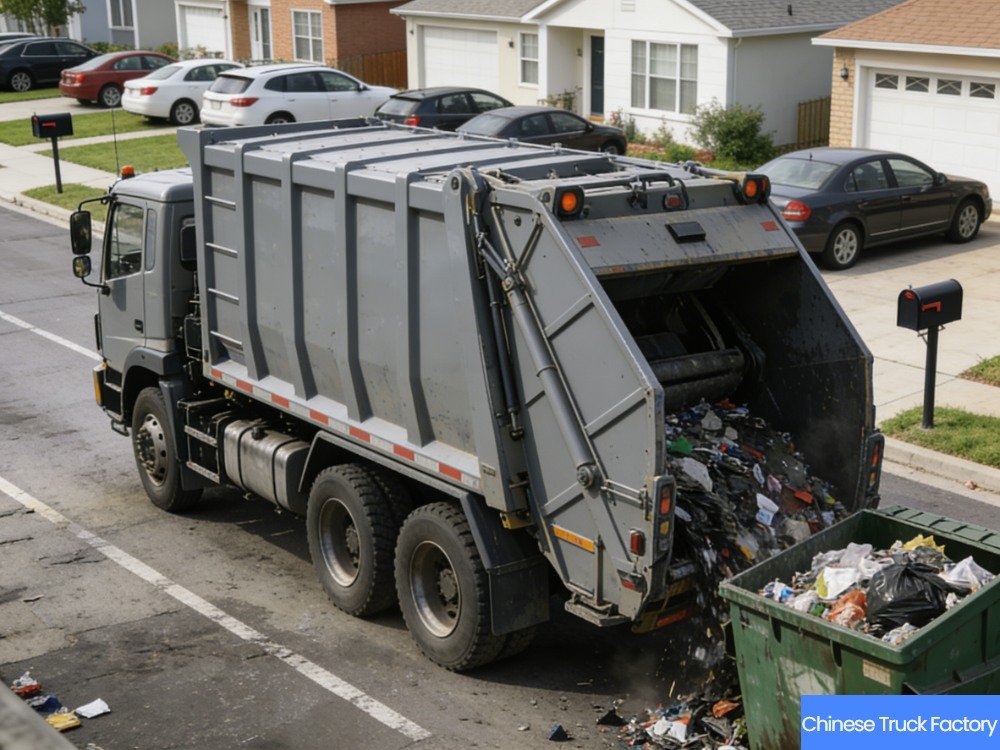
For those of us in the logistics and sanitation industry, mobile compactors are the most interesting. These are the garbage trucks that roam city streets. Their mechanism is more complex because it must operate while the vehicle is moving and handle variable loads.
On a standard rear loader, often manufactured by specialized rear loader refuse truck manufacturers, the process involves a “Sweep and Slide” motion:
- Loading: Waste is dumped into the rear hopper.
- Sweep: A sweep blade curves down and scoops the trash.
- Slide: The slide blade moves on a track, packing the trash against the ejector panel inside the truck body.
This continuous packing allows a single truck to collect from hundreds of homes before needing to tip at the landfill.
Detailed Breakdown: The Hydraulic Circuit
To truly answer trash compactor how does it work, we must look at the hydraulics. This is where the power comes from. In high-quality sanitation vehicles, such as those found in professional sanitation vehicles, the hydraulic system is designed for high pressure and durability.
The Power Unit
The process starts with the pump. In mobile units, this is often a PTO (Power Take-Off) pump connected to the truck’s transmission. When the driver engages the PTO, the truck’s engine spins the pump, circulating hydraulic fluid.
The Control Valves
Fluid flows to a directional control valve. This is the “brain” of the hydraulic circuit. When the operator pulls a lever (or presses a button), the valve directs oil to the specific side of the cylinder to extend or retract the ram. Modern systems use solenoids and sensors to automate this cycle, preventing the ram from jamming if it hits an object it can’t crush (like a concrete block).
| Feature | Hydraulic System | Electric Mechanical System |
|---|---|---|
| Power Source | Fluid pressure (Oil) | Screw drives or chains |
| Force Output | Extremely High (30,000+ lbs) | Moderate |
| Maintenance | Check hoses, seals, fluid levels | Grease gears, check chains |
| Best Application | Heavy-duty trucks, Industrial waste | Small indoor units, Retail |
Operational Cycle of a Mobile Refuse Truck
Let’s walk through a real-world scenario using a standard heavy-duty compactor truck. Understanding this cycle helps in selecting the right equipment and maintaining safety standards.

1. The Collection Phase
Operators load waste into the hopper. For larger items, the “breaker bar” is essential. As the hydraulic ram cycles, long pieces of wood or metal are forced against this bar, snapping them into smaller pieces that fit into the main body. This is a standard feature for top-tier new garbage truck manufacturers targeting the USA and global markets.
2. The Packing Phase
The hydraulic cylinders extend. The specific pressure per square inch (PSI) determines how tight the “brick” of trash becomes. High-performance trucks operate at pressures exceeding 2,500 PSI. This squeezes liquids out and crushes air pockets. The compacted trash is pushed forward against an “ejector panel.”
3. The Resistance Logic
Smart systems measure resistance. As the truck gets fuller, the hydraulic pressure required to push the trash increases. The system senses this pressure spike. When the pressure hits a specific limit, it tells the operator the truck is at capacity. Overloading can damage the cylinders, so this feedback loop is critical.
Safety Mechanisms and Sensors
You cannot discuss trash compactor how does it work without addressing safety. These machines generate enough force to crush a car. Therefore, safety interlocks are non-negotiable.
Photo-Eyes and Limit Switches:
Modern compactors use a “photo-eye” (a light beam). If the beam is broken by trash, the machine knows to cycle. However, safety standards require emergency stop buttons and physical limit switches that stop the ram if a hopper door is opened. In the realm of specialized vehicles, these safety protocols are rigorous.
Bypass Valves:
To prevent the machine from destroying itself, a relief valve is installed. If the ram encounters an unbreakable object (like an engine block throw in by mistake), the pressure builds up. Once it hits the safety limit, the valve opens, and fluid bypasses the cylinder, returning to the tank. The ram simply stops moving rather than exploding a hose.
Environmental and Economic Benefits
Why go through all this mechanical trouble? The data speaks for itself. According to waste management reports, uncompacted trash is mostly air. By achieving a compaction ratio of 4:1 or even 6:1 in high-end models, fewer trips are needed to the landfill.
- Reduced Fuel Costs: Fewer trips mean less diesel burned.
- Lower Landfill Fees: Many landfills charge by volume or have surcharges for loose loads.
- Sanitation: Compacted waste in a sealed truck body reduces odors and prevents vermin (rats and bugs) from accessing the food source.
Expert Insight: “In fleet operations, the biggest variable cost is the driver’s time and fuel. If a compactor truck can hold 12 tons instead of 4 tons of loose trash, you have effectively tripled your fleet’s efficiency without buying more trucks.” — J. Miller, Fleet Logistics Consultant.
Choosing the Right Equipment Manufacturer
When sourcing these vehicles, the quality of the steel and the reliability of the hydraulic system are paramount. The market has shifted significantly in recent years. While there are many domestic options, global supply chains have opened doors to high-value manufacturing.
Many fleet managers are now looking at direct sourcing. Companies like Chinese Truck Factory have become integral players in the global supply chain, offering heavy-duty chassis and advanced compaction bodies that rival expensive European brands. Whether you need urban muck transport solutions or dedicated refuse trucks, vetting the manufacturer’s hydraulic specs is key.
What to Look For in Specs:
- Cycle Time: How fast does the ram complete a crush? (Standard is 30-45 seconds).
- Hopper Size: Can it fit a sofa or just bags?
- Steel Grade: Is the floor made of AR450 (abrasion-resistant) steel? This prevents garbage liquids (leachate) from rusting through the floor.
Maintenance: Keeping the Pressure Up
A compactor is only as good as its maintenance. The most common point of failure is not the steel, but the hydraulic fluid.
Contamination Control
Dirt is the enemy. If grit gets into the hydraulic fluid, it acts like sandpaper inside the pumps and valves. Regular filter changes are essential. For those managing sanitation vehicle fleets, a strict schedule of fluid analysis can predict pump failure before it happens.
The Slide Tracks
On mobile rear loaders, the slide blades run on tracks (shoes). These are wear items. If they aren’t greased or replaced when worn, steel grinds on steel, leading to expensive repairs. Checking these wear pads is a weekly task.
Advanced Compactor Types: Beyond the Rear Loader
While we focused on the standard rear loader, the answer to trash compactor how does it work changes slightly with other vehicle types.
Side Loaders
Used for automated residential pickup. An arm grabs the can, dumps it, and a smaller ram packs it laterally. These require complex PLC (Programmable Logic Controller) computers to synchronize the arm and the packer.
Front Loaders
These trucks pick up commercial dumpsters over the cab. The compactor is similar to a rear loader but pushes from front to back. These are the workhorses of commercial waste collection.
If you are exploring different truck types, understanding the nuances between a dedicated refuse truck and something like a diesel dump truck is vital. While a dump truck just carries loose material, the refuse truck is a mobile processing plant.
Real-World Data: Efficiency in Numbers
Let’s look at the impact of compaction technology on logistics. A study by the Environmental Research & Education Foundation suggests that optimized compaction routes can reduce fleet mileage by up to 25%. Furthermore, modern high-compaction bodies maximize the payload. A standard 25-yard rear loader can legally carry about 10-12 tons of MSW. Without compaction, that same truck body would carry less than 3 tons.
For businesses looking for dump truck companies near me or waste partners, asking about their truck’s compaction ratio can actually give you insight into their pricing structure. More efficient trucks usually mean better rates for the customer.
Troubleshooting Common Issues
Even the best machines jam. Here is a quick guide for operators:
- Ram is slow: Check hydraulic fluid levels and filter status. Cold weather can also thicken the oil.
- Low Compaction Force: The relief valve might be set too low, or the pump is wearing out.
- Loud Screeching: Usually indicates a starved pump (cavitation) or dry slide tracks.
Frequently Asked Questions (FAQ)
How much does a trash compactor reduce volume?
Typically, a standard industrial or truck-mounted compactor achieves a ratio of 4:1. This means 4 cubic yards of loose trash are compressed into 1 cubic yard of space. High-density balers can achieve even higher ratios depending on the material.
Does a trash compactor require special electrical power?
Stationary units usually require 3-phase industrial power (208V, 230V, or 460V). Mobile units on trucks are powered by the truck’s diesel engine via a PTO (Power Take-Off) unit driving a hydraulic pump.
Can you put anything in a trash compactor?
No. You should never put flammable materials, pressurized tanks (propane), or hazardous waste into a compactor. While they can crush wood and light metal, heavy structural steel or concrete can damage the ram and hydraulic cylinders.
What is the difference between a compactor and a baler?
A compactor compresses trash into a container for disposal at a landfill. A baler compresses recyclable materials (like cardboard or plastic) into a tied-off block (bale) to be sold for recycling.
Final Thoughts on Waste Management Technology
Understanding trash compactor how does it work reveals the efficiency hidden in plain sight on our streets. It is a blend of raw hydraulic power and smart engineering design. For industry professionals, choosing the right equipment—whether it is a stationary unit or a fleet of rear loaders—defines the profitability of the operation.
If you are in the market for robust, industrial-grade vehicles, reliability is key. Manufacturers like Chinese Truck Factory provide the heavy-duty solutions required to withstand the daily grind of waste compaction. By selecting the right specifications and maintaining the hydraulic systems, you ensure safety, efficiency, and a cleaner environment for everyone.
References:
1. United States Environmental Protection Agency (EPA) – Sustainable Materials Management Data.
2. Occupational Safety and Health Administration (OSHA) – Standards for Waste Management Vehicles.