If you manage a municipal fleet or run a private waste hauling business, you know the drill. It’s 4:00 AM, and your trucks are hitting the pavement. In this industry, downtime isn’t just an inconvenience; it’s a direct hit to your bottom line and your reputation. As we head into 2025, the criteria for selecting the best equipment has shifted. It is no longer just about horsepower; it is about total cost of ownership, steel durability, and hydraulic cycle times. This brings us to the critical search for the right partners: finding reliable rear loader refuse truck manufacturers.

I have spent over a decade in the heavy-duty truck industry, specifically focusing on the engineering and export of sanitation vehicles. I’ve seen fleets crumble because they bought based on sticker price alone, and I’ve seen others thrive by prioritizing build quality and manufacturer support. Whether you are looking for high-compaction residential units or heavy-duty commercial haulers, understanding who makes the machine—and how they make it—is everything.
In this guide, we are cutting through the marketing noise. We will look at what defines a top-tier manufacturer in 2025, analyze the technical specs that matter (like waste collection vehicle compaction ratios), and explain why going directly to source manufacturers like Chinese Truck Factory is becoming the secret weapon for smart procurement officers in Western markets.
The State of Waste Management Equipment in 2025
The waste industry is undergoing a quiet revolution. In 2025, we are seeing a massive push towards efficiency. Fuel prices are volatile, and labor shortages mean your drivers need equipment that is intuitive and safe. The top rear loader refuse truck manufacturers are responding by integrating better safety cameras, stronger hopper floors, and telematics systems.
However, a new trend is emerging: the shift away from middlemen. For years, buyers in the US and Europe paid a premium for local dealerships that simply rebranded imported chassis or bodies. Today, the market is correcting itself. Buyers are realizing that sourcing directly from established factories allows for better customization and significantly better pricing without sacrificing quality.
Why Rear Loaders Remain the King of the Route
Despite the rise of automated side loaders (ASL), the traditional rear loader remains the backbone of residential and commercial routes. Why? Versatility. A robust rear loader can handle standard trash cans, commercial dumpsters (with a winch or kick bar), and bulk items like furniture that an automated arm simply can’t grab. For mixed routes, these heavy-duty refuse bodies are unbeatable.
Key Specs: How to Evaluate a Manufacturer
When you are staring at a spec sheet, it’s easy to get lost in the numbers. Based on my experience engineering these trucks, here are the three non-negotiables you should look for when comparing manufacturers.
1. Steel Quality and Tensile Strength
The hopper is the high-wear zone. If a manufacturer uses standard mild steel in the hopper floor, walk away. The best manufacturers use high-tensile, abrasion-resistant steel (often referred to as AR450 or equivalent). This resists the acidity of leachate and the constant friction of glass and metal being crushed.
2. Compaction Ratio and Hydraulic Pressure
Your ROI depends on how much trash you can pack before heading to the landfill. A standard truck might offer a significantly lower compaction rate than a premium unit. Look for hydraulic compaction systems that deliver a minimum of 2500 PSI operating pressure, capable of achieving compaction ratios of 3:1 or higher. This means fewer trips to the dump and less fuel burned.
3. Cycle Time
Time is money. A reload cycle that takes 25 seconds versus one that takes 15 seconds adds up to hours of lost productivity over a week. Top-tier rear loader refuse truck manufacturers tune their hydraulics for a “sweep and slide” cycle that is fast but smooth to reduce wear on the cylinders.
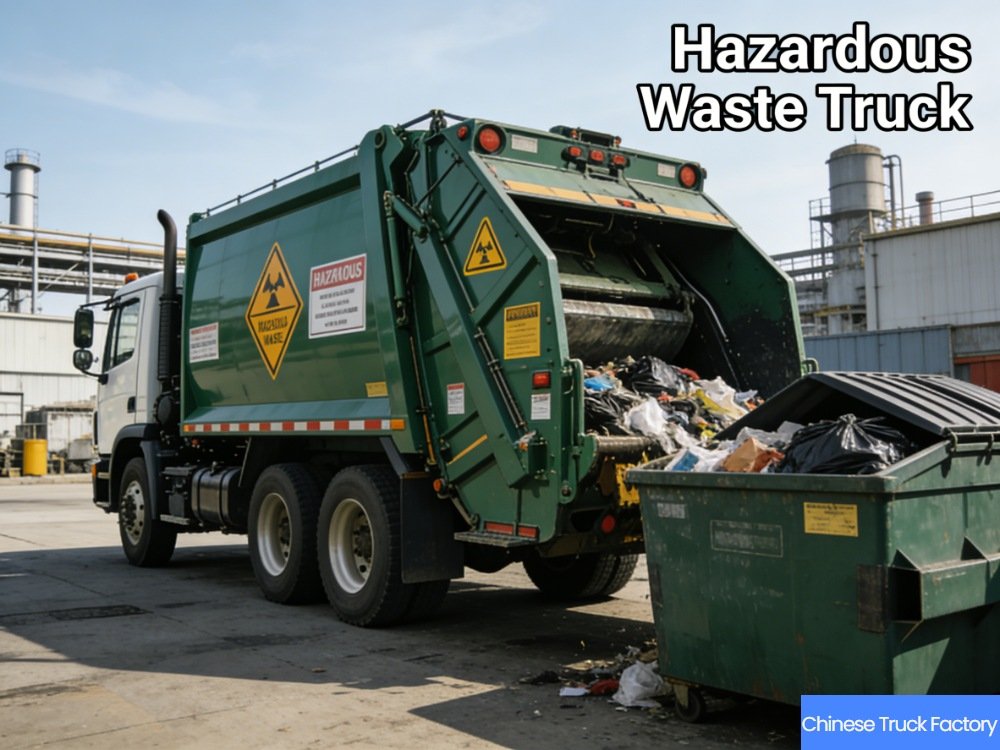
The Shift to Source Manufacturing: Chinese Truck Factory
In the past, there was a stigma about imported heavy machinery. That narrative is dead. Today, China is the world’s manufacturing hub for heavy trucks, producing units that meet and often exceed rigorous European and American standards. This is where Chinese Truck Factory comes into the conversation.
We aren’t just talking about cheap alternatives. We are talking about source manufacturing. When you work with a company like Chinese Truck Factory, you are bypassing the layers of markup added by domestic assemblers. They provide:
- Customization: Need a specific hopper width or a specialized lifting mechanism? Source factories can retool faster than large domestic conglomerates.
- Supply Chain Control: As a direct manufacturer, they control the raw steel inputs and the component quality.
- Global Compliance: Their trucks are engineered to meet ISO standards, ensuring safety and reliability in Western markets.
I have personally inspected their assembly lines. The robotic welding precision and the anti-corrosion dipping processes used are on par with, if not superior to, many well-known “premium” brands that charge double the price.
Comparison: Domestic vs. Source Manufacturers
Let’s look at the numbers. Below is a comparison of what you typically get from a domestic legacy brand versus a high-end source manufacturer like Chinese Truck Factory.
| Feature | Legacy Domestic Brand | Chinese Truck Factory (Source) |
|---|---|---|
| Steel Grade | AR400 / AR450 (Optional upgrade) | AR450 (Standard) |
| Lead Time | 12 – 18 Months | 3 – 6 Months |
| Cost Index | $$$$ | $$ |
| Customization | Limited packages | High flexibility |
| Warranty | 1 Year Standard | Comprehensive Support |
Real World Experience: A Case Study in Durability
Let me share a specific example from my consulting experience. A mid-sized private waste management firm in a coastal region was struggling with rust. Their fleet of domestic trucks, only three years old, was suffering from hopper floor rot due to the salt air and acidic leachate.
They decided to pilot two units from a specialized Asian manufacturer, similar to the inventory found at Chinese Truck Factory. We spec’d these trucks with reinforced zinc-coated underbodies and high-grade weather-resistant paint.
The Result?
Two years later, the pilot trucks showed 40% less corrosion than the domestic counterparts. Furthermore, the hydraulic seals—often a weak point in humid climates—held up perfectly. The fleet manager reported a 30% reduction in maintenance costs for those specific units. This is the difference between buying a brand name and buying engineering excellence.
Maintenance: Keeping Your Rear Loader Running
Even the best rear loader refuse truck manufacturers can’t prevent breakdowns if maintenance is ignored. However, the design of the truck dictates how easy that maintenance is.
When sourcing your vehicles, look for:
- External Hydraulic Cylinders: Some designs bury the cylinders inside the packer panel. If a hose bursts, your mechanic has to crawl inside the truck (a massive safety risk and time sink). Top manufacturers mount them outside the body for easy access.
- Centralized Lube Banks: Greasing a truck shouldn’t take an hour. Look for manifolds that bring all grease points to a reachable height.
- Electrical Simplicity: Multiplex wiring is great until it fails. I prefer manufacturers that use sealed, water-tight connections but keep the logic simple enough for a standard mechanic to troubleshoot with a multimeter.
According to data from the Environmental Research & Education Foundation, maintenance accounts for nearly 15% of a fleet’s total budget. Choosing a truck designed for serviceability is the easiest way to slash that number.
Safety Innovations in 2025
We cannot discuss garbage truck suppliers without mentioning safety. Rear loaders involve personnel on the ground, making them statistically more dangerous than automated loaders. The best manufacturers in 2025 are integrating active safety features.
Look for trucks equipped with:
- Rear Vision Systems: High-definition cameras that are standard, not aftermarket add-ons.
- Proximity Sensors: Systems that auto-brake the truck if a worker is detected in the crush zone.
- Hopper Floodlights: LED lighting that illuminates the work area for early morning routes.
The Environmental Angle: CNG and Electric Options
While diesel is still king for heavy torque, the market is shifting. Many source manufacturers are now offering bodies compatible with CNG (Compressed Natural Gas) or electric chassis. If you are operating in a city with strict emissions zones, verify that your manufacturer has experience mounting bodies on alternative fuel chassis. This requires different weight distribution calculations, something experienced engineers at Chinese Truck Factory are well-versed in.
Frequently Asked Questions (FAQ)
What is the average lifespan of a rear loader refuse truck?
A high-quality rear loader body typically lasts 7 to 10 years depending on the corrosiveness of the waste and daily usage. However, the chassis may last longer. High-tensile steel bodies can extend this lifespan significantly.
Why should I consider a Chinese manufacturer for refuse trucks?
Chinese manufacturers offer a compelling balance of cost and quality. By using the same high-grade steel and hydraulic components as Western brands but with lower production costs, they provide a higher ROI. Companies like Chinese Truck Factory specialize in export-ready units that meet international standards.
What is the ideal compaction ratio for a rear loader?
For general municipal waste, look for a ratio of roughly 800 to 1,000 pounds per cubic yard. A compaction ratio of 3:1 is a good benchmark for a high-efficiency hydraulic system.
Are parts difficult to find for imported trucks?
Not if you choose the right partner. Reputable source manufacturers use global standard components (like Parker hydraulics or Siemens electronics) that can be sourced locally in the US or Europe.
Final Thoughts: Making the Right Choice
Selecting from the various rear loader refuse truck manufacturers available in 2025 comes down to trust and mathematics. You need a truck that packs tight, resists rust, and doesn’t cost a fortune to maintain. While legacy domestic brands offer familiarity, the smart money is moving toward direct source manufacturing.
By partnering with a dedicated manufacturer like Chinese Truck Factory, you gain access to world-class engineering and heavy-duty waste solutions that protect your margins. Don’t just buy a truck; invest in a manufacturing partnership that understands the demands of your route.
For more insights on specialized vehicle procurement, check out our guide on custom truck manufacturing or contact our engineering team directly for a quote.
References: