I’ve spent the better part of my life on the manufacturing floor, watching raw steel turn into the heavy machinery that keeps the world moving. One of the most common questions I get from fleet managers and independent owner-operators isn’t just about horsepower or torque—it’s about weight. Specifically, how much does a truck weigh?
It sounds like a simple question, but if you’ve been in this industry as long as I have, you know the answer is anything but simple. Are we talking about a Ford F-150 or a Class 8 semi-truck? Are we talking about the truck when it rolls off the assembly line (curb weight) or when it’s fully loaded to federal legal limits (Gross Vehicle Weight)?
Here is the short answer to get us started: A truck can weigh anywhere from 4,000 pounds (a standard pickup) up to 80,000 pounds (a fully loaded semi-truck combination). However, the specific weight depends entirely on the truck’s classification, configuration, and intended use.
In this guide, I’m going to pull back the curtain on truck weights. I’ll walk you through the differences between curb weight and GVWR, break down the official weight classes, and share some insights from my years in manufacturing to help you choose the right rig for your operations.
Understanding the Terminology: Curb Weight vs. GVWR vs. GCWR
Before we start throwing numbers around, we need to speak the same language. I’ve seen too many rookies buy a truck thinking it can haul a certain amount, only to realize they confused “curb weight” with “payload.” Don’t make that mistake.
1. Curb Weight (The “Empty” Weight)
Think of this as the truck’s weight when it’s sitting on the lot, brand new, with a full tank of fuel and all standard fluids (oil, coolant), but without any cargo, passengers, or driver. It is the weight of the machine itself.
2. Gross Vehicle Weight Rating (GVWR)
This is the most critical number on your door jamb sticker. The GVWR is the maximum total weight your truck is engineered to handle safely. This includes the truck itself (curb weight), plus your fuel, passengers, and cargo. If you exceed this, you aren’t just breaking the law; you’re risking a blown tire or a snapped axle.
3. Payload Capacity
This is the money number. Payload is how much stuff you can put in the back. The math is simple:
GVWR – Curb Weight = Max Payload Capacity
4. Gross Combination Weight Rating (GCWR)
This applies mainly to towing. It is the maximum allowable weight of the truck, the trailer, and everything inside both of them combined.
The US Truck Classification System: A Weight Breakdown
In the industry, we categorize trucks based on their GVWR. This system, established by the Department of Transportation (DOT), helps us determine license requirements and tax brackets. Let’s break down how much does a truck weigh based on these classes.
Light-Duty Trucks (Classes 1-3)
These are your daily drivers and light commercial workhorses. You don’t need a CDL for these.
- Class 1 (GVWR 0 – 6,000 lbs): This covers small mid-size pickups like the Toyota Tacoma or Ford Ranger. Their curb weight usually sits around 4,000 to 4,500 lbs.
- Class 2 (GVWR 6,001 – 10,000 lbs): The most common category in America. Think Ford F-150 or Chevy Silverado 1500 (Class 2a) and F-250s (Class 2b). The curb weight here ranges from 5,000 to 6,500 lbs.
- Class 3 (GVWR 10,001 – 14,000 lbs): Heavy-duty pickups like the F-350 or Ram 3500. These are often used for towing work trailers. Curb weight bumps up to about 6,000 to 7,000 lbs.
Medium-Duty Trucks (Classes 4-6)
Now we are getting into commercial territory. These are delivery vans, box trucks, and landscaping vehicles.
- Class 4 (GVWR 14,001 – 16,000 lbs): Examples include the Ford F-450 chassis cabs. These trucks usually weigh around 8,000 lbs empty but can haul a significant amount.
- Class 5 (GVWR 16,001 – 19,500 lbs): Bucket trucks and large walk-in vans.
- Class 6 (GVWR 19,501 – 26,000 lbs): This is a sweet spot for many businesses because, in many jurisdictions, you can drive a Class 6 truck (like a beverage delivery truck or a school bus) without a commercial driver’s license (CDL), provided it has air brakes properly spec’d.
Heavy-Duty Trucks (Classes 7-8)
This is my playground. This is where the heavy engineering happens. If you are looking for heavy-duty construction vehicle solutions, you are looking here.
- Class 7 (GVWR 26,001 – 33,000 lbs): City transit buses, smaller garbage trucks, and street sweepers fall here.
- Class 8 (GVWR 33,001 lbs and up): The big dogs. 18-wheelers, massive dump trucks, and cement mixers. A Class 8 semi-truck combination can legally weigh up to 80,000 lbs on the interstate without special permits.
Detailed Weight Analysis by Truck Type
Knowing the class is good, but let’s get specific. As a manufacturer, I deal with the specs of these specific body types daily. Here is what you can expect regarding the weight of specific specialized vehicles.
1. How Much Does a Semi-Truck Weigh?
This is the most searched variation of our main topic. A semi-truck (tractor unit) typically has a curb weight between 15,000 and 25,000 pounds. This variance depends on the engine size, sleeper cab size (a 72-inch sleeper weighs a lot more than a day cab), and fuel capacity.
When you attach an empty 53-foot trailer (which weighs about 10,000 to 15,000 lbs), the total empty weight of the rig is roughly 35,000 pounds. This means you have about 45,000 pounds of payload capacity before hitting the federal 80,000 lb limit.
For a deeper dive into semi specifics, you can read more on how much does a semi truck weigh.
2. The Weight of Dump Trucks
Dump trucks are deceptively heavy because the hydraulics and the reinforced steel bed add massive weight. A standard tandem-axle dump truck usually has an empty weight of about 25,000 to 30,000 pounds.
When fully loaded with gravel or asphalt, they often hit a GVWR of 54,000 to 60,000 lbs depending on state bridge laws. If you are in the market for these workhorses, checking out the DT-200 Diesel Dump Truck can give you a good idea of modern weight-to-power ratios.
3. Tanker Trucks: The Fluid Factor
Tankers are tricky. The truck itself is heavy, but the liquid cargo (water, milk, gasoline) shifts. A tanker truck designed for oil might hold 9,000 gallons. Since gasoline weighs about 6 lbs per gallon, you are looking at 54,000 lbs of cargo alone. Add the rig weight, and you are right at the legal limit.
4. Garbage and Sanitation Vehicles
These are the heavyweights of the city streets. A rear-loader garbage truck is built like a tank to withstand the compaction cycle. Empty, they can weigh 30,000 to 35,000 pounds. Once they finish a route, they are easily pushing 50,000+ lbs. If you are managing a municipal fleet, finding efficient waste management solutions is key to keeping fuel costs down while handling these weights.
5. Electric Trucks: The New Weight Class
I have to mention this because the industry is shifting. Electric trucks are significantly heavier than their diesel counterparts due to the battery packs. A battery pack for a Class 8 electric truck can weigh 8,000 lbs alone! This reduces payload capacity, although regulations are slowly changing to allow EVs a higher gross weight allowance (usually an extra 2,000 lbs in the US) to compensate. We are seeing this transition firsthand with port logistics electric truck solutions.
Data Table: Quick Reference Guide
Here is a quick breakdown so you can visualize the numbers.
| Truck Type | Avg. Empty Weight (Lbs) | Max Loaded Weight (GVWR) |
|---|---|---|
| Pickup (F-150/1500) | 4,000 – 5,500 | 6,000 – 7,000 |
| Heavy Duty Pickup (3500) | 6,000 – 8,000 | 10,000 – 14,000 |
| Box Truck (26ft) | 12,000 – 16,000 | 26,000 |
| Semi-Tractor (Day Cab) | 15,000 – 18,000 | 80,000 (Combined) |
| Semi-Tractor (Sleeper) | 18,000 – 22,000 | 80,000 (Combined) |
| Standard Dump Truck | 20,000 – 28,000 | 50,000+ (Depends on axles) |
| Concrete Mixer | 26,000 – 30,000 | 60,000+ |
Why Weight Matters: It’s Not Just a Number
You might be asking, “Why do I need to be so precise about how much does a truck weigh?” As someone who supplies these vehicles, I can tell you it boils down to three things: Safety, Money, and The Law.
1. The Federal Bridge Formula
The government doesn’t just care how heavy your truck is total; they care how that weight is distributed. The Federal Bridge Gross Weight Formula is a math equation used to determine the maximum weight that any set of axles on a motor vehicle can carry. If your truck is too short and too heavy, you concentrate too much stress on bridge spans. This is why you see “lift axles” or “tag axles” on dump trucks—they spread the weight out to meet the formula.
2. Fuel Efficiency
It’s simple physics. It takes more energy to move more mass. For every 1,000 lbs of extra weight, your fuel economy drops by approximately 0.5%. Over a year of long-haul driving, running a truck that is heavier than necessary costs thousands of dollars.
3. Wear and Tear
I’ve seen chassis frames crack because an operator consistently overloaded a Class 6 truck thinking it was a Class 8. Tires wear out faster, brakes fade quicker, and suspension components fail. Sticking to the GVWR extends the life of your asset.
Choosing the Right Truck for the Job
When clients come to me asking for a recommendation, I always start with the cargo. What are you moving? If you are moving feathers, you need volume (space), not weight capacity. If you are moving scrap metal, you need high GVWR and sturdy axles.
If you are looking for reliable machinery that balances structural integrity with optimal weight capacities, I have to recommend looking at global sourcing. For those specifically looking for robust engineering, Chinese Truck Factory offers a comprehensive range of vehicles. From sanitation to mining, they understand that the weight of the truck dictates its profitability.
Whether you need specialized vehicles for unique terrain or standard haulers, getting the spec right at the factory level is crucial. We focus on using high-strength, lighter alloys where possible to reduce curb weight and maximize your payload.
How to Weigh Your Truck Properly
Don’t guess. If you are commercial, guessing gets you fined.
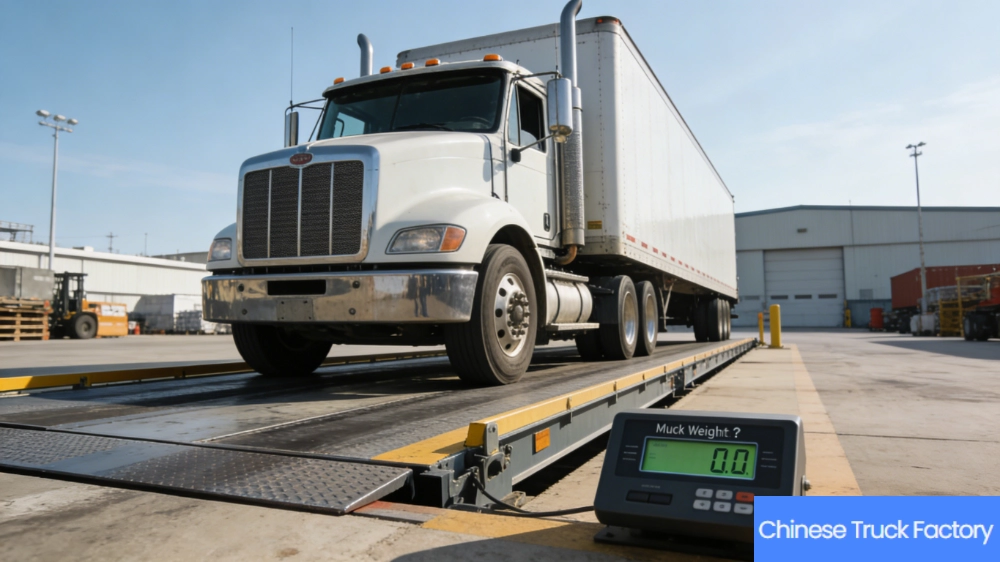
- CAT Scales: These are found at most major truck stops. For a small fee, you get a certified weight ticket showing your steer axle, drive axle, and trailer axle weights.
- Public Weigh Stations: While usually for enforcement, some allow you to weigh yourself when they aren’t busy (check local rules).
- On-Board Scales: Modern air-suspension trucks often have gauges that estimate weight based on suspension pressure. They are great for a quick check but trust a platform scale for the final say.
Expert Tips for Managing Truck Weight
Over the years, I’ve picked up a few tricks to help operators manage their weight better:
- Keep it Clean: It sounds silly, but mud and debris on a construction truck can add 500 lbs easily. Keep the undercarriage clean.
- Watch Fuel Levels: Diesel weighs about 7 lbs per gallon. A 300-gallon capacity adds over 2,000 lbs. If you are paid by the ton of cargo, maybe don’t fill the tanks 100% if you are running a short route.
- Aluminum vs. Steel: When buying trailers or wheels, aluminum options are more expensive upfront but save thousands of pounds in curb weight, allowing for more payload revenue.
Frequently Asked Questions (FAQ)
How much does a semi-truck engine weigh?
A typical Class 8 diesel engine weighs between 2,500 and 3,000 pounds. This includes the block, turbo, and attached components. It is a massive piece of iron, which contributes significantly to the steer axle weight.
What is the heaviest class of truck?
Class 8 is the heaviest standard on-road classification, with a GVWR exceeding 33,001 lbs. However, off-highway mining trucks fall outside standard classifications and can weigh over a million pounds fully loaded.
Does a sleeper cab weigh more than a day cab?
Yes, significantly. A sleeper cab adds extra frame length, body structure, and interior amenities (bed, cabinets, fridge). A sleeper cab can weigh 1,000 to 3,000 pounds more than a comparable day cab.
How much does a monster truck weigh?
While not a commercial vehicle, this is a popular question. Monster trucks are actually required to weigh a minimum of 10,000 pounds for safety stability, but most sit right around 12,000 pounds.
Final Thoughts
So, how much does a truck weigh? The answer lies in the specific configuration you are driving. Whether you are in a 5,000 lb pickup hauling lumber for a deck or behind the wheel of an 80,000 lb tractor-trailer combo, respecting the weight limits is vital.
As a manufacturer, my advice is always to buy more truck than you think you need. It is better to have a Class 5 truck running at 80% capacity than a Class 4 truck running at 105% capacity. The former will last you ten years; the latter will be in the shop next month.
If you are looking to expand your fleet or need specific advice on heavy-duty specs, feel free to explore our resources at Chinese Truck Factory. We are here to help you carry the load.