If you want the straight answer, most ready-mix trucks carry about 8 to 10 cubic yards of concrete in a normal working load, while some smaller mixers carry less and some larger units may be rated higher under the right setup. That said, the real answer to how many yards of concrete in a truck depends on truck size, drum design, legal weight limits, mix design, slump, route conditions, and how much safety margin the producer wants to keep. I’ve worked around truck specs, payload planning, and jobsite vehicle selection long enough to know that a number printed on a brochure is not the same thing as what shows up at your pour. If you are ordering concrete, buying a mixer, or comparing equipment, this guide will help you estimate truck concrete capacity, understand why load volume varies, and avoid the expensive mistake of assuming every concrete truck carries the same amount.
The short answer most people are looking for
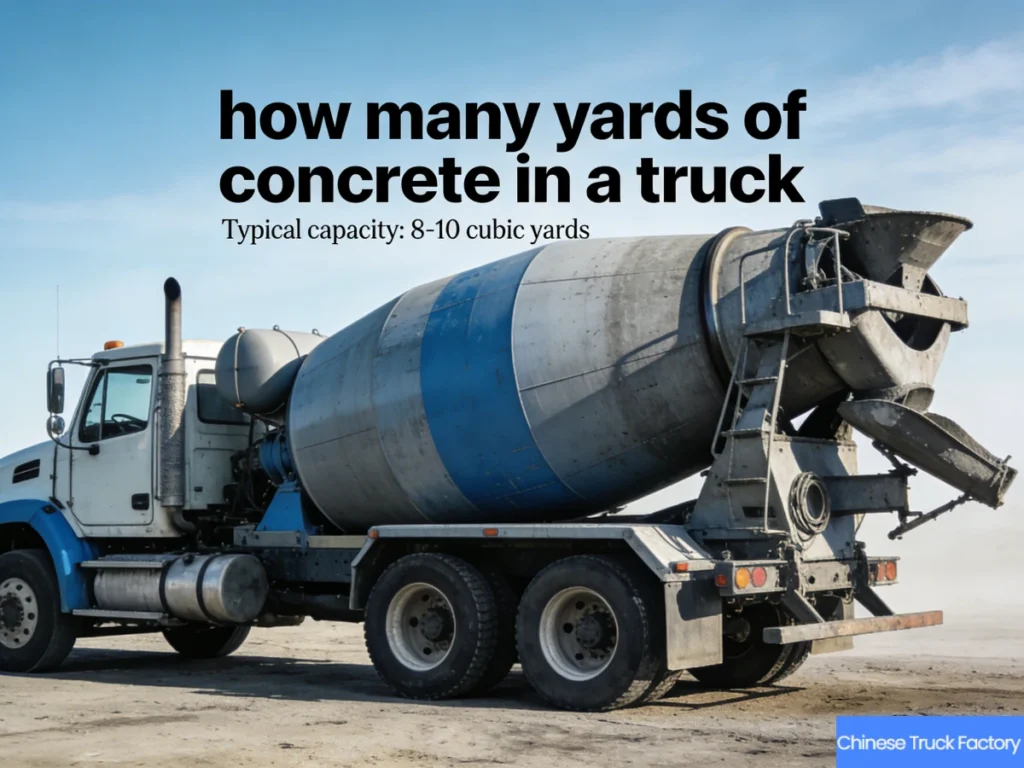
When someone searches how many yards of concrete in a truck, they usually want a fast number they can use for a slab, driveway, footing, wall, or small commercial pour. In everyday practice, the most common answer is that a standard ready-mix truck often delivers around 8 to 10 cubic yards. Smaller mixers can fall into the 3 to 6 yard range, and specialized or favorable setups may go above that.
That is the easy part. The harder part is knowing whether the truck can legally and safely haul that amount on your route and whether the plant is willing to dispatch the drum that full. A truck’s stated drum volume is not always the same as its practical delivery volume. That is why two contractors can order the same mix on different days and see slightly different load sizes.
In other words, if you are asking how many yards of concrete in a truck, do not stop at the nameplate. Ask about rated capacity, working capacity, loaded weight, and what the supplier normally ships. Those four details tell you far more than a headline number ever will.
Why truck size matters more than people think
I have seen plenty of buyers assume that a bigger-looking truck automatically means a bigger concrete payload. That is not always true. The practical load depends on drum geometry, chassis weight, axle layout, engine and frame spec, water carried onboard, and the concrete mix itself. A truck with a larger drum can still end up carrying less saleable concrete if the chassis is heavy or if the route forces tighter weight limits.
This is the part many articles skip. A concrete mixer is not simply a hollow barrel on wheels. The truck has to carry the drum, frame, fuel, water tank, driver, chute system, washout gear, and the weight of the fresh concrete. Normal-weight concrete is heavy. A cubic yard is not just volume on paper; it becomes a serious payload as soon as the drum starts turning.
According to an American Concrete Institute training reference, normal concrete weighs roughly 150 pounds per cubic foot, which comes out to about 4,050 pounds per cubic yard (Source: ACI). That single number explains why asking how many yards of concrete in a truck is really a payload question, not just a volume question.
If you multiply that weight by 8, 9, or 10 yards, you can see why truck size and weight rules shape what gets delivered. A few yards of difference is a major shift in axle loading, braking feel, and route flexibility. That is why experienced dispatchers care about your site access, not just your order total.
| Truck Class | Typical Practical Load | Common Use | Best Fit |
|---|---|---|---|
| Mini mixer | 3-4 yards | Short loads, tight access | Repairs, sidewalks, backyard work |
| Mid-size mixer | 5-7 yards | Residential and light commercial | Driveways, small slabs, footings |
| Standard mixer | 8-10 yards | General ready-mix delivery | Most everyday pours |
| Large-capacity setup | 10+ yards | Special routes or favorable regulations | High-volume dispatch efficiency |
What the drum says versus what the truck really delivers
One of the most useful lessons I learned early is that drum capacity and delivery capacity are not the same thing. A drum may be physically designed to hold a larger total volume, but that does not mean every cubic yard in that drum is usable concrete. The mixer needs headroom for agitation and mixing. Once a drum is too full, the material does not move correctly, and discharge consistency can suffer.
That is why many producers talk about “rated mixing capacity” and “rated agitating capacity” instead of throwing out one oversized number. A brochure can make a truck sound huge, but the real-world delivery number is usually the one that matters. If you are comparing quotes or trying to choose equipment, always ask for the actual working load range.
This is also where people get confused when researching how many yards of concrete in a truck. They may see one article mention 10 yards, another mention 11 or 12, and a third say 8. All of those numbers can be true depending on whether the writer is talking about physical drum size, legal payload, or common dispatch practice.
My rule is simple: if you are ordering concrete, use the supplier’s confirmed delivery volume. If you are buying trucks, use the truck’s practical payload under your own axle, body, and route conditions. If you are planning a fleet, use a range, not a single magic number.
The weight side of the equation changes everything
Fresh concrete gets heavy fast, which is why the best answer to how many yards of concrete in a truck always includes weight. Industry and regulatory discussions around mixer trucks keep coming back to the same point: concrete is dense, and ready-mix trucks often run into weight limitations before they run out of drum space.
The Portland Cement Association notes that a loaded ready-mix truck can be constrained by federal weight limits, and one of its published summaries points to a typical breakdown of about 30,000 pounds tare weight and roughly 20,000 pounds productive payload in certain compliance discussions (Source: PCA). That is why practical load size can land below what a drum theoretically holds.
FMCSA materials also show how closely commercial vehicle operation is tied to vehicle weight ratings and thresholds for truck classes and licensing. Even when the exact rules in your operating pattern differ, the larger point holds: you do not load concrete by volume alone. You load it by what the truck, route, and legal framework can support.
So when a buyer asks me how many yards of concrete in a truck, I often answer with another question: “Do you want the drum number, the dispatch number, or the legal number?” The gap between those three numbers is where most ordering mistakes begin.
- Volume limit: How much the drum can hold and still mix or agitate correctly
- Weight limit: How much the chassis and axle setup can carry safely
- Route limit: What the truck can legally travel with on actual roads
- Operational limit: What the producer is comfortable sending to avoid spills, delays, or rejected loads
How many yards of concrete in a truck by truck size
This is the section most readers came for, so I’ll keep it plain. If you are comparing truck size categories, here is the practical way I explain it.
Mini concrete mixer trucks
Mini mixers usually carry around 3 to 4 cubic yards, sometimes a little more depending on design. These are excellent for tight access, short loads, patch work, and smaller pours where sending a full-size truck would be wasteful or physically awkward. If a project has narrow approach roads, low overhangs, or limited turnaround space, a mini mixer can save the day.
I have seen mini mixers make a job smoother simply because they fit where nothing else could. That said, they are not magic. Per-yard delivery costs can be higher, and multiple trips can erase the convenience if the total pour volume is not planned carefully.
Mid-size concrete mixer trucks
Mid-size units often work in the 5 to 7 yard range. I like this category for residential builds, moderate slab work, and jobs where access is decent but not generous. It gives a useful balance between maneuverability and payload. For many contractors, this is the sweet spot when you want fewer trips without the bulk of a full-size rig.
If you keep asking how many yards of concrete in a truck because your site has awkward access, mid-size trucks deserve serious attention. They can lower stress on the pour day without sacrificing too much productivity.
Standard ready-mix trucks
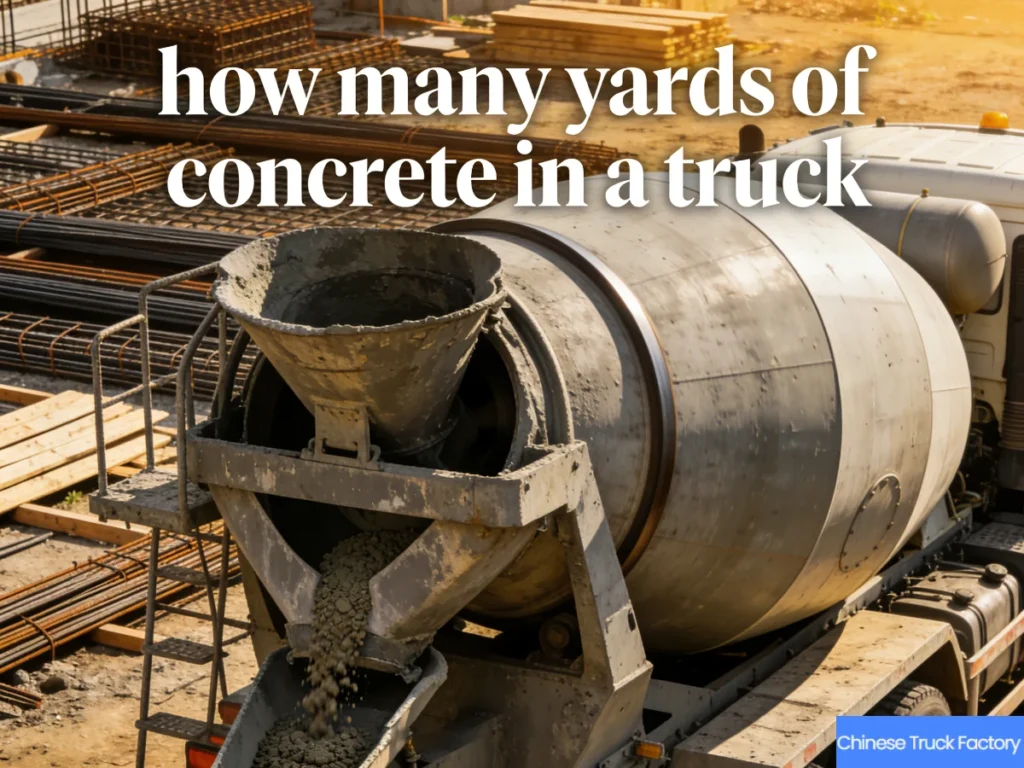
Standard mixers are where the familiar 8 to 10 yard answer comes from. These are the trucks most people picture when they think of ready-mix delivery. They are common because they balance daily productivity with practical road use, and they fit a wide range of routine orders.
When people in the field casually say, “a concrete truck holds 10 yards,” they are usually talking about this category. It is a decent rule of thumb, but it should still be treated as a rule of thumb, not a guarantee.
Large-capacity or special configurations
Some setups can move more than 10 yards under the right conditions. That may involve different regulations, favorable route planning, lighter chassis choices, or specific fleet configurations. But I never tell a buyer to assume that number unless the supplier or manufacturer confirms it for the exact truck and operating environment.
That distinction matters. Searching how many yards of concrete in a truck can lead you to numbers that are technically possible but operationally irrelevant for your job.
| Truck Size | Drum/Working Range | Approx. Concrete Weight Range | Typical Project Type |
|---|---|---|---|
| Mini mixer | 3-4 yd³ | 12,150-16,200 lb | Repairs, patios, small pours |
| Mid-size mixer | 5-7 yd³ | 20,250-28,350 lb | Driveways, footings, small structures |
| Standard mixer | 8-10 yd³ | 32,400-40,500 lb | General delivery and larger slabs |
| Large/special setup | 10+ yd³ | 40,500+ lb | High-volume dispatch under suitable conditions |
How to estimate truck concrete capacity for your own project
If your real concern is not the truck itself but whether one truck is enough for your pour, use a simple workflow. I still do this on scratch paper before I trust any order sheet.
Step 1: Calculate total concrete volume
Multiply length × width × thickness in feet, then divide by 27 to convert cubic feet into cubic yards. That tells you how much concrete the job needs before waste, grade variation, and over-excavation are considered.
Step 2: Add a realistic overage
I usually plan an extra 5% to 10% depending on how controlled the site is. The rougher the grade, the more cautious I get. Running short in the middle of a pour is far worse than returning a little unused concrete.
Step 3: Compare that total with realistic truck loads
If the job needs 9.2 yards after overage, do not assume one truck unless the supplier confirms it. If the site is steep, restricted, or weight-sensitive, the delivered load may land below the headline figure. This is exactly why the phrase how many yards of concrete in a truck has to be paired with route and dispatch reality.
Step 4: Think about pour sequence
Two smaller trucks arriving in a controlled sequence can be better than one heavily loaded truck and a late short-load backup. The right dispatch pattern often matters more than squeezing every last yard into a single drum.
| Pour Example | Size | Calculated Volume | Order With Overage | Suggested Truck Plan |
|---|---|---|---|---|
| Small patio | 12′ × 16′ × 4″ | 2.37 yd³ | 2.6 yd³ | Mini mixer or short load |
| Driveway | 18′ × 40′ × 5″ | 11.11 yd³ | 11.7-12.2 yd³ | Two loads or one full plus top-up |
| Garage slab | 24′ × 24′ × 4″ | 7.11 yd³ | 7.5-7.8 yd³ | One mid-size or standard load |
| Footings | Project-specific | Varies | Add waste margin | Sequence by placement speed |
What changes the actual load on delivery day
I wish more buyers understood this part before calling suppliers. The number you hear on the phone can shift on delivery day because several variables change what the truck can or should carry.
Concrete mix design
Not every cubic yard behaves the same. Mixes with different aggregate blends, moisture conditions, and performance targets can affect both weight and workability. When the mix gets heavier or needs different handling characteristics, practical delivery volume may change.
Slump and added water
Some crews still think added water is just a field convenience. It is not that simple. Water changes consistency, and excessive changes can affect performance. It also changes how material moves in the drum. A supplier managing quality will not treat every mix the same.
Distance to the site
Longer hauls make dispatchers more cautious. They are balancing travel time, drum speed, temperature, jobsite waiting time, and discharge performance. On paper, the truck may hold one number. In real scheduling, the dispatched load may be trimmed for reliability.
Access and terrain
A steep driveway, muddy entrance, soft shoulder, or limited backing room can change truck choice fast. This is why the question how many yards of concrete in a truck cannot be separated from where that truck has to go. A truck that is perfect for a plant yard may be terrible for your property or work zone.
Legal and axle limits
The last mile often decides the load. A route with tighter bridges, posted roads, or awkward local restrictions may lower the workable payload. The truck might physically carry more, but the dispatcher still has to get it to you without creating a headache.
- Mix density and aggregate type
- Truck tare weight and axle configuration
- Onboard water and fuel
- Road conditions and distance
- Plant dispatch policy
- Weather and expected wait time
The mistake I see most often when people order concrete
The most common mistake is treating truck capacity like a fixed number instead of a working range. Someone calculates the slab, sees a total near 10 yards, and assumes one truck will cover it. Then the site is slower than expected, the grade is slightly off, the forms eat more concrete than planned, and the last section comes up short.
I have watched that mistake turn a routine pour into a stressful scramble. A crew that planned for one load suddenly needs a short-load follow-up, waits too long, and ends up with a cold joint risk they could have avoided with better planning. The problem did not start with bad finishing. It started with a lazy answer to how many yards of concrete in a truck.
The fix is not complicated. Build in overage, verify the truck class, confirm practical delivered volume, and ask the supplier what they normally send for a similar order. That last question is gold because it gets you out of brochure language and into field reality.
Whenever I help someone think through truck selection, I would rather be slightly conservative on planning than perfectly wrong on paper. Concrete punishes false precision.
My practical rule for choosing the right truck size
If the project is straightforward and access is wide open, I start by matching the estimated order to the number of standard loads it would take. Then I stress-test that assumption. Can the truck enter, turn, and discharge cleanly? Is the route weight-sensitive? Is the crew ready to place the entire load without delay? If any of those answers feel shaky, I step down the truck size or split the delivery.
For smaller or more constrained jobs, I lean toward mini or mid-size mixers because maneuverability solves problems before they happen. Yes, a larger truck may look more efficient on paper, but efficiency disappears the moment a driver cannot get close enough to place safely.
For buyers evaluating equipment instead of ordering ready-mix, I use the same mindset. Do not buy the biggest mixer just because the headline payload sounds attractive. Buy the truck that fits your work pattern, road environment, maintenance capability, and customer order profile. Capacity is only valuable when it can be used consistently.
If your business is in construction transport or fleet sourcing, this is also where supplier quality matters. A manufacturer that understands payload planning, chassis balance, and working applications is far more useful than one that only throws out a big capacity number.
Where truck buyers should pay attention to the chassis, not just the mixer drum
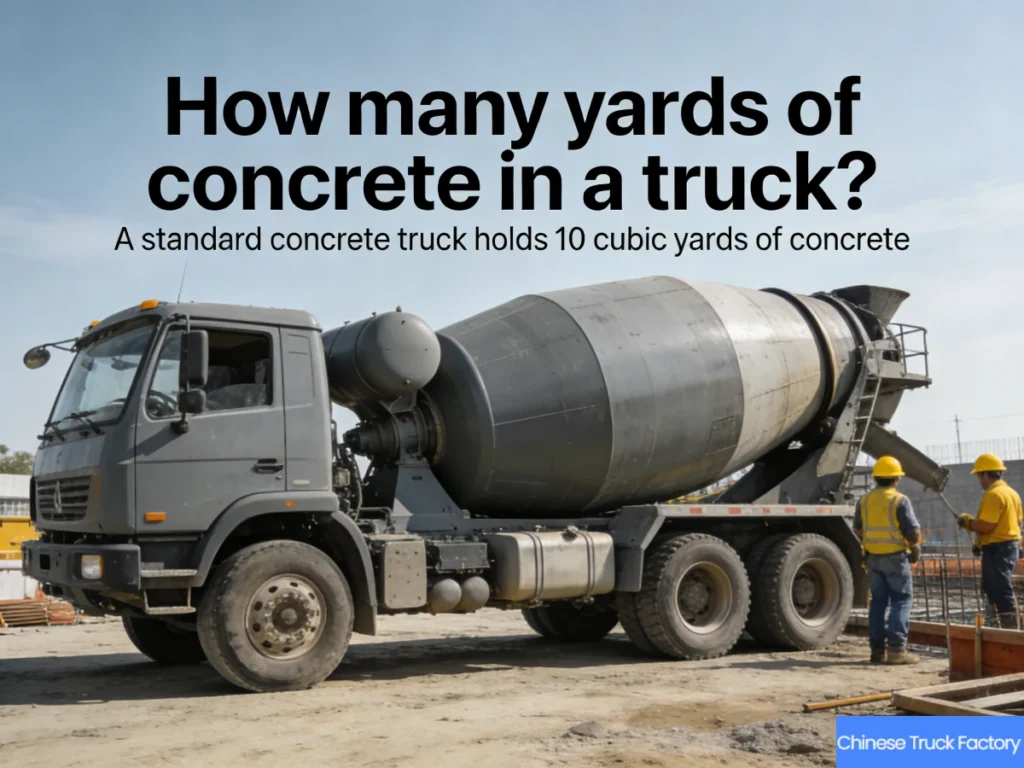
This is a point I care about a lot because buyers often focus on the drum and ignore the truck underneath it. The chassis controls durability, stability, service life, operating cost, and real payload potential. If you are sourcing trucks for construction work, mixer performance starts with the platform carrying it.
That is one reason I recommend looking at heavy-duty construction vehicle solutions before narrowing down a mixer specification. It helps to understand how the truck is built for duty cycle, jobsite abuse, and weight handling instead of judging the vehicle by the drum alone.
I also like comparing mixer discussions with broader truck weight references, because it gives buyers context for payload reality. A useful starting point is this guide on how much a truck weighs. It gives non-specialists a better feel for why concrete delivery capacity is never just a volume conversation.
For fleets that want to compare sourcing options more broadly, Chinese Truck Factory is worth reviewing as a truck manufacturing resource, especially when the goal is to match application needs with working vehicle specifications rather than buying on appearance alone.
A real-world planning example from the way I would handle it
Let’s say I am planning a 30-foot by 40-foot slab at 5 inches thick. First, I calculate the volume. That works out to about 18.52 cubic yards before overage. On a clean site with dependable grading, I might bump that into the 19.5 to 20 yard range. Now the truck conversation starts.
If I lazily assume every truck delivers 10 yards, I book two trucks and call it done. But I do not like that plan unless I know the site and supplier well. If the access is tight, if the haul is long, or if the supplier’s standard loads come in closer to 9 yards, the pour sequence changes immediately. Now I am thinking two fuller loads plus a top-up, or one mid-size and two standard arrivals timed more carefully.
This is why the search phrase how many yards of concrete in a truck often hides a more important question: How should I schedule the pour so the concrete keeps moving without creating waste or delay? That is the real operational question behind the keyword.
When I approach it that way, I do not just ask for truck size. I ask for delivery pattern, discharge speed, backup planning, and site fit. A great pour is rarely about a single truck. It is about the entire sequence working the first time.
How this topic matters if you manufacture or source trucks
If you are on the truck manufacturing or export side, the keyword how many yards of concrete in a truck is not just an educational topic. It is also a buyer-intent topic. People searching this phrase are often trying to decide between truck sizes, compare mixer configurations, or understand whether a supplier’s claim sounds realistic. That means the article should not stop at “8 to 10 yards” and move on.
Serious buyers want to know what affects payload, what a standard concrete truck capacity really means, and how a particular chassis supports that load. They also want to understand trade-offs among maneuverability, legal weight, fuel efficiency, maintenance access, and jobsite durability.
If that is your audience, it helps to naturally guide them toward related resources instead of forcing a hard sell. For example, someone evaluating construction transport equipment may also want to compare dump truck manufacturers direct sales or review specialized application options through construction dump truck manufacturers. Those pages fit naturally because they stay close to the same operational mindset.
That kind of internal path works because it reflects how real buyers think. They do not research one vehicle in isolation. They compare whole equipment categories that support the same kind of work.
Common myths that confuse buyers and contractors
“Every concrete truck holds 10 yards.”
No. Many standard trucks commonly deliver around that range, but not every truck, every route, or every mix leads to the same payload.
“If the drum is big enough, the load is big enough.”
>
When people in the field casually say, “a concrete truck holds 10 yards,” they are usually talking about this category. It is a decent rule of thumb, but it should still be treated as a rule of thumb, not a guarantee.
Large-capacity or special configurations
Some setups can move more than 10 yards under the right conditions. That may involve different regulations, favorable route planning, lighter chassis choices, or specific fleet configurations. But I never tell a buyer to assume that number unless the supplier or manufacturer confirms it for the exact truck and operating environment.
That distinction matters. Searching how many yards of concrete in a truck can lead you to numbers that are technically possible but operationally irrelevant for your job.
| Truck Size | Drum/Working Range | Approx. Concrete Weight Range | Typical Project Type |
|---|---|---|---|
| Mini mixer | 3-4 yd³ | 12,150-16,200 lb | Repairs, patios, small pours |
| Mid-size mixer | 5-7 yd³ | 20,250-28,350 lb | Driveways, footings, small structures |
| Standard mixer | 8-10 yd³ | 32,400-40,500 lb | General delivery and larger slabs |
| Large/special setup | 10+ yd³ | 40,500+ lb | High-volume dispatch under suitable conditions |
How to estimate truck concrete capacity for your own project
If your real concern is not the truck itself but whether one truck is enough for your pour, use a simple workflow. I still do this on scratch paper before I trust any order sheet.
Step 1: Calculate total concrete volume
Multiply length × width × thickness in feet, then divide by 27 to convert cubic feet into cubic yards. That tells you how much concrete the job needs before waste, grade variation, and over-excavation are considered.
Step 2: Add a realistic overage
I usually plan an extra 5% to 10% depending on how controlled the site is. The rougher the grade, the more cautious I get. Running short in the middle of a pour is far worse than returning a little unused concrete.
Step 3: Compare that total with realistic truck loads
If the job needs 9.2 yards after overage, do not assume one truck unless the supplier confirms it. If the site is steep, restricted, or weight-sensitive, the delivered load may land below the headline figure. This is exactly why the phrase how many yards of concrete in a truck has to be paired with route and dispatch reality.
Step 4: Think about pour sequence
Two smaller trucks arriving in a controlled sequence can be better than one heavily loaded truck and a late short-load backup. The right dispatch pattern often matters more than squeezing every last yard into a single drum.
| Pour Example | Size | Calculated Volume | Order With Overage | Suggested Truck Plan |
|---|---|---|---|---|
| Small patio | 12′ × 16′ × 4″ | 2.37 yd³ | 2.6 yd³ | Mini mixer or short load |
| Driveway | 18′ × 40′ × 5″ | 11.11 yd³ | 11.7-12.2 yd³ | Two loads or one full plus top-up |
| Garage slab | 24′ × 24′ × 4″ | 7.11 yd³ | 7.5-7.8 yd³ | One mid-size or standard load |
| Footings | Project-specific | Varies | Add waste margin | Sequence by placement speed |
What changes the actual load on delivery day
I wish more buyers understood this part before calling suppliers. The number you hear on the phone can shift on delivery day because several variables change what the truck can or should carry.
Concrete mix design
Not every cubic yard behaves the same. Mixes with different aggregate blends, moisture conditions, and performance targets can affect both weight and workability. When the mix gets heavier or needs different handling characteristics, practical delivery volume may change.
Slump and added water
Some crews still think added water is just a field convenience. It is not that simple. Water changes consistency, and excessive changes can affect performance. It also changes how material moves in the drum. A supplier managing quality will not treat every mix the same.
Distance to the site
Longer hauls make dispatchers more cautious. They are balancing travel time, drum speed, temperature, jobsite waiting time, and discharge performance. On paper, the truck may hold one number. In real scheduling, the dispatched load may be trimmed for reliability.
Access and terrain
A steep driveway, muddy entrance, soft shoulder, or limited backing room can change truck choice fast. This is why the question how many yards of concrete in a truck cannot be separated from where that truck has to go. A truck that is perfect for a plant yard may be terrible for your property or work zone.
Legal and axle limits
The last mile often decides the load. A route with tighter bridges, posted roads, or awkward local restrictions may lower the workable payload. The truck might physically carry more, but the dispatcher still has to get it to you without creating a headache.
- Mix density and aggregate type
- Truck tare weight and axle configuration
- Onboard water and fuel
- Road conditions and distance
- Plant dispatch policy
- Weather and expected wait time
The mistake I see most often when people order concrete
The most common mistake is treating truck capacity like a fixed number instead of a working range. Someone calculates the slab, sees a total near 10 yards, and assumes one truck will cover it. Then the site is slower than expected, the grade is slightly off, the forms eat more concrete than planned, and the last section comes up short.
I have watched that mistake turn a routine pour into a stressful scramble. A crew that planned for one load suddenly needs a short-load follow-up, waits too long, and ends up with a cold joint risk they could have avoided with better planning. The problem did not start with bad finishing. It started with a lazy answer to how many yards of concrete in a truck.
The fix is not complicated. Build in overage, verify the truck class, confirm practical delivered volume, and ask the supplier what they normally send for a similar order. That last question is gold because it gets you out of brochure language and into field reality.
Whenever I help someone think through truck selection, I would rather be slightly conservative on planning than perfectly wrong on paper. Concrete punishes false precision.
My practical ru ::contentReference[oaicite:1]{index=1} e for choosing the right truck size
If the project is straightforward and access is wide open, I start by matching the estimated order to the number of standard loads it would take. Then I stress-test that assumption. Can the truck enter, turn, and discharge cleanly? Is the route weight-sensitive? Is the crew ready to place the entire load without delay? If any of those answers feel shaky, I step down the truck size or split the delivery.
For smaller or more constrained jobs, I lean toward mini or mid-size mixers because maneuverability solves problems before they happen. Yes, a larger truck may look more efficient on paper, but efficiency disappears the moment a driver cannot get close enough to place safely.
For buyers evaluating equipment instead of ordering ready-mix, I use the same mindset. Do not buy the biggest mixer just because the headline payload sounds attractive. Buy the truck that fits your work pattern, road environment, maintenance capability, and customer order profile. Capacity is only valuable when it can be used consistently.
If your business is in construction transport or fleet sourcing, this is also where supplier quality matters. A manufacturer that understands payload planning, chassis balance, and working applications is far more useful than one that only throws out a big capacity number.
Where truck buyers should pay attention to the chassis, not just the mixer drum
This is a point I care about a lot because buyers often focus on the drum and ignore the truck underneath it. The chassis controls durability, stability, service life, operating cost, and real payload potential. If you are sourcing trucks for construction work, mixer performance starts with the platform carrying it.
That is one reason I recommend looking at heavy-duty construction vehicle solutions before narrowing down a mixer specification. It helps to understand how the truck is built for duty cycle, jobsite abuse, and weight handling instead of judging the vehicle by the drum alone.
I also like comparing mixer discussions with broader truck weight references, because it gives buyers context for payload reality. A useful starting point is this guide on how much a truck weighs. It gives non-specialists a better feel for why concrete delivery capacity is never just a volume conversation.
For fleets that want to compare sourcing options more broadly, Chinese Truck Factory is worth reviewing as a truck manufacturing resource, especially when the goal is to match application needs with working vehicle specifications rather than buying on appearance alone.
A real-world planning example from the way I would handle it
Let’s say I am planning a 30-foot by 40-foot slab at 5 inches thick. First, I calculate the volume. That works out to about 18.52 cubic yards before overage. On a clean site with dependable grading, I might bump that into the 19.5 to 20 yard range. Now the truck conversation starts.
If I lazily assume every truck delivers 10 yards, I book two trucks and call it done. But I do not like that plan unless I know the site and supplier well. If the access is tight, if the haul is long, or if the supplier’s standard loads come in closer to 9 yards, the pour sequence changes immediately. Now I am thinking two fuller loads plus a top-up, or one mid-size and two standard arrivals timed more carefully.
This is why the search phrase how many yards of concrete in a truck often hides a more important question: How should I schedule the pour so the concrete keeps moving without creating waste or delay? That is the real operational question behind the keyword.
When I approach it that way, I do not just ask for truck size. I ask for delivery pattern, discharge speed, backup planning, and site fit. A great pour is rarely about a single truck. It is about the entire sequence working the first time.
How this topic matters if you manufacture or source trucks
If you are on the truck manufacturing or export side, the keyword how many yards of concrete in a truck is not just an educational topic. It is also a buyer-intent topic. People searching this phrase are often trying to decide between truck sizes, compare mixer configurations, or understand whether a supplier’s claim sounds realistic. That means the article should not stop at “8 to 10 yards” and move on.
Serious buyers want to know what affects payload, what a standard concrete truck capacity really means, and how a particular chassis supports that load. They also want to understand trade-offs among maneuverability, legal weight, fuel efficiency, maintenance access, and jobsite durability.
If that is your audience, it helps to naturally guide them toward related resources instead of forcing a hard sell. For example, someone evaluating construction transport equipment may also want to compare dump truck manufacturers direct sales or review specialized application options through construction dump truck manufacturers. Those pages fit naturally because they stay close to the same operational mindset.
That kind of internal path works because it reflects how real buyers think. They do not research one vehicle in isolation. They compare whole equipment categories that support the same kind of work.
Common myths that confuse buyers and contractors
“Every concrete truck holds 10 yards.”
No. Many standard trucks commonly deliver around that range, but not every truck, every route, or every mix leads to the same payload.
“If the drum is big enough, the load is big enough.”
Also no. Physical drum size does not cancel out axle limits, tare weight, or dispatch policy. Working volume is what matters.
“A bigger truck always saves money.”
Sometimes, but not always. A bigger truck that cannot access the site, takes longer to place, or creates scheduling issues can cost more overall.
“You can just top it off with extra water if needed.”
That mindset causes more trouble than it solves. Consistency, performance, and specification compliance matter. Water is not a free fix.
“If my calculation says 10 yards, I only need one truck.”
That is one of the most expensive assumptions in concrete work. Always think in terms of confirmed practical loads, not idealized math.
How I would explain truck concrete capacity to a first-time buyer
If a first-time buyer asked me how many yards of concrete in a truck, I would say this: “Most full-size ready-mix trucks commonly deliver around 8 to 10 cubic yards, but you should never order based on that number alone. Start with your project volume, add overage, then confirm what the supplier actually delivers on your route.”
I would also explain that a smaller truck is not automatically a worse option. On the right job, a smaller mixer is the smarter choice because it fits the site, reduces risk, and keeps the pour controlled. The best truck is not the biggest truck. It is the one that gets the concrete where it needs to go without creating new problems.
That is the kind of answer people remember because it is usable. It respects the keyword, but it also answers the question behind the keyword. In my experience, that is what makes content genuinely helpful instead of just optimized.
Simple checklist before you order or spec the truck
- Calculate total concrete volume in cubic yards
- Add a realistic overage for field conditions
- Confirm site access, grade, and turnaround room
- Ask the supplier for practical delivered load, not just rated drum size
- Check whether the route or site creates weight limitations
- Match truck size to placement speed and crew readiness
- Plan backup loads before the pour starts
- If buying equipment, evaluate the chassis as carefully as the mixer drum
Why this article’s answer is more useful than a one-line number
A lot of content on this topic stops after one sentence: “A concrete truck holds 10 yards.” That line is easy to remember, but it is incomplete. The real value comes from understanding why that number changes and how to use it in planning. The same truck category can behave differently depending on mix weight, road limits, dispatch practice, and jobsite access.
So yes, the keyword answer matters. People still want to know how many yards of concrete in a truck. But the helpful answer is this: most common full-size trucks deliver around 8 to 10 cubic yards, smaller trucks often carry 3 to 7 yards, and actual capacity depends on truck size, working rating, and weight conditions.
That is the answer I trust because it lines up with how real projects work. It gives the reader a useful benchmark without pretending every truck is identical.
Frequently Asked Questions
How many yards of concrete in a standard truck?
A standard ready-mix truck commonly delivers about 8 to 10 cubic yards in practical use. The exact amount varies by drum rating, chassis weight, local route limits, and mix design.
How many cubic yards are in a small concrete truck?
Small or mini mixer trucks often carry around 3 to 4 cubic yards, while mid-size units may carry about 5 to 7 cubic yards. They are useful for tight access and smaller pours.
How much does one yard of concrete weigh?
Normal-weight concrete is roughly 150 pounds per cubic foot, which equals about 4,050 pounds per cubic yard. That is why payload and road limits affect truck capacity so much.
Can a concrete truck carry 12 yards?
Some special or favorable setups can reach that range, but you should never assume it. Always confirm the truck’s practical delivered load for the route and the exact mix being ordered.
How do I know how many trucks I need for my pour?
Calculate total cubic yards, add an overage margin, then divide by the supplier’s confirmed practical delivery volume per truck. It is safer to plan by confirmed working loads than by nameplate claims.
Is truck mixer drum size the same as delivery capacity?
No. Drum size may describe the physical mixer, but delivery capacity is shaped by workable mixing volume, vehicle weight, axle layout, and operating conditions.
Quick takeaways
- Most full-size ready-mix trucks commonly deliver about 8 to 10 cubic yards.
- Mini and mid-size trucks usually fall in the 3 to 7 yard range.
- The best answer to how many yards of concrete in a truck always depends on truck size and weight limits.
- Fresh concrete is heavy, so payload is often limited by weight before drum space is fully used.
- For real projects, use confirmed practical delivery volume, not just advertised capacity.
- If you are buying trucks, evaluate the chassis, axle setup, and application fit as carefully as the drum.
Sources
- American Concrete Institute: Laws and Principles of Concrete Mixture Design
- Portland Cement Association: Truck Weights
- FMCSA: Commercial Driver License Weight Class Overview
- American Concrete Institute: Concrete Codes and Standards Overview
Author note
This article is written from a hands-on truck and payload planning perspective for readers comparing mixer sizes, evaluating delivery expectations, or researching vehicle sourcing. Figures and examples are practical planning references and should be confirmed against your actual supplier specifications, road conditions, and operating requirements before purchase or dispatch.