If you are managing a municipal route or analyzing fleet efficiency, the most critical number in your logistics planning isn’t just fuel mileage—it’s total payload capacity. The question of how many bins fit in a garbage truck dictates your route density, labor costs, and the “tipping” frequency at the landfill.
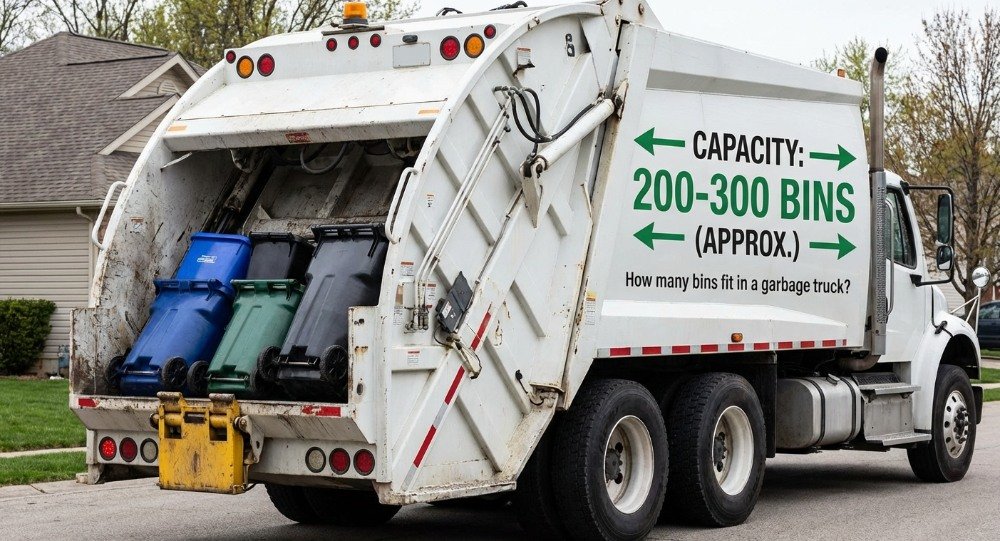
The short answer? A standard 25-cubic yard rear loader can typically service between 800 to 1,200 residential homes (standard 96-gallon carts) before needing to offload. However, this number fluctuates wildly based on the “Golden Three” variables: the truck’s body volume, the compaction ratio of the hydraulic system, and the density of the waste stream.
In this guide, we strip away the guesswork. We will break down the mathematics of compaction, compare different chassis configurations, and provide actionable data to help you optimize your waste management operations.
The Core Math: Cubic Yards vs. Gallons
To understand how many bins fit in a garbage truck, we first need to align our units of measurement. In the United States, truck bodies are measured in cubic yards, while residential bins (carts) are measured in gallons. This mismatch often leads to calculation errors in fleet planning.
Here is the base conversion you need to memorize:
- 1 Cubic Yard = 201.97 Gallons (We usually round this to 202 gallons for field math).
If we look at a theoretical scenario without compaction, a 25-cubic yard truck body holds roughly 5,050 gallons of air/space. If you were tossing in empty, uncrushed milk jugs, you wouldn’t fit much. This is why the hydraulic system is the heart of the operation. Without compaction, a massive truck would be full after just 50 homes. Understanding this volume conversion is the first step in mastering waste management solutions for your city or private route.
The Compaction Ratio: The “Magic” Multiplier
The gross volume of the truck is irrelevant without knowing the compaction force. The blade (or packer panel) exerts thousands of pounds of pressure per square inch (PSI) to densify the refuse.
Standard Industry Ratios
- Residential Waste (MSW): Typically achieves a ratio of 3:1 to 4:1. This means 3 cubic yards of loose trash are squeezed into 1 cubic yard of space.
- Recycling: Lower ratios, around 2:1, to prevent glass breakage or material contamination.
- Industrial/Construction: Varies significantly based on material, but heavy-duty hydraulics can push higher.
The Calculation Formula:
(Truck Cubic Yards × 202 Gallons × Compaction Ratio) ÷ Bin Size = Total Bins
For a deeper technical look at how hydraulic systems achieve these pressures, you can review our guide on how trash compactors work.
Truck Configurations and Capacity Limits
Not all trucks are created equal. The answer to how many bins fit in a garbage truck changes depending on whether you are running a side loader in the suburbs or a rear loader in a dense alleyway.
1. Rear Loaders (The Workhorse)
Rear loaders are the most common vehicles for mixed routes. They typically range from 18 to 32 cubic yards. Because they have a large hopper and powerful sweep blades, they handle high compaction rates well.
Capacity Estimate: A 25-yard rear loader usually services 800-1000 homes per load. Operators looking for reliable chassis for these bodies often compare various rear loader refuse truck manufacturers to find the best balance of torque and payload.
2. Automated Side Loaders (ASL)
Designed for speed and single-operator efficiency. These trucks use a mechanical arm to grab 96-gallon carts. While efficient, the packing mechanism sometimes achieves slightly lower density than a rear loader because the packing cycle happens while the truck is moving to the next stop.
Capacity Estimate: A 28-yard ASL can handle roughly 1,000-1,200 carts on a good day, assuming standard household waste density.
3. Front Loaders
These are primarily commercial trucks lifting 2 to 8-yard metal dumpsters. We calculate their capacity differently (in “yards” rather than “bins”). A 40-yard front loader body can compact about 160-200 yards of loose commercial waste.
Field Note: While weight limits (GVWR) are often the legal ceiling before volume limits, modern lightweight bodies allow you to pack more volume without hitting DOT weight fines. Always check your local bridge laws.
Standard Bin Sizes Breakdown
To get an accurate count, you must know what your customers are rolling out to the curb.
- 96-Gallon Cart: The US standard for single-family homes. Holds ~4-5 kitchen bags.
- 64-Gallon Cart: Common for recycling or smaller households.
- 35-Gallon Cart: Used in dense urban areas or for senior rates.
The “Set-Out” Rate Factor:
Just because a home has a 96-gallon bin doesn’t mean it’s full. The industry average “set-out” volume is often around 60-70% full. For safety margins, however, fleet managers usually calculate based on 100% capacity to avoid overflowing trucks mid-route.
Data Table: Estimated Capacity Cheat Sheet
The following table assumes a standard 3:1 compaction ratio and 100% full bins (worst-case scenario planning). This helps answer how many bins fit in a garbage truck at a glance.
| Truck Body Size (Cubic Yards) | Compaction Ratio | Total Capacity (Gallons) | 96-Gallon Bins (Approx) | 64-Gallon Bins (Approx) |
|---|---|---|---|---|
| 16 yd (Mini) | 3:1 | 9,696 | 101 | 151 |
| 20 yd (Mid-Size) | 3:1 | 12,120 | 126 | 189 |
| 25 yd (Standard) | 3:1 | 15,150 | 158* | 236* |
| 32 yd (Heavy Duty) | 3:1 | 19,392 | 202* | 303* |
*Note: The numbers above represent the mathematical volume of full uncompacted bins fitting into the compacted space. However, in reality, household trash is already loose. Real-world experience shows that a 25-yard packer effectively services 800+ homes because the trash inside the bins is loose and compresses massively (often 10:1 from the kitchen bag to the landfill face). The table above is strictly volume-to-volume math, but operational reality is much higher.
Factors That Kill Efficiency
Why do some trucks fill up faster than others? It usually comes down to three operational issues:
- Hydraulic Health: If your pump pressure is low, your compaction ratio drops from 4:1 to 2:1, effectively cutting your route in half. Regular maintenance of the sanitation vehicle hydraulics is non-negotiable.
- Wet Waste: Rain-soaked cardboard or high organic content (food waste) doesn’t compress; it squishes. It also adds massive weight, causing you to “weigh out” before you “cube out.”
- Bulky Items: A single sofa or mattress thrown into a rear loader can create “void spaces” in the body that the blade cannot fill, wasting valuable cubic yardage.
Choosing the Right Equipment for Your Route
Maximizing bin count isn’t just about math; it’s about hardware. The US market is seeing a shift toward more modular, durable truck bodies that can handle higher pressures. However, the cost of domestic chassis has skyrocketed.
For fleet operators and independent contractors looking to balance budget with high-performance specs, looking at global supply chains is becoming a smart move. Companies like Chinese Truck Factory provide heavy-duty chassis and specialized bodies that meet international safety standards while offering competitive pricing.
Whether you need a specialized new garbage truck manufacturer alternative or robust specialized vehicles for specific industrial waste, sourcing from established global manufacturers can significantly lower your Cost Per Mile (CPM).
For specific inquiries on custom builds compatible with US-style bins, you can explore options at Chinese Truck Factory.
Frequently Asked Questions
How many bins fit in a 25-yard garbage truck?
In a real-world residential route, a 25-yard garbage truck with a standard compaction ratio of 3:1 can service approximately 800 to 1,000 homes using 96-gallon carts. This assumes the waste is typical household refuse. If the waste is loose and dry, the number can go higher.
What is the compaction ratio of a standard garbage truck?
Most residential rear loaders and side loaders operate at a compaction ratio between 3:1 and 4:1. This means they can compress 1,000 pounds of loose trash into a space that would normally only hold 250-300 pounds. High-efficiency industrial compactors can reach ratios of 6:1.
Does wet weather affect garbage truck capacity?
Yes. Wet waste is denser and heavier. While it doesn’t necessarily take up more volume, it increases the vehicle’s weight. Drivers will often hit the legal weight limit (GVWR) before the truck is physically full of bins during rainy seasons.
Conclusion
Answering how many bins fit in a garbage truck is an exercise in dynamic logistics. While the math suggests a strict volume limit, the efficiency of your packer blade and the type of waste collected are the real deciding factors. For most operators, planning for 800-1,000 homes per 25-yard load is a safe baseline.
As the industry evolves, ensuring you have reliable, high-compaction equipment is the only way to maintain profitability. Whether you are running a single truck or a municipal fleet, always prioritize equipment that delivers consistent hydraulic pressure to maximize every inch of payload.