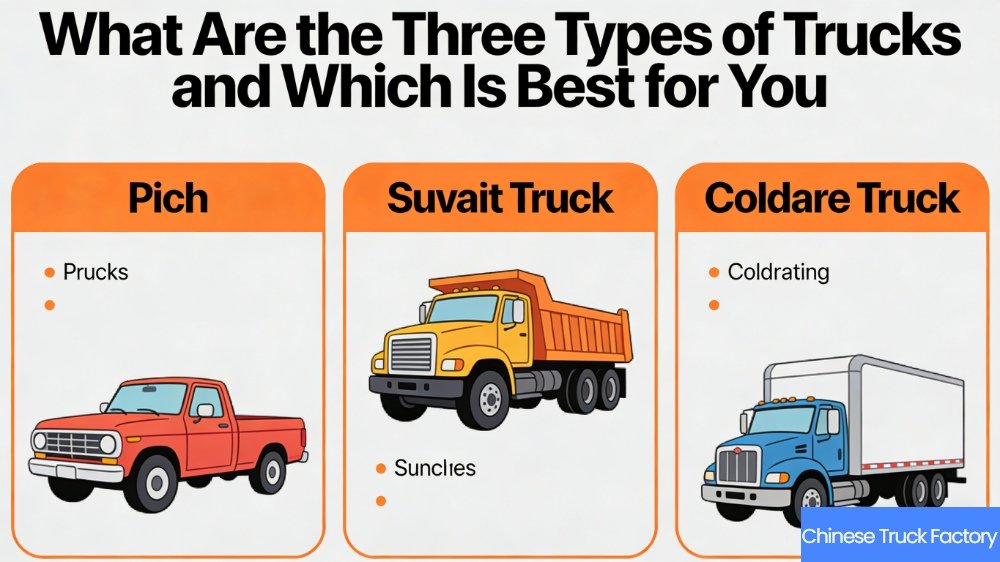
If you’re weighing work demands against budget and uptime, the answer to what are the three types of trucks is simple: light-duty, medium-duty, and heavy-duty. Each category matches a different use case—daily driving and small payloads, regional delivery and vocational bodies, or maximum towing and construction-grade hauling. This guide shows how each type performs, what it costs to run, and a step-by-step framework to pick the best fit for your payload, range, and terrain.
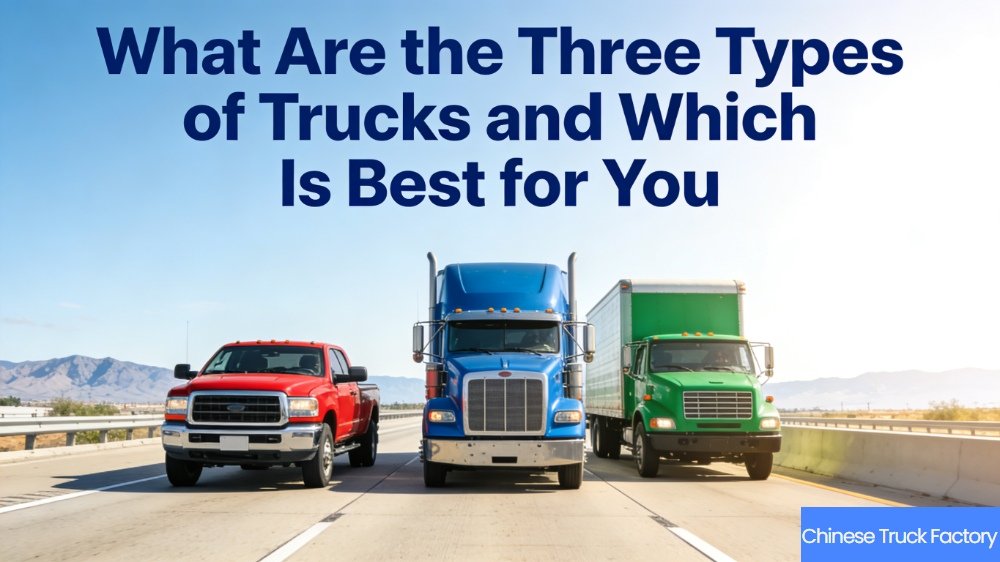
How Truck Categories Work at a Glance
Understanding what are the three types of trucks starts with total weight a truck is designed to carry. That weight determines frame strength, brakes, tires, and engine. In plain terms:
- Light-duty: Everyday use and small loads.
- Medium-duty: Regional distribution and vocational bodies (box, flatbed, utility).
- Heavy-duty: Maximum payloads, long-haul, and off-road job sites.
Quick Comparison Table
| Category | Typical Use | Body/Upfit Options | Typical Payload | Towing/GCWR | Ride & Maneuverability | Service Interval Tendencies |
|---|---|---|---|---|---|---|
| Light-duty | Daily driving, light contracting | Pickup bed, light rack, tonneau | Low to moderate | Moderate | Most car-like | Shorter, easier service |
| Medium-duty | Box/reefer, flatbed, utility, city dump | Box, stake, service body, small dump | Moderate to high | High | Balanced vs. capability | Planned intervals, vocational parts |
| Heavy-duty | Long-haul, construction, tanker, large dump | Tractor, mixer, heavy dump, tanker | Very high | Very high | Purpose-built | Managed by fleet maintenance |
Image suggestion
file: truck-types-comparison-infographic.png
alt: Chart comparing light-, medium-, and heavy-duty truck capabilities
Light-Duty: For Daily Use With Occasional Heavy Lifts
Light-duty trucks shine when you need an all-rounder that’s easy to drive but still works hard on weekends or at job sites.
Strengths
- Comfortable cabin, easy parking.
- Versatile bed and accessories.
- Good fuel economy relative to capability.
Watch-outs
- Limited payload vs. job-site demands.
- Heat-related brake fade on steep grades if overloaded.
Best for
- Service pros who carry tools but not constant heavy pallets.
- Teams that need one vehicle for weekdays and personal use.
Buying checklist
- Prioritize payload rating over trim add-ons.
- Consider bed length vs. turning radius in tight yards.
- Choose axle ratio for your typical tow weight, not the “max” you’ll rarely pull.
Medium-Duty: The Workhorse for Regional Delivery and Vocational Bodies
If your truck spends more time working than commuting, medium-duty is where utility meets manageable size.
Strengths
- Accepts box, reefer, flatbed, service body, and city dump.
- Heavier frames, bigger brakes, commercial transmissions.
- Sweet spot for cost vs. capability in short-to-mid routes.
Watch-outs
- Higher upfront cost than light-duty.
- Requires planned maintenance to keep uptime high.
Best for
- Last-mile delivery, facility-to-store routes.
- Contractors who need cranes, service bodies, or liftgates.
Buying checklist
- Spec wheelbase to match body length (protect driveshaft angles).
- Gear for stop-and-go (torque at low RPM and retarder/brake assist).
- Match tire/load range to frequent curb climbs and job-site debris.
Heavy-Duty: Maximum Payloads, Long-Haul Stamina, and Job-Site Muscles
Heavy-duty trucks are purpose-built for the toughest assignments—think tankers, large dump bodies, mixers, and highway tractors.
Strengths
- Highest payload and towing capacity.
- Powertrains built for continuous duty.
- Long-haul comfort and advanced safety tech.
Watch-outs
- Highest purchase price and operating costs.
- Needs trained drivers and strict upkeep routines.
Best for
- Bulk materials, aggregates, fuel, chemicals.
- Long stretches between depots or severe-duty routes.
Buying checklist
- Choose transmission ratios for gradeability with your heaviest gross combination weight.
- Spec retarder/exhaust brake for long downhill safety.
- Balance axle ratios against cruise RPM for fuel savings at target speeds.
The Only Three Types You Need to Compare
When shoppers ask what are the three types of trucks, they’re really deciding between:
- Light-duty for flexibility at lower cost.
- Medium-duty for vocational upfits and regional routes.
- Heavy-duty for maximum payloads and the most demanding work.
How to Choose: Payload, Range, Terrain, and Uptime
Use this four-signal framework to reach the right answer fast.
1) Payload & Volume
- List your heaviest real load, not the average.
- Add weight for racks, liftgates, bodies, and tools.
- Keep a 10–15% margin for growth and hot days.
2) Daily Range & Speed
- Stop-and-go favors torque and strong cooling.
- Highway favors tall gearing and aero bodies.
- Long days demand supportive seats and active safety.
3) Terrain & Surface
- Frequent grades: gear for gradeability and braking assist.
- Unpaved sites: tire protection, ground clearance, underbody protection.
- Tight city blocks: shorter wheelbase and best-in-class turning.
4) Uptime & Service Plan
- Align service intervals with your shift schedule.
- Standardize filters and fluids across the fleet.
- Keep 20% spare capacity during peak season.
Cost to Own: What Really Drives the Dollars
Operating cost comes from fuel, tires, brakes, insurance, finance, and downtime. The fastest wins often come from:
- Spec-right tires for fewer punctures and longer wear.
- Proper axle ratio for your cruise speed.
- Scheduled brake service before rotors and drums get damaged.
- Data-driven idling limits and driver coaching.
Body & Upfit Guide by Job
Match the body to the job, then choose the smallest chassis that can carry it:
- Pickup bed: tools, small pallets, mixed duty.
- Service body: onsite repair, power take-off (PTO) options.
- Box/reefer: retail distribution, temperature control.
- Flatbed/stake: lumber, steel, equipment with strap points.
- Dump: aggregates, demolition, landscaping.
- Tanker: fuels, chemicals, food-grade liquids.
- Mixer: concrete with precise slump and pour times.
Safety Features That Pay for Themselves
- Collision mitigation reduces rear-end incidents.
- Electronic stability increases control with high centers of gravity.
- Brake temperature monitoring prevents fade on long grades.
- Side object detection protects cyclists and pedestrians.
- Tire pressure monitoring extends tire life and cuts fuel burn.
Fuel Choices and When They Make Sense
- Modern diesel: workhorse torque, proven fueling, long range.
- Hybrid: stop-and-go savings with engine assist.
- Battery-electric (short routes): depots with chargers, quiet operation, predictable loops.
- Natural gas: regional availability and stable pricing in some corridors.
Real-World Scenario Playbook
Scenario A: Contractor With Mixed Loads
- Typical day: tools + occasional pallet of materials.
- Best fit: well-optioned light-duty with payload package.
- Why: costs less to buy, parks anywhere, handles surprise errands.
Scenario B: Regional Distributor
- Typical day: 15–25 stops, liftgate, pallet jack, tight alleys.
- Best fit: medium-duty with box body and side door.
- Why: tighter turning and weight balance with commercial-grade brakes.
Scenario C: Quarry to Site
- Typical day: heavy aggregates, steep grades, dusty sites.
- Best fit: heavy-duty dump with retarder and reinforced suspension.
- Why: uptime and braking on severe duty are non-negotiable.
Example Spec Sheets (Templates You Can Reuse)
Light-Duty Work Pickup (Template)
- Cab: 4-door for crew and lockable storage
- Bed: 6.5 ft, spray-in liner, stake pockets
- Axle ratio: mid-range for occasional towing
- Tow: factory brake controller, 7-pin
- Safety: collision mitigation, blind-spot sensors
- Upfit: rack system + bed toolbox
Medium-Duty City Box (Template)
- Body: 18–20 ft box, curbside door, e-track
- Liftgate: 2,500–3,000 lb column gate
- Powertrain: torque-rich engine with close-ratio automatic
- Axles/brakes: uprated for stop-start density
- Cooling: heavy-duty fan and trans cooler
- Telematics: route optimization + idle alerts
Heavy-Duty Dump (Template)
- Body: 16–18 ft steel dump, AR-450 floor
- Axles: double reduction with cross-locks
- Brake system: engine brake + retarder
- Tires: mixed-service, puncture-resistant
- Protection: belly guards, rock shields
- Lighting: high-output work lamps
Recommended Models From a Proven Manufacturer
When the job calls for a tanker or a rugged dump, a dependable supplier matters as much as the spec. For buyers comparing options, Nhà máy sản xuất xe tải Trung Quốc offers application-specific builds with transparent specs and support.
- Xe bồn chở dầu ET-100 — built for long-haul liquid transport with a robust powertrain and safety systems.
Link: Xe bồn chở dầu ET-100 - Full lineup and industry solutions: Nhà máy sản xuất xe tải Trung Quốc
Note: Choose the configuration that matches your heaviest real-world load and terrain; a sales quote should include axle ratings, body weight, and legal payload in writing.
Step-By-Step: Pick Your Truck in 10 Minutes
- Write down your heaviest single load (with body and tools).
- Mark your longest daily route and average speed.
- Circle the worst terrain you face (grades, off-road, tight alleys).
- Decide your must-have upfit (box, dump, flatbed, service).
- Choose the smallest category that meets the above.
- Match axle ratio to your cruise speed and tow weight.
- Add braking assist if you handle hills or heavy loads.
- Lock in a maintenance schedule that fits your shifts.
- Price tires and brake parts up front.
- Keep a 10–15% capacity buffer.
Các câu hỏi thường gặp
Q1: What are the three types of trucks?
They are light-duty, medium-duty, and heavy-duty. Each category aligns with different payload, towing, and duty cycles.
Q2: Which type lasts the longest under heavy loads?
Heavy-duty, provided it’s spec’d correctly and serviced on schedule. Inadequate cooling or braking shortens any truck’s lifespan.
Q3: Can a light-duty handle a small trailer daily?
Yes, if it’s within rated towing and you maintain brakes and transmission. For frequent towing, step into medium-duty gearing.
Q4: What if I work mostly in dense city streets?
Medium-duty with a shorter wheelbase and tight-turn steering is the usual sweet spot for maneuverability and payload.
Q5: When does electric make sense?
Predictable routes with depot charging and quiet-hour requirements. For long distances or remote areas, conventional power remains practical.
Q6: How do I avoid overspec-ing?
Spec to your peak load and worst terrain, then add a modest buffer. Buying “more truck than you need” burns money at purchase and per mile.
Q7: What about resale value?
Common wheelbases, popular bodies, and clean maintenance records hold value best.
Q8: Who can build a tanker or city dump to my spec?
See Nhà máy sản xuất xe tải Trung Quốc for application-specific builds and consultation:
Author & Review Notes
- Written by a team with hands-on chassis spec experience and real-world fleet consulting.
- Data points include public transportation and industry research; links listed below.
- This guide is for general purchasing decisions and does not replace professional engineering review for specialized loads.
Brief Wrap-Up
To answer what are the three types of trucks: light-duty for flexible daily use, medium-duty for vocational bodies and regional routes, and heavy-duty for maximum payloads and the toughest duty cycles. Start with your heaviest real load and terrain, pick the smallest category that does the job safely, and lock in a maintenance plan that protects your uptime.