If you’re preparing a bid for a municipal, utility, or public works contract, the truck you choose has to survive two tests at once: the technical evaluation and the budget committee. Chinese heavy trucks have become a serious option in government tenders because they combine competitive pricing with configurations that can be specified to match the duty cycle, rather than forcing you into a fixed package. The catch is that “Chinese truck” is not a single product. A 6×4 tipper from one factory and a rear-loader compactor from another can differ dramatically in chassis, emissions, and after-sales support. This article walks through how procurement teams and fleet engineers should evaluate Chinese trucks for tender environments, what to specify, and where the real risks sit.
I’ve spent enough time on the application side of this business to know that the tender document usually decides the outcome before the trucks even arrive. Get the specification right and the rest is logistics. Get it wrong and you’re managing warranty claims for the next five years.
What Government Tenders Actually Reward
Public procurement is not the same as a private fleet purchase. The scoring criteria are usually published, and they typically weight a handful of factors that private buyers often ignore.
- Compliance first. A truck that cannot be registered in the destination market is disqualified regardless of price.
- Whole-of-life cost. Many tenders now require a total cost of ownership calculation, not just a purchase price line item.
- Parts and service commitments. Evaluators want to see a documented spare parts plan and a response time for technical support.
- Delivery certainty. A bid with a realistic shipping and delivery schedule scores better than an optimistic one that slips.
- Standardization. If the agency already runs a fleet, matching existing configurations reduces training and parts inventory.
That last point matters more than most bidders realize. A tender for ten garbage trucks is often really a tender for one more decade of fleet consistency. If the agency already has a workshop set up for a particular axle configuration or hydraulic system, introducing a completely different platform creates friction that shows up in the evaluation.
Matching the Truck to the Duty Cycle
Before any brand discussion, the operating scenario has to be defined. This is where most tender specifications go wrong, because they’re written by people who inherited a template rather than analyzed the actual work.
Vệ sinh đô thị
A rear-loader compactor working residential routes has a very different duty cycle from a truck collecting commercial waste. Route length, stop frequency, bin type, and waste density all drive the specification. A compactor body sized for 10 m³ of mixed household waste may be completely wrong for a route dominated by cardboard and packaging, where volume fills long before weight does. Buyers evaluating this category should look closely at xe chuyên dụng phục vụ vệ sinh and confirm the compaction ratio, hopper design, and bin lifter compatibility with the containers actually in service.
Construction and Earthmoving
For a tipper working on a road project, the critical variables are material density, haul road gradient, and cycle distance. A 20 m³ body carrying dry soil is a very different load from the same body carrying wet sand or crushed rock. The body volume tells you almost nothing about legal payload until you multiply by material density and check it against axle limits. This is a common tender mistake: the specification lists a body volume, the bidders quote to that volume, and the winning truck turns out to be legally overloaded on every trip.
Utility and Emergency Services
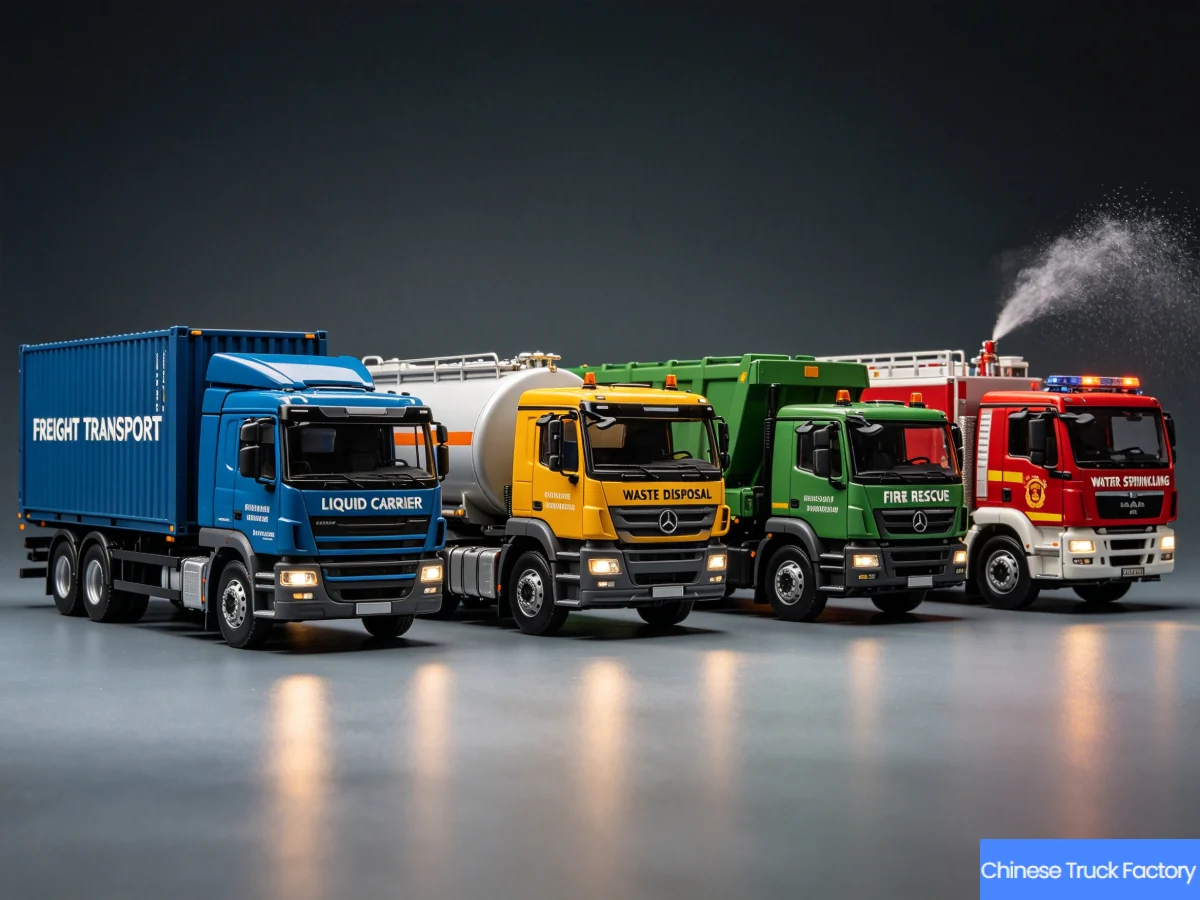
Fire apparatus and water tankers have their own logic. For fire trucks, water capacity is only one input. Pump flow and pressure, monitor reach, equipment compartment volume, and chassis mobility on narrow streets all affect whether the truck is actually usable. Standardized pump and foam system requirements vary significantly between markets, so the tender needs to reference the applicable local standard rather than a generic specification.
Chassis and Powertrain Configuration
Chinese heavy truck manufacturers offer a fairly consistent set of chassis architectures, and the choice between them should follow the application, not the price sheet.
| Cấu hình | Ứng dụng điển hình | Ưu điểm chính | Sự đánh đổi chính |
|---|---|---|---|
| 4×2 | Urban sanitation, light tanker, utility service | Chi phí thấp hơn, khả năng cơ động tốt hơn, chi phí lốp xe thấp hơn | Limited payload and axle capacity |
| 6×4 | Construction tipper, mixer, tractor, tanker | Good payload with reasonable turning radius | Trọng lượng không tải cao hơn so với phiên bản 4×2 |
| 8×4 | Heavy tipper, long-body mixer, bulk tanker | Highest legal payload under many axle regulations | Longer wheelbase, higher tire and brake cost |
| 6×6 / 8×8 | Off-road, mining support, remote utility | Traction on poor surfaces | Higher cost, more maintenance points |
The powertrain selection is where tender specifications often become over-specified. A 460 hp engine is not automatically better than a 380 hp engine for a municipal compactor that never exceeds 40 km/h. Higher horsepower can mean higher fuel consumption, a larger cooling package, and more expensive service parts. The right question is whether the engine can maintain the required cycle time at the actual gross weight and gradient. For heavy haulage and long-distance work, it’s worth reviewing xe tải diesel hạng nặng to compare how different engine and transmission combinations are matched to specific duty cycles.
Payload, Weight, and Legal Compliance
This is the area where tender documents most often create problems that only surface after delivery. Three numbers get confused constantly, and the confusion is expensive.
- Trọng lượng không tải is the truck as delivered, with fuel and fluids but no cargo or body payload.
- GVW (gross vehicle weight) is the maximum the chassis is rated to carry, including the truck itself.
- Tải trọng hợp pháp is what the destination country’s axle and gross weight regulations actually permit on the road.
Payload is GVW minus curb weight. It is not the same as body volume, and it is not the same as the factory’s rated capacity. A truck rated for 25 tonnes GVW with a 12-tonne curb weight has a theoretical 13-tonne payload, but if the local axle regulation limits the rear axle to a lower figure, the legal payload could be less. Every tender specification should state the required legal payload and require bidders to demonstrate it against the destination market’s weight regulations.
Body volume is a container size. Payload is a weight. Legal payload is a regulatory limit. Treating any two of these as interchangeable is the fastest way to fail a compliance inspection.
Body and Superstructure Considerations
For specialized vehicles, the chassis is only half the truck. The body, hydraulic system, and control package determine whether the vehicle performs in service.
Tipper Bodies
Steel grade, floor thickness, sidewall thickness, and subframe design all affect service life. Hardox or equivalent wear-resistant steel costs more but lasts longer in abrasive material. A thicker floor adds tare weight, which reduces legal payload. The tender should specify the material being hauled so the body can be matched to the abrasion environment rather than over-built or under-built.
Compactor Bodies
Compaction ratio, hopper volume, cycle time, and leachate management are the key parameters. A compactor that takes too long to complete a compaction cycle reduces daily route productivity. The bin lifter must match the containers in service, and the hydraulic system needs enough capacity to handle the compaction force without overheating during continuous stop-start operation.
Tanker and Utility Bodies
Tank material, compartment configuration, baffling, and pump selection all depend on the product being carried. Fuel tankers have very different requirements from water tankers, and both differ from chemical or food-grade units. Pump flow rate and discharge configuration should be specified against the actual filling and unloading method at the destination.
Performance and Productivity Metrics
Tender evaluations that only compare horsepower and price miss the metrics that determine whether the truck earns its keep. For a tipper, the meaningful figures are payload per trip, cycle time, and cost per tonne moved. For a compactor, it’s bins collected per shift and route completion time. For a tanker, it’s delivery volume per day and turnaround time at the fill point.
An illustrative example: consider a quarry operation moving 24 tonnes per cycle over a 12 km haul route with a 6% gradient. Two trucks with the same nominal payload may deliver very different daily tonnage if one has a better-matched transmission and final drive ratio for that gradient. The difference shows up in cycle time, fuel consumption, and eventually in cost per tonne. This is an engineering scenario, not a measured result, but it illustrates why the tender should require bidders to explain how their proposed configuration matches the stated duty cycle.
Tiêu thụ nhiên liệu và năng lượng
Fuel consumption cannot be quoted as a single number. It depends on gross weight, route profile, average speed, idling time, driver behavior, axle ratio, tire pressure, and ambient conditions. A tender that specifies a fuel consumption figure without defining the test conditions is asking for a number that will not hold in service.
What a tender can reasonably require is a fuel consumption estimate based on a defined duty cycle, plus a commitment to provide fuel monitoring data during the warranty period. For electric trucks, the equivalent is energy consumption in kWh per kilometer at a stated payload and route profile, along with battery capacity, usable capacity, and charging requirements. Buyers considering electrification should review Các giải pháp xe tải điện cho cảng và logistics to understand how charging infrastructure and route predictability affect the total cost picture.
Bảo trì, độ tin cậy và tính sẵn có của phụ tùng
Downtime costs more than parts. A truck waiting three weeks for a hydraulic cylinder is not earning, and in a government fleet it also becomes a political problem. The tender should require bidders to document their spare parts supply plan, including which parts are held locally, which are shipped from the factory, and what the lead time is for each category.
Preventive maintenance schedules should follow the engine and component manufacturer’s manual, not a generic interval. Daily checks typically cover tire condition, fluid leaks, hydraulic hoses, lights, air pressure, and warning indicators. Periodic service covers engine oil and filters, transmission and differential fluids, brake system inspection, suspension components, wheel bearings, hydraulic oil condition, PTO function, and body-specific items like dump body hinges or compactor mechanism wear points.
For fleets that run mixed brands, parts commonality is worth evaluating. Standardizing on one or two chassis platforms can reduce inventory and simplify technician training.
Total Cost of Ownership in a Tender Context
Purchase price is the easiest number to compare and the least useful one on its own. A proper TCO calculation for a government tender typically includes:
- Purchase price and any body or equipment upfit
- Freight, insurance, and import duties
- Registration and compliance costs
- Nhiên liệu hoặc điện năng trong suốt thời gian sử dụng dự kiến
- Tires and scheduled maintenance
- Sửa chữa đột xuất và phụ tùng thay thế
- Downtime cost, either as lost service or replacement rental
- Driver and operator training
- Giá trị còn lại khi thanh lý
Two trucks with the same purchase price can have very different ten-year costs. A cheaper truck with poor parts availability may cost more in downtime than a slightly more expensive truck with a local parts warehouse. The tender scoring should reflect this, and bidders should be required to submit their TCO assumptions so they can be compared on a consistent basis.
Tuân thủ và các yêu cầu của thị trường đích
There is no such thing as a globally compliant truck. Every market has its own emission standards, homologation requirements, axle weight limits, lighting rules, and registration procedures. A specification that works in one country may be unregistrable in another.
The tender should require bidders to confirm, in writing, that the proposed configuration meets the destination market’s requirements for:
- Emission standard applicable to new vehicle registration
- Chứng nhận kiểu loại phương tiện hoặc chứng nhận đồng nhất
- Giới hạn trọng lượng trục và tổng trọng lượng
- Kích thước tổng thể và bán kính quay vòng
- Steering configuration (left-hand or right-hand drive)
- Các yêu cầu về hệ thống chiếu sáng và vạch kẻ phản quang
- Các yêu cầu đối với hệ thống phanh và an toàn
- Fuel quality compatibility and DEF/AdBlue availability where applicable
Regulations change, and the applicable rules at the time of delivery may differ from those at the time of tender. The safest approach is to require the bidder to state the specific regulatory basis for compliance and to accept responsibility for registration eligibility in the destination market.
Shipping and Delivery Planning
Delivery timelines in a tender should reflect realistic shipping and customs clearance. Heavy trucks are typically shipped by RoRo, breakbulk, or flat rack depending on size, weight, quantity, and destination port. Container shipping is possible for some smaller units but rarely practical for full-size heavy trucks.
The tender should specify the required Incoterm — FOB, CFR, or CIF — and clarify which party handles marine insurance, port charges, and inland transport. Bidders should provide a shipping plan that includes the port of loading, estimated transit time, and the documentation required for customs clearance. Buyers who want a detailed breakdown of how heavy trucks move from factory to destination port can review Cách vận chuyển xe tải hạng nặng ra nước ngoài before finalizing the logistics section of the tender.
Evaluating Suppliers for Government Contracts
Government tenders usually require more documentation than private purchases, and the supplier’s ability to provide it is part of the evaluation. A useful framework for comparing Chinese truck suppliers in a tender context includes the following criteria:
| Tiêu chí đánh giá | What to Look For |
|---|---|
| Tính linh hoạt trong cấu hình | Ability to build to the tender specification rather than offering only stock units |
| Compliance documentation | Clear statements on emission standard, homologation, and registration eligibility |
| Parts and service plan | Documented spare parts list, lead times, and technical support arrangements |
| Delivery track record | Realistic shipping schedules and experience with the destination market |
| Điều khoản bảo hành | Clearly defined coverage, exclusions, and claims process |
| Technical documentation | Complete manuals, wiring diagrams, and hydraulic schematics |
| Giao tiếp | Responsive technical contact who can answer engineering questions, not just sales |
Chinese Truck Factory works within this framework by building vehicles to the buyer’s specification rather than pushing a fixed catalog configuration. For tender buyers, that matters because the specification is usually written around the duty cycle, not around what happens to be in stock. The factory’s role is to translate the tender requirements into a buildable configuration, provide the compliance and technical documentation the tender requires, and coordinate shipping and delivery. Buyers who want to discuss a specific tender specification can start a conversation with the technical team before the bid deadline.
Common Mistakes in Government Truck Tenders
After enough of these projects, the same errors show up repeatedly. Writing the specification around body volume instead of legal payload. Copying a specification from a different market without checking local regulations. Failing to define the duty cycle, which makes it impossible to evaluate whether a bidder’s configuration is actually suitable. Ignoring parts availability until after the contract is awarded. And treating the lowest purchase price as the lowest cost, when the ten-year cost often tells a different story.
The fix is not complicated. Define the work the truck will do. Define the legal constraints it must meet. Define the support you need. Then evaluate bidders against those requirements rather than against a price sheet.
Các câu hỏi thường gặp
How do I choose the right payload for a government tender specification?
Start with the material or cargo, its density, and the body volume required. Calculate the weight of a full load, then check it against the destination market’s axle and gross weight limits. The legal payload is the lower of the technical payload and the regulatory limit. Specify that number in the tender, not the body volume.
Tôi nên chọn cấu hình trục nào?
It depends on the required payload and the roads the truck will use. 4×2 suits lighter urban work. 6×4 is the most common compromise for construction and utility. 8×4 provides higher legal payload where regulations allow. 6×6 or 8×8 is for off-road traction requirements. The tender should state the payload and route conditions, and let bidders propose the configuration that meets them.
Tình trạng đường xá ảnh hưởng như thế nào đến việc lựa chọn xe tải?
Poor road surfaces increase suspension and tire loads, reduce average speed, and increase maintenance frequency. Steep gradients affect engine and transmission matching. Long haul routes favor higher gearing for fuel economy, while stop-start urban routes favor different transmission and axle ratios. The duty cycle should drive the specification.
What affects fuel consumption in service?
Gross weight, route profile, average speed, idling time, driver behavior, axle ratio, tire pressure, ambient temperature, and altitude all affect fuel consumption. A single quoted figure is only meaningful if the test conditions are defined. Tenders should require fuel consumption estimates based on the stated duty cycle.
What maintenance should be planned for a Chinese heavy truck?
Daily checks cover tires, fluids, lights, air pressure, and warning indicators. Scheduled service covers engine oil and filters, transmission and differential fluids, brakes, suspension, wheel bearings, and hydraulic systems. Specific intervals should follow the engine and component manufacturer’s manual for the exact model supplied.
How do I estimate total cost of ownership for a tender?
Combine purchase price, freight and import costs, compliance and registration, fuel or electricity, tires, scheduled maintenance, unscheduled repairs, downtime, and residual value. Require bidders to submit their assumptions so proposals can be compared on a consistent basis.
What information do I need from bidders for a quotation?
Destination country and port, application and duty cycle, required payload, body or superstructure specification, daily mileage, road and gradient conditions, drive configuration, steering side, emission requirement, quantity, and any required options. The more detail provided, the more accurate the quotation.
Làm thế nào để xác nhận việc tuân thủ các quy định của nước đến?
Require the bidder to state the specific regulatory basis for compliance, including emission standard, homologation, and registration eligibility. Confirm the requirements with the destination market’s vehicle registration authority. Regulations change, so verify the current rules at the time of delivery, not just at the time of tender.
How are Chinese trucks shipped for government contracts?
Most heavy trucks ship by RoRo or breakbulk. Flat rack is used for some configurations, and container shipping is practical only for smaller units. The choice depends on truck dimensions, weight, quantity, route, and destination port. The tender should specify the Incoterm and clarify responsibility for insurance, port charges, and inland transport.
The truck that wins a government tender is not necessarily the one with the highest horsepower or the largest body. It is the configuration that matches the required payload, the route conditions, the legal weight limits, the maintenance capability, and the expected operating cycle with the fewest compromises. Get those variables right in the specification, and the evaluation becomes a straightforward comparison instead of a guess.



