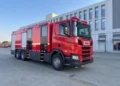
There is no single manufacturer that wins across every application, and any list that claims otherwise is selling something. The honest answer is that the “best” knuckle boom crane comes down to how the crane, the chassis, and the hydraulic system are matched to your actual lifting duty. A crane that performs well on a 16-ton chassis doing utility work may be the wrong choice on a 6×4 truck that also has to carry cargo. What follows is a practical framework I use when evaluating crane packages for fleet buyers, plus how to read the specifications that actually matter.
The short version: the best knuckle boom crane is the one whose load chart covers your heaviest lift at your real working radius, on a chassis that still has enough legal payload left for the cargo you intend to carry. Everything else is secondary.
Start With the Lift, Not the Crane Brand
Most buyers begin by picking a tonnage class — 5-ton, 8-ton, 12-ton — and then shopping for a brand. That sequence produces bad decisions. The nominal tonnage on a knuckle boom crane describes the maximum capacity at the shortest working radius, usually with the boom fully retracted and the outriggers fully deployed. It says almost nothing about what the crane can lift at the radius where you actually work.
Before you look at a single datasheet, write down these four numbers:
- Trọng lượng tải tối đa — the heaviest single item you will lift, including rigging and any load-handling attachment.
- Horizontal working radius — the distance from the crane’s rotation center to the load’s center of gravity at that heaviest lift.
- Chiều cao nâng — the height the load must reach, measured from the ground or from the truck bed.
- Boom configuration — how many hydraulic extensions you need to reach that radius and height.
Only after you have those four numbers does a load chart become meaningful. A crane rated at 12 tonnes might lift 12 tonnes at 2.5 meters and only 2.5 tonnes at 10 meters. If your real lift is 4 tonnes at 9 meters, the 12-tonne crane may still be inadequate — and a differently configured crane in the same nominal class might work.
This is the single most common specification error I see in crane truck procurement. Buyers compare tonnage badges. They should be comparing load charts at the working radius.
Reading a Knuckle Boom Load Chart Properly
A knuckle boom load chart is a grid. One axis is working radius. The other is boom extension or lift height. Each cell gives the maximum capacity at that combination of radius and extension, with the outriggers in a defined position. A few rules apply across almost all cranes:
- Capacity falls as radius increases. This is geometry, not a design flaw.
- Capacity falls as boom extension increases, because the boom’s own weight and the load moment both grow.
- Capacity depends on outrigger deployment. A chart may show different columns for fully extended, partially extended, and stowed outriggers.
- Capacity depends on whether the crane is lifting over the rear, the side, or the front. Side lifts are usually the limiting case.
- Manual extensions and jib sections reduce capacity further. If the chart has a separate column for them, use that column.
When you compare two cranes, compare them at your specific radius, height, and outrigger condition. A crane that looks weaker on paper at short radius may be stronger at long radius, or vice versa. There is no shortcut here.
Chassis Matching: The Part Buyers Underestimate
A knuckle boom crane is a load on the chassis even when it is not lifting. The crane, its base, the subframe, the outrigger beams, and the hydraulic system all add weight. That weight comes directly out of your available cargo payload and changes your axle load distribution.
Three things need to be checked together:
- Curb weight with the crane installed. This is the truck’s empty weight including the crane, subframe, outriggers, hydraulic tank, oil, and any auxiliary equipment.
- Front and rear axle loads in the loaded condition. With the crane mounted behind the cab, the rear axle carries most of the crane’s static weight. When you lift a load over the side, the moment arm transfers load to the outriggers and can unload or overload an axle depending on geometry.
- Remaining legal payload. This is GVW minus curb weight, subject to your destination country’s axle and gross weight limits. It is not the same as the chassis’s rated capacity.
A larger crane on a given chassis reduces the cargo you can legally carry. That trade-off is unavoidable. If the truck’s primary job is lifting and the cargo is secondary, a larger crane makes sense. If the truck is a delivery vehicle that occasionally lifts a pallet, a smaller crane preserves payload.
Người mua khi đánh giá khả năng nâng nên so sánh biểu đồ tải trọng thực tế trước khi lựa chọn một cần cẩu gắn trên xe tải, and should confirm the chassis configuration that the crane will be mounted on. The crane and the truck are one system.
What Separates One Crane Manufacturer From Another
There is no defensible global ranking of knuckle boom crane makers. What I can do is describe the criteria that actually distinguish one supplier from another, so you can evaluate them yourself.
| Tiêu chí đánh giá | Những điều cần kiểm tra | Tại sao điều này lại quan trọng |
|---|---|---|
| Load chart honesty | Does the published chart match the physical test data? Are outrigger conditions clearly stated? | An optimistic chart leads to overload and structural failure. |
| Boom construction | Steel grade, welding quality, section design, weight of the boom itself. | Boom weight reduces capacity at long radius and adds to chassis load. |
| Hệ thống thủy lực | Pump type, valve design, hose routing, filtration, oil cooling. | Determines cycle speed, heat tolerance, and long-term reliability. |
| Thiết kế chân chống | Span, beam stiffness, hydraulic or manual extension, pad size. | A narrow outrigger span limits capacity and stability. |
| Hệ thống điều khiển | Manual, radio remote, proportional control, overload protection. | Affects safety, precision, and operator fatigue. |
| Phụ tùng và dịch vụ | Availability of seals, hoses, valves, cylinders, and control components. | Downtime cost usually exceeds the price difference between suppliers. |
| Tài liệu hướng dẫn | Load chart, maintenance manual, parts book, hydraulic schematic. | Without these, local repair is guesswork. |
| Integration with chassis | Subframe design, PTO matching, mounting position, weight distribution. | A good crane on a poorly matched chassis is still a bad truck. |
Notice what is not on that table: brand name, country of origin, and price. Those matter, but they matter less than whether the crane’s actual capability matches your lift and whether you can keep it running.
PTO and Hydraulic System: Where Uptime Is Won or Lost
The crane does not run on its own. It runs on hydraulic power taken from the truck engine through a power take-off. The PTO, the pump, the reservoir, the filtration, and the oil cooling all determine how well the crane performs in continuous duty.
Key questions to resolve before ordering:
- Is the PTO engine-driven, transmission-driven, or front-mounted? Each has different engagement characteristics and different interference with other truck functions.
- Does the pump flow and pressure match the crane’s requirements at the crane’s rated speed? A pump that is too small slows cycle time. A pump that is too large may exceed the crane’s rated input and generate excess heat.
- Is there sufficient hydraulic oil cooling? On cranes that run continuously — waste handling, utility work, construction — oil temperature is often the limiting factor on duty cycle.
- Is the filtration adequate for the environment? Dust, moisture, and temperature extremes shorten hydraulic component life.
- Is the reservoir sized correctly? Undersized reservoirs cause aeration and overheating.
These details are rarely in the sales brochure, but they show up in the maintenance log. A crane with a marginal hydraulic package may lift the same load as a better-integrated one, but it will spend more time in the shop.
Mounting Position and Stability
Where the crane sits on the chassis is not a cosmetic decision. Mounting position affects:
- Rear axle load. A crane mounted far behind the rear axle adds more load to that axle than the same crane mounted closer to the axle centerline.
- Stability during side lifts. The outrigger span and the crane’s position relative to the chassis centerline determine how much counterweight the truck’s own mass provides.
- Cargo space. A crane mounted behind the cab leaves the bed clear. A crane mounted at the rear of the bed interferes with loading and unloading.
- Driver visibility and access. A crane blocking the rear window or the side access is a daily annoyance that affects safety.
There is no universal “best” mounting position. It depends on what the truck carries and how it is loaded. What matters is that the mounting position is chosen deliberately, with the axle load calculation done before the subframe is welded.
Comparing Configurations: A Practical Table
The table below compares typical knuckle boom crane configurations by application. It is intended as a starting point, not a specification. Final numbers depend on the specific crane model, chassis, and destination requirements.
| Cấu hình | Typical Chassis | Trường hợp sử dụng tốt nhất | Ưu điểm chính | Hạn chế chính |
|---|---|---|---|---|
| Small crane, short boom | 4×2 or light 6×4 | Utility service, small deliveries, municipal work | Preserves cargo payload, low curb weight | Limited radius and height; cannot handle heavy lifts |
| Mid-size crane, 3–4 boom sections | 6×4 or 6×2 | Construction support, equipment transport, general cargo | Balanced lifting capacity and payload | Requires careful axle load calculation |
| Large crane, 5+ boom sections | Xe tải hạng nặng 6×4 hoặc 8×4 | Heavy lifting, precast concrete, structural steel | High capacity at long radius | Significant curb weight; reduces legal cargo payload |
| Crane with jib or manual extension | Depends on lift | High lifts, tight access | Reaches where standard boom cannot | Capacity drops sharply; requires careful chart reading |
| Rear-mounted crane | Any suitable chassis | Loading from the rear, waste handling | Clear bed space for cargo | Affects rear axle load and rear visibility |
| Behind-cab mounted crane | 6×4, 8×4 | General cargo with side loading | Good weight distribution; clear rear access | Reduces available bed length |
Read that table as a set of trade-offs, not a ranking. A small crane is not worse than a large crane. It is worse for a specific lift and better for a specific payload requirement.
How Chinese Truck Factory Fits Into This Framework
When buyers evaluate suppliers against the criteria above, a few things tend to separate effective suppliers from the rest. Chinese Truck Factory is worth including in that evaluation because the company operates as a direct manufacturer-side supplier of xe chuyên dụng, including crane trucks, and because the selection process is built around the buyer’s duty cycle rather than a fixed catalog.
Specifically, the criteria that matter for knuckle boom crane sourcing are:
- Application-first specification. The crane and chassis should be selected from your lift weight, working radius, lifting height, and cargo payload requirement — not from a stock list.
- Chassis and crane integration. The subframe, PTO, hydraulic system, and mounting position need to be designed as one package.
- Tài liệu. Load charts, maintenance manuals, and hydraulic schematics should be provided with the vehicle, not promised after delivery.
- Parts planning. Consumable and wear parts — seals, hoses, filters, control components — should be identified before shipment so the buyer can plan spares.
- Export and shipping. Crane trucks are tall and heavy; the shipping method must be chosen with the vehicle’s actual dimensions and weight in mind. The company’s guide to Cách vận chuyển xe tải hạng nặng ra nước ngoài covers the practical side of that decision.
- Compliance awareness. Emission standards, axle-weight limits, steering configuration, and registration rules vary by destination. A supplier that asks about these before quoting is a supplier that understands the market.
This is not a claim that one supplier is universally better. It is a statement that the criteria above are the ones that predict whether a crane truck will work in your operation, and that Chinese Truck Factory’s process is built around them.
Maintenance: What Actually Drives Cost
The purchase price of a knuckle boom crane is a small fraction of what it costs to own over its working life. Downtime is the larger number. A crane that is out of service for three days costs more in lost work than the price difference between a mid-range and a premium crane in most applications.
Maintenance on a knuckle boom crane falls into a few categories:
- Hydraulic system. Oil condition, filter changes, hose inspection, cylinder seal integrity, valve function. Hydraulic oil contamination is the most common cause of premature component failure.
- Structural. Boom pin wear, welding inspection, subframe bolt torque, outrigger beam condition.
- Mechanical. Slew bearing lubrication, winch (if fitted), hook and rigging inspection.
- Controls. Remote function, overload protection calibration, emergency stop function.
- Chassis-side. PTO engagement, pump drive, reservoir level, oil cooler condition.
Specific service intervals should come from the crane manufacturer’s manual and the chassis manufacturer’s manual. Do not guess at them, and do not accept a verbal interval from a salesperson. The manual is the authority.
For fleets, the practical approach is to build a daily walk-around inspection — leaks, hose condition, pin wear, control function, outrigger operation — into the operator’s routine. Most crane failures announce themselves early. The daily inspection catches them before they become a breakdown.
Total Cost of Ownership for a Crane Truck
A crane truck’s total cost of ownership is not the invoice price. It is the sum of:
- Purchase price, including the crane, chassis, subframe, and hydraulic package
- Freight and shipping to the destination port
- Import duties, taxes, and clearance costs
- Registration and any local compliance costs
- Fuel or energy over the operating life
- Tires, which on a crane truck wear faster on the rear axle due to the crane’s static load
- Scheduled maintenance, including hydraulic oil and filters
- Unscheduled repairs, which are the hardest to predict and the most damaging to budget
- Kho phụ tùng thay thế
- Downtime, valued at the revenue the truck would have generated
- Giá trị còn lại khi thanh lý
Two cranes with the same purchase price can have very different TCO. The one with better parts availability, simpler hydraulic design, and a more honest load chart usually wins over five years, even if it costs more up front.
If you want a quotation that reflects your actual application rather than a generic price, the trang liên hệ is the place to start. Bring the four lift numbers, the chassis preference, the destination country, and the intended duty cycle. That information is what turns a price into a specification.
Kiểm tra tuân thủ và thị trường đích
No crane truck is “globally compliant.” Compliance is determined by the destination country, and it covers the chassis, the crane, and the combined vehicle. Before committing to a configuration, confirm:
- Emission standard required for registration in the destination market
- Axle-weight and gross-weight limits, which determine your legal payload
- Overall vehicle dimensions, including crane height and outrigger span
- Cấu hình hệ thống lái — lái bên trái hoặc lái bên phải
- Yêu cầu về chiếu sáng và đánh dấu
- Các yêu cầu về phanh và an toàn
- Any specific crane or lifting equipment certification required locally
- Chất lượng nhiên liệu và tính sẵn có của bất kỳ chất lỏng xử lý khí thải nào cần thiết
- Năng lực bảo trì tại chỗ cho cần cẩu và khung gầm
These requirements change. Confirm them with the destination country’s transport authority and customs authority before finalizing the order. A configuration that is legal in one market may be unregisterable in another.
Shipping Considerations for Crane Trucks
Crane trucks are among the more difficult vehicles to ship because of their height and weight distribution. The shipping method depends on:
- Vehicle dimensions with the crane stowed
- Total weight and axle load distribution
- Whether the vehicle can be driven on and off the vessel
- Number of units
- Route and destination port
Roll-on/roll-off is often the simplest method for a single drivable crane truck. Flat rack or breakbulk may be necessary if the vehicle’s dimensions exceed RoRo limits, or if the crane cannot be stowed low enough for the vessel’s deck clearance. Container shipping is generally not practical for a full crane truck, though it can work for disassembled or smaller units.
The method should be decided with the actual vehicle dimensions and weight in hand, not estimated from a catalog. This is one area where a small dimension error causes a large shipping problem.
Các câu hỏi thường gặp
How do I choose the right knuckle boom crane capacity?
Start with your heaviest lift, the horizontal working radius at that lift, and the required lifting height. Then find a crane whose load chart covers that combination with the outriggers in the position you will actually use. Nominal tonnage alone is not enough. Also confirm the crane’s weight does not reduce your legal cargo payload below what you need.
Is a larger crane always better?
No. A larger crane adds weight, reduces cargo payload, increases cost, and may require a heavier chassis. If your lifts are modest and your cargo is the priority, a smaller crane is often the better choice. The right crane is the smallest one that covers your heaviest lift at your working radius with a reasonable safety margin.
What is the difference between rated capacity and actual lifting capacity?
Rated capacity is the maximum the crane can lift at its shortest radius with the boom fully retracted and outriggers fully deployed. Actual lifting capacity at any other radius, height, or outrigger condition is lower, and is given by the load chart. Always use the load chart for the specific lift you are planning.
How does the crane affect the truck’s legal payload?
The crane, subframe, outriggers, and hydraulic system all add to the truck’s curb weight. That weight reduces the payload available for cargo. The exact reduction depends on the crane model and the chassis, and must be calculated before the vehicle is built. Legal payload is also limited by the destination country’s axle and gross weight rules.
Tôi cần cung cấp những thông tin nào để nhận báo giá xe cẩu?
Destination country and port, maximum lift weight, working radius, lifting height, required cargo payload, chassis preference or drive configuration, steering side, emission requirement, quantity, and any specific options. For the crane itself, the load chart requirement is the most important input.
How are knuckle boom crane trucks shipped internationally?
RoRo is common for drivable units that fit the vessel’s height and weight limits. Flat rack or breakbulk is used when dimensions or weight exceed RoRo limits. The choice depends on the actual vehicle dimensions, weight, quantity, and route. Confirm the shipping method with the vehicle’s real measurements, not catalog estimates.
What maintenance does a knuckle boom crane need?
Hydraulic oil and filter service, hose and cylinder inspection, boom pin and slew bearing lubrication, outrigger beam inspection, control system checks, and PTO and pump inspection. Specific intervals come from the crane and chassis manufacturers’ manuals. Daily walk-around inspection catches most developing problems before they cause a breakdown.
What Actually Determines the Right Crane Truck
The knuckle boom crane market does not have a single best manufacturer, and buyers who shop by brand name alone usually end up with a crane that is either oversized for their payload or undersized for their heaviest lift. The variables that matter are the lift weight, the working radius, the lifting height, the chassis capacity, the remaining legal payload, the hydraulic system integration, and the availability of parts and service in the destination market.
If you take one thing from this, make it the load chart. Read it at your real working radius, with your real outrigger condition, before you compare prices. The crane that covers your lift with the least weight penalty and the simplest maintenance profile is almost always the right one — regardless of whose name is on the boom.