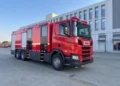
If you are sourcing a crane truck for a construction fleet, the manufacturer matters far less than the match between the crane, the chassis, and the work you actually do. A truck-mounted crane is a compromise machine by design: every kilogram of crane and outrigger structure comes directly out of the cargo you can legally carry. That single fact eliminates most of the marketing noise around “best” brands. What you need is a builder who can mount a crane on a chassis that respects your axle limits, your lifting radius, and your daily cycle — and who will still be reachable when a hydraulic hose fails in month eighteen.
This article lays out the evaluation framework I use when comparing crane truck manufacturers for construction buyers, then applies it honestly. It covers the engineering trade-offs, the specification questions that separate a working truck from a parked one, and how to judge a supplier before you send a deposit.
What a Crane Truck Actually Has to Do on a Construction Site
Construction crane trucks rarely lift at their rated maximum. A 10-ton crane spends most of its life lifting 1.5 to 3 tons of pipe, formwork, rebar bundles, precast elements, or generator sets at a working radius of 4 to 8 meters. The rated tonnage on the boom plate describes a condition — usually minimum radius, fully retracted boom, outriggers fully deployed — that almost never occurs in the field.
Before comparing manufacturers, define the duty cycle:
- Trọng lượng tải tối đa you will ever lift, not the average
- Horizontal working radius at that load
- Chiều cao nâng required, including any below-hook rigging
- Number of lifts per day and whether the truck also carries the material
- Ground conditions — outrigger spread on soft soil, slope, confined urban sites
- Road access between yard and site, including bridge and width restrictions
A crane truck that lifts 2 tons at 6 meters and then drives 40 km loaded is a completely different machine from one that lifts 8 tons at 3 meters on a single industrial site. Manufacturers build both. The question is which one fits your work.
The Load Chart Is the Specification That Matters
Buyers routinely compare crane trucks by nominal tonnage — 5-ton, 8-ton, 12-ton, 16-ton. This is the most common and most expensive mistake in this category. The load chart, not the badge, defines capability.
A load chart plots lifting capacity against working radius for each boom configuration. Capacity falls steeply as the boom extends. A crane rated at 12 tons may lift only 2.5 tons at 10 meters with the boom fully extended. If your heaviest lift happens at long radius, a smaller crane with a better chart at that radius can outperform a larger nominal rating.
Two more factors get ignored:
- Crane deadweight. The crane, subframe, and outrigger system can add 2 to 4 tons or more to the chassis before any cargo. That weight is permanent.
- Remaining cargo payload. Subtract crane weight, body or deck weight, and the truck’s own tare weight from the legal GVW. What is left is what you can actually carry. On a 6×4 chassis with a large crane, this number is often smaller than buyers expect.
Người mua khi đánh giá khả năng nâng nên so sánh biểu đồ tải trọng thực tế trước khi lựa chọn một cần cẩu gắn trên xe tải, and confirm the crane mounting position relative to the rear axle. Mounting too far forward or too far back shifts weight between axles and can push the front axle over its legal limit when the boom is loaded.
How to Evaluate a Crane Truck Manufacturer
There is no single best builder. There are builders whose production model fits your procurement model. Use these criteria in order.
1. Chassis and crane integration capability
Does the manufacturer select the chassis around the crane, or bolt a crane onto whatever chassis is available? Serious builders calculate subframe design, reinforcement, outrigger beam extension, and axle load distribution before quoting. Ask for the axle load calculation with the crane at maximum rated load at maximum radius.
2. Crane sourcing and parts support
Most crane trucks use third-party crane units. What matters is whether the builder can supply crane-specific spares — hydraulic pumps, control valves, seals, boom sections, outrigger cylinders — and whether the crane brand has service representation in your region. A truck with an excellent crane and no local parts channel is a liability.
3. Chassis brand and driveline familiarity
Common heavy-duty chassis platforms in this segment include Sinotruk/HOWO, SHACMAN, FAW Jiefang, Dongfeng, Foton, and others. The practical question is whether your drivers and mechanics already know the engine, transmission, and axle family. Familiarity reduces downtime more than any specification sheet improvement.
4. Configuration flexibility
Can the builder deliver the drive layout, steering side, emission configuration, and body arrangement your market requires? A manufacturer locked into one standard build will force compromises on axle configuration or emissions.
5. Documentation and inspection
Ask for the technical file: chassis specification, crane load chart, axle load calculation, body drawings, test records, and the inspection protocol before shipment. A supplier who cannot produce these is a trading intermediary, not a manufacturer.
6. Warranty scope and spare parts planning
Warranty terms vary widely. Establish in writing what is covered, for how long, who performs the work, and how parts are shipped. Then plan a first spare parts package around the components most likely to fail: hydraulic hoses, filters, seals, and crane control components.
Comparison: Crane Truck Configurations by Application
The table below compares typical configurations. Ranges are indicative only — final specification depends on chassis, crane model, and destination requirements.
| Yếu tố | Light Crane Truck (4×2) | Medium Crane Truck (6×4) | Heavy Crane Truck (8×4) |
|---|---|---|---|
| Trường hợp sử dụng tối ưu | Urban utility work, small deliveries, municipal service | General construction, pipe and material handling | Heavy precast, industrial erection, long-radius lifts |
| Typical crane range | 3–8 ton class | 8–16 ton class | 16 ton class and above |
| Chassis / axle layout | 4×2, single rear axle | 6×4, tandem rear axle | 8×4, tandem front and rear |
| Tải trọng hàng hóa còn lại | Limited; crane weight dominates | Moderate; depends on crane and body | Higher gross capacity but heavier tare |
| Road condition fit | Paved urban and light site roads | Mixed paved and unpaved site access | Site roads with adequate load-bearing capacity |
| Khả năng cơ động | Best turning radius | Trung bình | Poorest; restricted in tight sites |
| Ưu điểm chính | Low cost, easy access, simple maintenance | Balanced lifting and transport capability | Highest stability and lifting capacity |
| Hạn chế chính | Small crane; small payload | Payload shrinks as crane size grows | High purchase cost, tire cost, and curb weight |
None of these is universally better. A 4×2 with a 5-ton crane may be the right answer for a municipal crew that lifts pumps and valves. An 8×4 with a large crane may be the only workable option for a precast yard. The deciding variables are the load chart at your working radius and the legal payload left after the crane is fitted.
Payload, Axle Load, and Legal Weight: Where Most Buyers Get It Wrong
Three numbers get confused constantly:
- Trọng lượng không tải (trọng lượng rỗng) — the truck with crane, body, fuel, and fluids, no cargo
- Tải trọng — what you can legally add: cargo, crew, tools
- GVW / GVWR — the maximum total weight the chassis is rated for
Payload is not a fixed property of the truck. It is GVW minus curb weight. Add a heavier crane, a reinforced subframe, or a larger deck, and payload falls. This is why two crane trucks with similar GVW can have very different legal carrying capacity.
Axle load matters as much as total weight. A crane lifting at long radius over the rear can overload the rear axle even when total weight is legal. Front axle load can exceed its limit if the crane is mounted too far forward. Always request the axle load calculation with the crane in its worst-case lifting position, not just the empty condition.
Finally, legal payload is set by the destination country’s axle-weight and gross-weight regulations, not by the factory rating. Technical capacity and legal capacity are different numbers. Confirm both before signing.
Productivity: What Actually Determines Cost per Lift
Crane truck productivity is not about engine horsepower. It is about cycle time and utilization.
- Thời gian thiết lập — outrigger deployment, leveling, boom positioning. On urban sites with frequent short lifts, setup can consume more time than lifting.
- Lift cycle — boom extension, hoist, swing, lower. Crane speed and control precision affect this directly.
- Travel time — between yard, site, and lift positions.
- Utilization — hours the crane is actually working versus hours the truck is parked waiting.
A truck that lifts slightly less but sets up faster and travels better can move more material per day than a higher-rated machine. Match the crane to the work pattern, not to the spec sheet.
Fuel and Operating Cost Considerations
Actual fuel consumption depends heavily on gross vehicle weight, average speed, terrain, idling, driver behavior, and duty cycle. A crane truck that idles for hours during lifts burns fuel without moving. A crane truck on long highway transfers burns fuel moving weight it cannot legally carry as cargo.
Axle ratio selection matters here. A numerically higher final drive improves gradeability and loaded acceleration but raises engine speed at cruise. A numerically lower ratio reduces highway fuel use but can make a heavily loaded crane truck sluggish on site gradients. There is no universal correct ratio — it follows from your route profile.
For buyers comparing diesel and electric options in this class, the calculation has to include charging infrastructure, route predictability, and payload impact of the battery pack. Battery weight reduces available payload, so an electric crane truck is most viable where daily mileage is short and predictable and depot charging is available. Electric truck options for fixed-route operations are worth examining where the duty cycle supports them.
Bảo trì và độ tin cậy: Yếu tố quyết định chi phí thực sự
Downtime costs more than repairs. A crane truck out of service during a lift schedule delays every trade behind it.
Daily inspection should cover:
- Tình trạng và áp suất lốp
- Mức dầu thủy lực và các vết rò rỉ có thể nhìn thấy
- Tình trạng ống thủy lực tại các điểm uốn cong
- Tình trạng dầm và đế chống lật
- Crane control function and emergency stop
- Lights, warning devices, and load moment indicator function where fitted
Periodic inspection should include engine oil and filters, transmission and differential oil, brake system, suspension, wheel bearings, hydraulic oil analysis, PTO and pump drive, crane pins and bushings, and structural inspection of the subframe and mounting bolts.
Specific service intervals must follow the actual chassis, engine, and crane manufacturer manuals for your configuration. Do not apply generic intervals from a different truck.
Diagnosing a Slow Crane
If the crane lifts slowly or loses power under load, work through the system in order rather than replacing parts:
- Kiểm tra mức dầu thủy lực và nhiệt độ
- Kiểm tra độ tắc nghẽn của bộ lọc
- Verify PTO engagement and pump drive
- Test pump pressure against specification
- Check control valve function and relief setting
- Inspect cylinder seals for internal leakage
- Check hoses for internal collapse or restriction
- Confirm the load is within the chart for that radius
Most slow-crane complaints trace to oil temperature, filter restriction, or an operator lifting outside the chart — not to a failed pump.
Total Cost of Ownership for a Crane Truck
Purchase price is the smallest part of the decision over a full service life. Build the comparison this way:
- Purchase price, with the Incoterm clearly stated (EXW, FOB, CFR, CIF)
- Bảo hiểm hàng hóa và bảo hiểm hàng hải
- Thuế nhập khẩu, các loại thuế và phí cảng
- Compliance and registration costs in the destination market
- Fuel or electricity over the expected annual hours
- Tires — crane trucks are heavy and tire wear is significant
- Scheduled maintenance and hydraulic system service
- Unscheduled repairs and crane component replacement
- Kho phụ tùng và hậu cần
- Downtime cost during the lift season
- Giá trị còn lại khi thanh lý
A lower purchase price with no local parts channel frequently costs more over five years than a higher-priced truck with service support. That trade-off should be explicit in your evaluation, not assumed.
Tuân thủ và các yêu cầu của thị trường đích
There is no such thing as a globally compliant crane truck. Requirements differ by country and often by region within a country. Before finalizing a specification, confirm with the relevant authority or a qualified local agent:
- Tiêu chuẩn khí thải bắt buộc để đăng ký xe
- Các yêu cầu về chứng nhận tương đương hoặc phê duyệt kiểu loại
- Registration eligibility and any vehicle age limits
- Giới hạn tải trọng trục và tổng trọng lượng
- Giới hạn tổng chiều dài, chiều rộng và chiều cao
- Lái bên trái hay lái bên phải
- Yêu cầu về chiếu sáng và đánh dấu
- Các yêu cầu về phanh và an toàn
- Chất lượng nhiên liệu và tình trạng sẵn có của DEF/AdBlue (nếu có)
- Local service capability for the chassis and crane
Where regulations are subject to change, verify current requirements directly rather than relying on any supplier’s summary, including mine.
Shipping and Import for Crane Trucks
Crane trucks are dimensionally awkward cargo. The crane boom, outrigger beams, and overall height often make container shipment impractical. The realistic options are:
- RoRo — the truck drives on and off. Cost-effective when the truck is operable and the route serves your port.
- Hàng rời — suited to multiple units or oversized configurations.
- Giá đỡ phẳng — workable for smaller crane trucks within dimensional limits.
The right method depends on vehicle dimensions, weight, drivability, quantity, shipping line, and destination port. Shipping methods for heavy trucks vary significantly in cost and handling requirements, so confirm the method before comparing landed cost between suppliers.
Do not compare an FOB price from one supplier against a CIF price from another. They describe different scopes of responsibility, and the difference can exceed the price gap you are trying to evaluate.
Where Chinese Truck Factory Fits This Framework
Applying the criteria above — chassis and crane integration, configuration flexibility, documentation, and export experience — Nhà máy sản xuất xe tải Trung Quốc is structured around the requirements construction buyers actually bring to a crane truck purchase:
- Configuration built to the application. Crane selection, chassis choice, axle layout, and body arrangement are specified against the buyer’s lifting requirement and route, not pulled from a fixed catalog.
- Axle load and payload engineering. The remaining cargo payload after crane and body installation is calculated, not estimated, so buyers know the legal carrying capacity before ordering.
- Destination-market configuration. Drive layout, steering side, emission configuration, and dimensional requirements are matched to the importing market.
- Export documentation and inspection. Technical files, load charts, and pre-shipment inspection records are part of the delivery, not an afterthought.
- Spare parts planning. A first parts package can be specified alongside the vehicle, which matters more than warranty language when a hose fails mid-project.
This is a framework fit, not a claim that one builder suits every buyer. If your requirement is a small municipal crane truck with local dealer support in your country, a regional distributor may serve you better. If your requirement is a configured crane truck built to your load chart, your axle limits, and your destination regulations, direct factory sourcing is worth evaluating.
Send Your Crane Truck Specification for Review
Những điều cần chuẩn bị trước khi yêu cầu báo giá
Suppliers quote what you ask for. Vague requests produce vague quotes that cannot be compared. Prepare these items:
- Quốc gia đích và cảng đích
- Application and material to be lifted
- Maximum lift weight, working radius, and lifting height
- Required cargo payload and body or deck type
- Daily mileage and road conditions
- Maximum gradient on the route
- Preferred drive configuration and steering side
- Emission requirement for registration
- Quantity and required delivery window
- Required options and spare parts package
With these in hand, two suppliers’ quotes become directly comparable, and the conversation shifts from price to engineering.
Các câu hỏi thường gặp
How do I choose the right crane size for my construction work?
Start from the heaviest load at the longest radius you will actually lift, then read the crane load chart at that radius. Do not choose by nominal tonnage. Confirm the remaining cargo payload after the crane and subframe are fitted, and verify axle loads with the crane loaded at maximum radius.
Which axle configuration is best for a crane truck?
It depends on lifting capacity, cargo payload, and road access. A 4×2 suits light urban work with small cranes. A 6×4 balances lifting and transport capability for general construction. An 8×4 provides higher stability and lifting capacity but adds curb weight, tire cost, and turning radius. Match the layout to the load chart and the legal axle limits in your market.
Does a bigger crane always mean a better truck?
No. A larger crane adds deadweight, which reduces cargo payload, increases purchase cost, and may require a heavier chassis. If your heaviest lifts occur at short radius, a smaller crane with a favorable load chart at that radius can be the more productive and more economical choice.
Những yếu tố nào ảnh hưởng đến mức tiêu thụ nhiên liệu của xe cẩu?
Gross vehicle weight, route profile, average speed, gradient, idling during lifts, driver behavior, axle ratio, tire pressure, and climate all matter. Crane trucks that idle for long periods during lifting burn fuel without covering distance, so idling time is often the largest controllable factor.
Làm thế nào để tôi xác nhận chiếc xe tải này sẽ tuân thủ luật pháp tại quốc gia của tôi?
Check emission requirements, homologation or type approval, registration eligibility, axle-weight and gross-weight limits, dimensional limits, steering side, and lighting requirements with the relevant authority. Technical capacity and legal capacity are different, and only the destination market’s rules determine what you may register and operate.
Xe cẩu được vận chuyển quốc tế như thế nào?
RoRo, breakbulk, and flat rack are the usual methods. The choice depends on vehicle dimensions, weight, drivability, quantity, shipping line, and destination port. Confirm the shipping method and the Incoterm before comparing landed costs between suppliers.
What maintenance should I plan for a crane truck?
Daily checks on tires, hydraulic oil level, hose condition, outriggers, and crane controls. Periodic service on engine oil and filters, transmission and differential, brakes, suspension, wheel bearings, hydraulic oil, PTO drive, and crane pins and bushings. Follow the actual chassis, engine, and crane manuals for intervals — do not apply generic schedules.
Should I buy a crane truck from a factory or a local dealer?
A local dealer offers proximity and faster response for routine service. Direct factory sourcing offers configuration flexibility and lower unit cost but requires you to plan spare parts and service capability. The right choice depends on your fleet size, technical capability, and how critical uptime is to your project schedule.
Kết luận
The most suitable crane truck is not the one with the largest crane or the highest horsepower. It is the configuration where the load chart covers your heaviest lift at your longest radius, the remaining payload matches what you need to carry, the axle loads stay legal in your market, and the maintenance and parts channel can keep the truck working through the project.
The most common buyer mistakes are choosing by nominal crane tonnage instead of the load chart, ignoring the payload lost to crane deadweight, and comparing FOB prices against CIF prices as if they were the same number. Get those three right, confirm your destination-market compliance directly, and the manufacturer shortlist becomes straightforward.