There is no single “best” Chinese truck for Latin America, and any supplier who tells you otherwise is selling a brochure, not a solution. The right truck depends on what it has to do every day: haul ore up a 12% grade in the Andes, run container shuttles between a port and a distribution center, collect municipal waste on narrow city streets, or move diesel to remote job sites. Chinese heavy truck manufacturers such as Sinotruk (HOWO), SHACMAN, FAW Jiefang, Dongfeng, Foton, JAC, Beiben, SAIC Hongyan, CAMC, and Dayun all build capable platforms, but capability only matters when the configuration matches the duty cycle, the road, the legal weight limits, and the maintenance reality of the destination market. What follows is a practical framework for choosing among them, not a ranking.
Start With the Job, Not the Brand
Most importers in this region begin with a brand name or a horsepower number. That is backwards. A truck is a tool, and the correct tool is defined by the task. Before you compare a HOWO 6×4 tractor to a SHACMAN F3000 dump truck, you need to answer a short set of operating questions. The answers will eliminate half the market for you.
- What is being carried? Bulk ore, sand, gravel, containers, fuel, water, municipal waste, or general cargo. Material density drives body volume and payload far more than horsepower does.
- What is the daily distance and cycle? A 3 km quarry haul and a 900 km long-haul route demand completely different drivetrains and cab specifications.
- Mặt đường như thế nào? Paved highway, compacted gravel, unsealed mine haul road, or mixed. This determines suspension, tire choice, and axle rating.
- What is the maximum gradient? A 6% grade on a paved road is manageable with a mid-range engine. A 15% grade on a loose surface with a full load is a different engineering problem entirely.
- Độ cao là bao nhiêu? Naturally aspirated and turbocharged diesel engines both lose power as air density drops. Above roughly 2,500 m, this becomes a real specification issue, not a footnote.
- What is the legal axle and gross weight limit? This is set by the destination country, not by the truck manufacturer.
If you cannot answer these six questions, no quotation you receive will be meaningful. Suppliers will simply quote whatever they have in stock.
Matching Truck Class to Operating Scenario
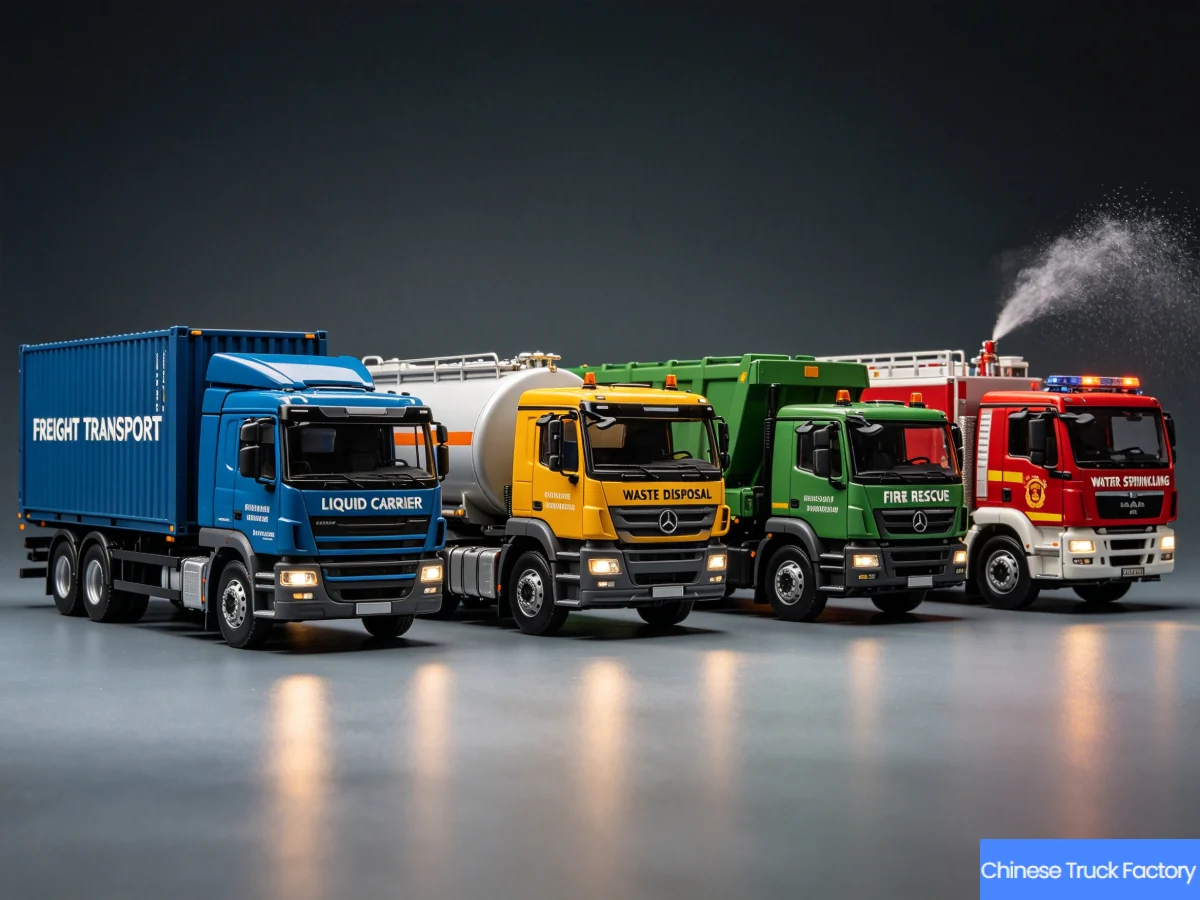
Latin American operations tend to fall into a handful of recognizable patterns. Each one points toward a different class of vehicle.
Construction and Aggregate Haulage
Typical duty: 15–30 tonne payloads over 5–40 km of mixed paved and gravel road, with frequent loading by excavator and dumping on uneven ground. The standard answer is a 6×4 rigid dump truck in the 25–40 tonne GVW class, or an 8×4 where higher legal payload is permitted and the road geometry allows the longer wheelbase. Body volume, not engine size, is usually the first constraint to define.
Hoạt động khai thác mỏ và mỏ đá
Mine haul roads are the hardest environment a truck will ever see. Continuous grades, loose surface, heavy dust, and high cycle frequency. Here the decision is usually between a reinforced rigid dump truck and a purpose-built wide-body mining truck. If you are evaluating this segment, the selection logic is covered in detail in this guide on Cách chọn xe ben cho ngành khai thác mỏ, which walks through material density, haul road gradient, and cost per tonne moved. The key point is that purchase price is the wrong metric. Cost per tonne moved is the right one.
Long-Haul and Container Transport
Highway tractor units pulling 40 ft containers or flatbeds over long distances. Aerodynamic efficiency, cab comfort for two drivers, fuel tank capacity, and axle ratio for sustained cruising speed matter more than raw torque. A 4×2 tractor may be sufficient for light container work on good roads, while 6×4 is the default for heavy gross combination weights and mixed terrain.
Municipal and Sanitation
Waste collection, street sweeping, water distribution, and sewer cleaning. These are stop-start urban cycles with low average speed, high hydraulic duty, and strict noise and maneuverability requirements. Chassis selection is secondary to the body and hydraulic system. Municipal buyers should look at the range of xe chuyên dụng phục vụ vệ sinh to understand how compactor bodies, bin lifters, and leachate systems are specified.
Specialized and Project Cargo
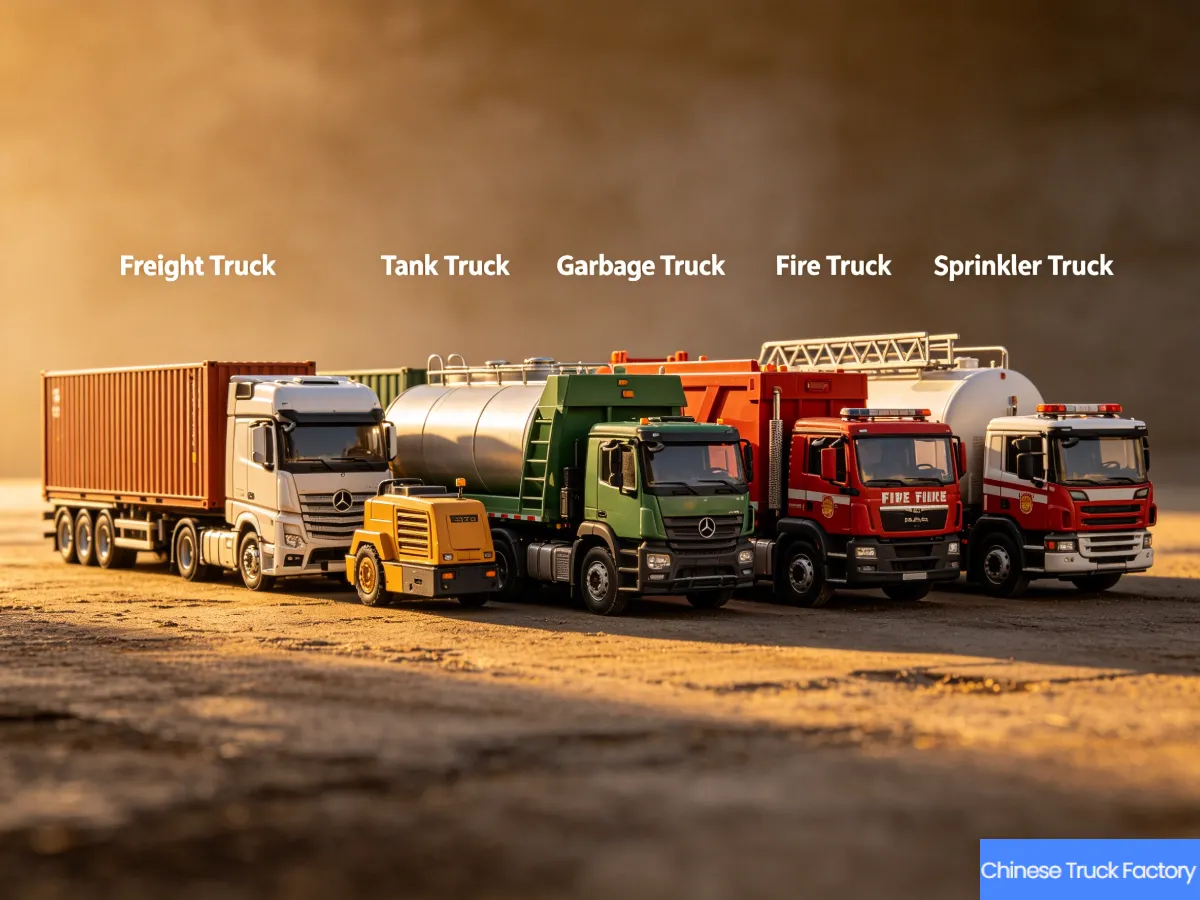
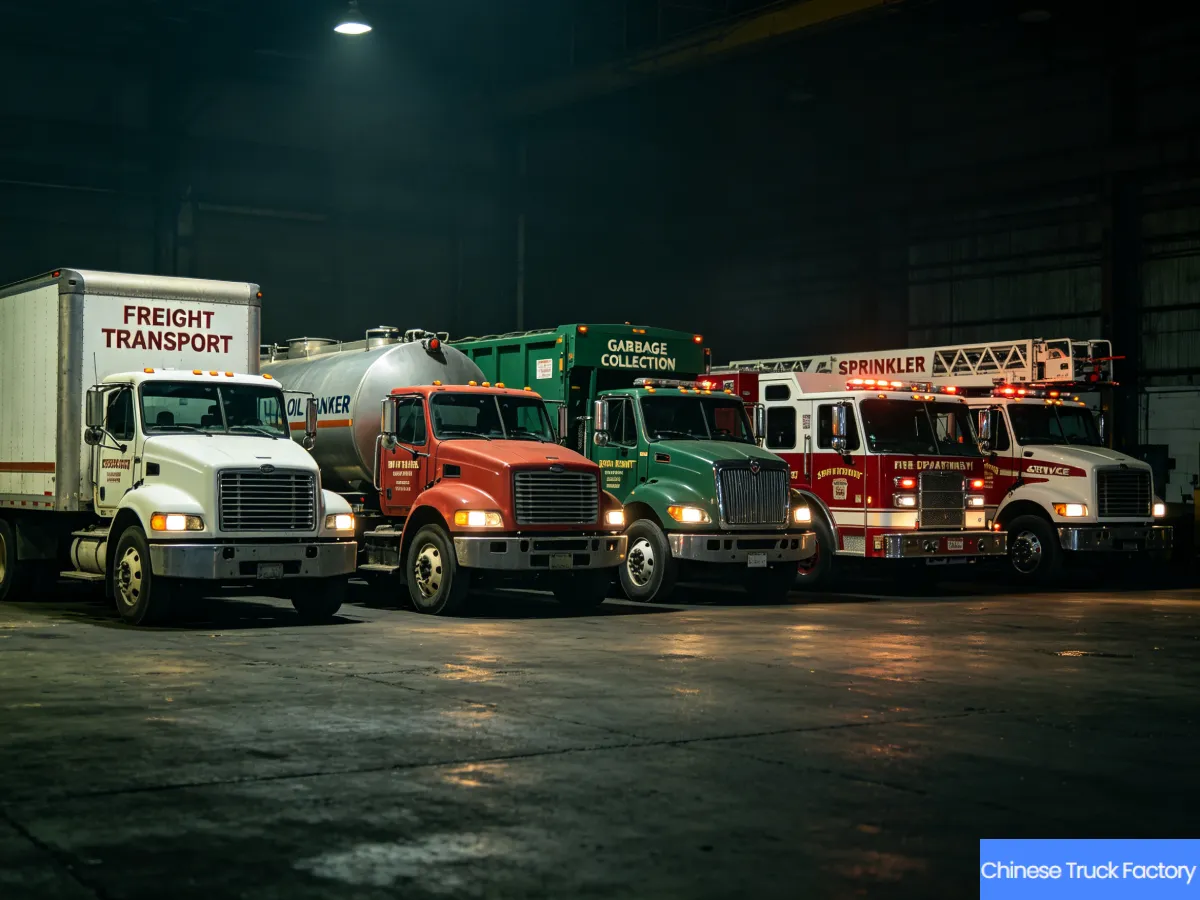
Fuel tankers, water bowsers, truck-mounted cranes, concrete mixers, and fire apparatus. These are built around the superstructure, and the chassis is chosen to carry it. A crane truck is a good example: the nominal crane rating is almost meaningless without the load chart, working radius, and outrigger configuration.
Cấu hình khung gầm và hệ truyền động
Once the application is clear, the configuration follows. This is where most specification errors happen, and they are expensive to correct after delivery.
| Cấu hình | Trường hợp sử dụng tốt nhất | Typical Strength | Hạn chế chính |
|---|---|---|---|
| 4×2 | Light container work, urban distribution, municipal service | Lower purchase cost, tighter turning circle, lower tare weight | Limited traction and axle load capacity; not suitable for heavy off-road |
| 6×4 | General construction haulage, heavy tractor work, most dump truck duty | Sự cân bằng tốt giữa khả năng bám đường, tải trọng và chi phí | Longer wheelbase than 4×2; higher tire cost |
| 6×6 | Severe off-road, steep unsealed grades, remote project sites | Maximum traction with all-wheel drive | Higher fuel consumption, more driveline complexity, higher maintenance |
| 8×4 | High legal payload on paved or firm gravel roads | Higher gross weight capacity, more axles to spread load | Greater tare weight, larger turning radius, higher tire and brake cost |
A common mistake is assuming that more axles always means more payload. In practice, an 8×4 carries more tare weight than a 6×4, so the net payload gain depends entirely on the legal gross weight limit in the destination country. If the legal limit is the same, the extra axle may only add cost and complexity without adding revenue.
Động cơ và hộp số
Chinese heavy trucks are typically offered with engines from Weichai, Sinotruk, Yuchai, or Cummins-licensed platforms, in the 300–460 hp range for on-road work and higher for mining. Torque, not horsepower, is what moves a loaded truck up a grade. A 400 hp engine with a well-matched transmission and axle ratio will outperform a 460 hp engine with a poorly matched drivetrain.
Transmission choice matters as much. Manual transmissions remain common because they are simple and repairable in markets with limited service infrastructure. Automated manual transmissions (AMT) reduce driver fatigue and can improve fuel economy in long-haul duty, but they require diagnostic capability that may not exist locally. If your operating region has limited dealer support, a manual gearbox is often the lower-risk choice.
Tỷ số trục và hộp số cuối
The final drive ratio determines the trade-off between top speed and gradeability. A numerically higher ratio (for example, 5.92) gives better pulling power and grade climbing but limits cruising speed and raises fuel consumption at highway speeds. A lower ratio (for example, 4.11) is better for long-haul on flat or gently rolling terrain. Choosing the wrong ratio is one of the most common and most expensive specification errors, because it cannot be corrected without replacing gearsets.
Payload, GVW, and Legal Weight: Getting the Numbers Right
This is where buyers get into trouble most often, and it deserves a clear separation of terms.
- Trọng lượng không tải (trọng lượng rỗng): The empty vehicle weight, including fuel, fluids, and driver.
- Tải trọng: The weight of cargo the vehicle can legally and technically carry. Payload = GVW − curb weight.
- GVW / GVWR: The maximum permissible total weight of the loaded vehicle.
- Thể tích cơ thể: The physical capacity of the dump body, tank, or cargo box, measured in cubic meters or liters. This is not the same as payload.
- Axle load: The weight carried by each axle. This must not exceed either the axle’s technical rating or the legal axle limit in the destination country.
The critical point: body volume does not equal payload. A 20 m³ dump body carrying dry sand at roughly 1.6 t/m³ would theoretically hold 32 tonnes. A 20 m³ body carrying wet gravel at 2.0 t/m³ would hold 40 tonnes. Neither figure is achievable if the chassis, axles, tires, and legal gross weight limit only allow 25 tonnes of payload. The correct approach is to calculate material density × body volume, then check that result against the chassis rating, axle ratings, tire load ratings, and the legal weight limit. The lowest of those numbers is your real payload.
Final legal payload is always governed by the destination country’s axle weight, gross weight, and vehicle registration regulations. A factory-rated capacity is a technical limit, not a legal permission.
For a deeper breakdown of how these figures interact, this explanation of Tải trọng của xe ben, tổng trọng lượng xe (GVW), trọng lượng không tải và tải trọng cho phép is worth reading before you finalize a specification.
Superstructure Design: Where the Real Engineering Lives
For specialized vehicles, the chassis is only half the truck. The body, tank, crane, or compactor determines whether the vehicle actually does the job it was purchased for.
Dump Bodies
Body volume, steel grade, floor thickness, sidewall thickness, and the hydraulic cylinder arrangement all affect both durability and tare weight. A thicker floor plate lasts longer in abrasive rock service but adds weight that reduces payload. The tipping angle and subframe design affect how cleanly material discharges — a body that leaves residual material behind on every cycle is losing productivity continuously. In mining and quarry work, wear-resistant steel is usually justified, but in light construction haulage it often is not.
Xe bồn chở dầu
Tank volume, material, compartment configuration, baffles, and pumping system must all match the product being carried. Baffles are not optional for liquid transport — they control surge and stability. The center of gravity of a partially filled tank changes constantly, which affects braking and cornering behavior. Product compatibility (fuel, water, chemicals) determines lining and material selection.
Xe chở rác có thiết bị nén rác
Waste density, bin type, loading method, body volume, and compaction ratio determine payload. A compactor body that achieves a high compaction ratio can carry significantly more waste per trip than a simple box body of the same volume, but the hydraulic system is more complex and requires more maintenance. Leachate management and hydraulic cycle time are often under-specified by first-time buyers.
Cần cẩu gắn trên xe tải
The nominal crane rating (5, 8, 12, 16 tonnes) is a starting point, not a capability statement. A crane rated at 12 tonnes may only lift 2 tonnes at full boom extension. The load chart, working radius, lifting height, outrigger span, and remaining cargo payload after the crane’s own weight are all part of the selection. Buyers evaluating lifting capacity should compare the actual load chart before selecting a cần cẩu gắn trên xe tải.
Performance and Productivity: The Numbers That Actually Matter
Horsepower figures sell trucks. Payload per trip, cycle time, and cost per tonne moved are what determine whether a truck makes money.
- Tải trọng mỗi chuyến: The real revenue unit, constrained by legal weight, not by body volume.
- Thời gian chu kỳ: Loading time + haul time + dumping time + return time. Reducing cycle time by 10% is roughly equivalent to adding 10% to the fleet.
- Số chuyến mỗi ngày: The product of cycle time and available operating hours.
- Gradeability: The maximum gradient the truck can climb with a full load at a reasonable speed. This is a function of torque, gear ratio, and traction.
- Fuel per cycle: More useful than fuel per 100 km for short-haul and stop-start work.
- Tonne-kilometre productivity: Payload × distance ÷ time. The single best measure of haulage efficiency.
- Tình trạng sẵn có của phương tiện: The percentage of scheduled hours the truck is actually available for work. Downtime is often more expensive than fuel.
Two trucks with identical horsepower can have very different productivity. The one with the better-matched drivetrain, lower tare weight, and higher availability will usually win on cost per tonne moved, even if it costs more to buy.
Tiêu thụ nhiên liệu và năng lượng: Không có con số cụ thể nào
Any supplier who quotes a fixed fuel consumption figure for a heavy truck is either quoting a specific test condition or guessing. Actual consumption depends on gross vehicle weight, route profile, average speed, gradient, traffic, idling time, driver behavior, axle ratio, tire pressure, aerodynamics, climate, altitude, and engine calibration.
What you can reasonably do is establish an indicative operating range for your specific duty cycle, then use it for comparison. For a loaded 6×4 dump truck on mixed terrain, a typical operating range might fall somewhere between 35 and 55 liters per 100 km depending on load, grade, and speed. For a long-haul 6×4 tractor at highway speed with a moderate load, the range might be lower. These are indicative ranges, not specifications — the only reliable figure comes from your own duty cycle data.
On the electric side, the calculation changes entirely. Battery capacity, usable capacity, kWh/km, payload impact, route predictability, charging power, and depot dwell time all matter. A truck with a 600 kWh battery and a predictable 150 km daily route with overnight depot charging may be viable. The same truck on an unpredictable 400 km route with no charging infrastructure is not. The full picture is covered in this guide to electric heavy truck range with a full load.
Bảo trì, độ tin cậy và tính sẵn có của phụ tùng
Downtime is the hidden cost that kills fleet economics. A truck that costs 15% less to buy but spends 20% more time in the workshop is a worse investment, not a better one.
Kiểm tra hàng ngày
- Tire condition and pressure (cold)
- Fluid leaks under the vehicle
- Tình trạng ống thủy lực và các phụ kiện nối
- Lights, indicators, and warning indicators
- Air system pressure build-up and leakage
- Visible damage to body, tank, or crane structure
Kiểm tra định kỳ
- Tình trạng dầu động cơ và bộ lọc
- Transmission and differential oil levels
- Brake system wear and adjustment
- Suspension components and leaf spring condition
- Wheel bearings and hub temperature
- Hydraulic oil condition and filter restriction
- PTO engagement and driveshaft condition
- Dump body hinges, crane pins, or compactor mechanism wear
Specific service intervals must always come from the actual engine and component manufacturer’s manual for the specific model. Do not accept generic intervals from a sales brochure.
Tình trạng sẵn có của các bộ phận
This is where brand choice genuinely matters. Some Chinese truck platforms have extensive parts distribution networks in Latin America, with local warehouses and dealer support. Others do not. Before committing to a model, confirm:
- Which local distributor stocks consumables and wear parts
- Lead time for major components such as engines, transmissions, and axles
- Whether diagnostic software and tools are available locally
- Whether the platform shares components with other models already in service
A truck that is technically excellent but has a 6-week parts lead time will lose money in operation. A slightly less advanced truck with a 3-day parts lead time will not.
Tổng chi phí sở hữu: Cách so sánh công bằng duy nhất
Purchase price is the smallest part of the decision. A realistic TCO model for a heavy truck over a 5-year operating period includes:
| Loại chi phí | Những nội dung cần bao gồm |
|---|---|
| Giá mua | Chassis + superstructure + options, quoted in a defined Incoterm (EXW, FOB, CFR, CIF) |
| Vận chuyển hàng hóa và vận chuyển | RoRo, breakbulk, or container/flat-rack, plus marine insurance and port handling |
| Nhập khẩu và tuân thủ | Customs duties, taxes, homologation, registration, and any required modifications |
| Nhiên liệu hay điện | Based on actual duty cycle, not a generic figure |
| Lốp xe | Replacement frequency depends heavily on road surface and axle loading |
| Bảo trì theo lịch trình | Oil, filters, fluids, and labor at manufacturer-recommended intervals |
| Các công việc sửa chữa ngoài kế hoạch | Realistic allowance based on operating environment and platform reputation |
| Kho phụ tùng thay thế | Working capital tied up in critical spares |
| Chi phí do thời gian ngừng hoạt động | Lost revenue per day of unplanned unavailability |
| Giá trị còn lại | Expected resale value at end of ownership period |
Two trucks with a 20% purchase price difference can easily reverse their ranking once fuel, tires, maintenance, and downtime are included. The cheapest truck is rarely the cheapest to operate.
Tuân thủ và các yêu cầu của thị trường đích
There is no such thing as a globally compliant truck. Every destination country has its own requirements, and they change. Before finalizing any specification, confirm the following for the specific country and the specific model year:
- Tiêu chuẩn khí thải: Euro II, Euro III, Euro V, or a local equivalent. This affects engine hardware, aftertreatment systems, and fuel quality requirements.
- Homologation and type approval: Whether the model is eligible for registration at all.
- Cấu hình hệ thống lái: Left-hand drive or right-hand drive, depending on the market.
- Axle weight and gross weight limits: These determine legal payload and may force a different axle configuration.
- Kích thước xe: Overall length, width, and height restrictions, especially for urban operation.
- Các yêu cầu về chiếu sáng và an toàn: Headlight patterns, reflectors, marker lights, and braking requirements.
- Chất lượng nhiên liệu: High-sulfur fuel can damage modern emission control systems. Confirm fuel quality before specifying a high-emission-standard engine.
- Tình trạng sẵn có của DEF/AdBlue: SCR-equipped engines require a reliable supply of DEF. If it is not available, an SCR-equipped truck is the wrong choice.
Because these requirements are country-specific and change over time, always verify current regulations with the destination country’s transport ministry or customs authority before placing an order. Do not rely on a supplier’s general statement that a model “meets international standards.”
Các vấn đề cần lưu ý về vận chuyển và nhập khẩu
How a truck is shipped affects both cost and delivery time, and the right method depends on the vehicle’s dimensions, weight, whether it can be driven, the quantity, and the destination port.
- RoRo (Roll-on/Roll-off): The truck is driven onto the vessel. Usually the most cost-effective for complete, drivable units. Requires the truck to be operational and the destination port to have RoRo capability.
- Hàng rời: The truck is lifted onto the vessel as general cargo. Suitable for very large or non-drivable units.
- Flat-rack: The truck is loaded onto a flat-rack container. Useful when RoRo is not available or when the buyer wants container handling.
- Thùng chứa: Only practical for smaller units or disassembled (CKD/SKD) shipments. Standard 40 ft containers cannot accommodate most complete heavy trucks.
Beyond shipping, budget for inland transport from the destination port, marine insurance, customs clearance, import duties, and port charges. A CIF quotation covers the truck to the destination port, but not the cost of getting it from the port to your yard. The full picture is covered in this guide to Cách vận chuyển xe tải hạng nặng ra nước ngoài.
Cách đánh giá nhà cung cấp
Supplier selection is as important as vehicle selection. A good truck from a bad supplier is a bad purchase. When evaluating suppliers, apply a consistent framework:
| Tiêu chí đánh giá | What to Look For |
|---|---|
| Năng lực kỹ thuật | Can they explain why a specific configuration suits your duty cycle, or do they only quote from a catalog? |
| Specification transparency | Do they provide full technical specifications, including curb weight, axle ratings, and body dimensions? |
| Tùy chỉnh | Can they modify the body, tank, crane, or chassis to match your application, or do they only sell standard units? |
| Quality control | Do they provide inspection reports, photos, and video of the actual unit before shipment? |
| Hồ sơ xuất khẩu | Can they handle the certificate of origin, commercial invoice, packing list, and any required conformity documents? |
| Dịch vụ hỗ trợ sau bán hàng | Do they provide spare parts lists, maintenance manuals, and technical support after delivery? |
| Giao tiếp | Do they respond clearly and promptly to technical questions, or do they avoid specifics? |
Against this framework, Nhà máy sản xuất xe tải Trung Quốc is structured to meet these criteria. The company works across heavy-duty diesel trucks, specialized vehicles, sanitation equipment, construction vehicles, and electric platforms, and provides configuration support based on the actual duty cycle rather than pushing a single stock model. Buyers can review the full range of xe tải diesel hạng nặng và xe chuyên dụng to see how the different platforms are configured. The emphasis is on matching the vehicle to the job, providing transparent specifications, and supporting the buyer through shipping and documentation. For buyers who want to discuss a specific application, the team can be reached through the trang liên hệ.
Những sai lầm thường gặp của người mua
- Comparing FOB prices to landed costs. A lower FOB price does not mean a lower total cost. Freight, insurance, duties, and port charges can vary significantly between suppliers and shipping methods.
- Specifying body volume without checking material density. A 25 m³ body does not mean 25 tonnes of payload.
- Choosing horsepower over torque and drivetrain matching. A well-matched 380 hp truck will outperform a poorly matched 460 hp truck on the same route.
- Ignoring parts availability. A truck that cannot be repaired locally is a liability, regardless of how good the specification looks on paper.
- Assuming emission standards are universal. A Euro V truck is useless in a market that only has high-sulfur fuel and no DEF supply.
- Underestimating downtime cost. The cost of a truck sitting idle is often greater than the cost of the repair itself.
- Not confirming legal weight limits. A truck that is technically capable of carrying 30 tonnes may only be legally permitted to carry 22 tonnes in the destination country.
Các câu hỏi thường gặp
Làm thế nào để chọn tải trọng phù hợp cho hoạt động của mình?
Start with the legal gross weight limit in the destination country, then subtract the curb weight of the configured vehicle. The result is your maximum legal payload. Compare that against the material density multiplied by the body volume. The lower of the two numbers is your real payload. Never specify a body volume without first calculating the weight of the material it will carry.
Tôi nên sử dụng cấu hình trục nào?
It depends on the road surface, the legal weight limit, and the required traction. A 4×2 is suitable for light urban and highway work. A 6×4 is the default for most construction and heavy haulage. A 6×6 is for severe off-road conditions where traction is the limiting factor. An 8×4 is for high legal payload on firm roads. More axles do not automatically mean more payload — they add tare weight, which reduces the net gain.
Tình trạng đường xá ảnh hưởng như thế nào đến việc lựa chọn xe tải?
Road condition affects suspension choice, tire specification, axle rating, and drivetrain configuration. Unsealed, poorly maintained, or steep roads require higher axle ratings, more robust suspension, and often all-wheel drive. Paved highway operation allows a lighter, more fuel-efficient specification. Specifying a highway truck for mine haul roads is a common and expensive mistake.
Những yếu tố nào ảnh hưởng đến mức tiêu thụ nhiên liệu của xe tải nặng?
Gross vehicle weight, route profile, average speed, gradient, traffic conditions, idling time, driver behavior, axle ratio, tire pressure, aerodynamics, climate, altitude, and engine calibration all affect fuel consumption. There is no single figure that applies to all operating conditions. Use an indicative range based on your specific duty cycle for comparison, and confirm with actual operating data once the truck is in service.
Tôi nên lên kế hoạch bảo trì những công việc nào?
Plan for daily inspections (tires, fluids, lights, leaks, hydraulics) and periodic maintenance (engine oil, filters, transmission, differential, brakes, suspension, wheel bearings, hydraulic oil, PTO, and body mechanism). Specific service intervals must come from the actual engine and component manufacturer’s manual for the specific model. Budget for unscheduled repairs and maintain a critical spare parts inventory to minimize downtime.
Làm thế nào để ước tính tổng chi phí sở hữu?
Add purchase price, freight, import duties and compliance costs, fuel or electricity, tires, scheduled maintenance, unscheduled repairs, spare parts inventory, downtime cost, and any driver costs, then subtract the expected residual value at the end of the ownership period. Purchase price is typically the smallest component. The cheapest truck to buy is rarely the cheapest to operate.
Tôi cần cung cấp những thông tin nào để nhận được báo giá chính xác?
Provide the destination country and port, the application, the material or cargo type, the required payload, the body or tank capacity, daily mileage, road condition, maximum gradient, altitude, required drive configuration, steering side, emission requirement, quantity, and any required options. For crane trucks, also provide the maximum lifting weight, working radius, and lifting height. For fire trucks, provide water or foam capacity, pump requirements, and application. For garbage trucks, provide waste type, bin type, loading method, and body capacity.
Làm thế nào để xác nhận việc tuân thủ các quy định của nước đến?
Check the emission standard, homologation and type approval requirements, axle weight and gross weight limits, vehicle dimension restrictions, steering configuration, lighting and safety requirements, fuel quality, and DEF availability for the specific country. Verify these with the destination country’s transport ministry or customs authority, and confirm with the supplier that the specific model and model year meets those requirements. Do not rely on general statements about international compliance.
Xe tải được vận chuyển từ Trung Quốc như thế nào?
Most complete heavy trucks are shipped by RoRo (Roll-on/Roll-off), which is usually the most cost-effective method for drivable units. Breakbulk is used for very large or non-drivable units. Flat-rack containers are used when RoRo is not available. Standard containers are only practical for smaller units or disassembled shipments. The right method depends on the vehicle dimensions, weight, quantity, and destination port capability.
Những suy nghĩ cuối cùng
The most suitable Chinese truck for a given operation is not necessarily the one with the highest horsepower, the largest body, or the lowest purchase price. It is the configuration that matches the actual payload, the route and road conditions, the legal weight limits, the available maintenance capability, and the expected operating cycle with the fewest compromises. Buyers who start with the duty cycle and work backward to the specification will consistently make better decisions than those who start with a brand name or a price. The parameters most worth confirming first are legal payload, axle configuration, drivetrain matching, parts availability, and destination-country compliance. Get those right, and the rest of the specification falls into place.