Most buyers who get burned sourcing trucks overseas don’t get burned by price. They get burned by a spec sheet that looked reasonable in a PDF and turned out to be wrong for the job. The mistakes repeat themselves: confusing body volume with payload, ordering a chassis before confirming the destination country’s axle-weight limits, ignoring the emission standard at the port of entry, or comparing an FOB number against a competitor’s CIF number as if they were the same thing. Avoiding those mistakes is mostly a matter of sequence — define the duty cycle first, then the weights, then the configuration, then the commercial terms. This article walks through that sequence in the order a procurement decision actually happens, and flags the points where buyers most often skip a step.
Hãy bắt đầu từ chu kỳ làm việc, chứ không phải từ chiếc xe tải
Every sourcing mistake I’ve seen traced back to a buyer who started with a model instead of a task. Before anyone opens a catalog, write down what the truck will physically do on an average working day.
- Hàng hóa hoặc vật liệu: what exactly is being moved, and at what density
- Payload per cycle: the real number, not the target
- Route length and surface: paved highway, gravel haul road, unpaved site access, urban stop-start
- Độ dốc: the steepest sustained climb on the loaded leg, not the average
- Altitude and ambient temperature: both affect engine derate and cooling
- Cycles per day and operating hours: this drives maintenance intervals and driver staffing
- Phương pháp bốc dỡ: excavator, loader, manual, crane, tipper, rear-load
Two trucks with the same GVW can be completely different machines depending on these answers. A 6×4 dump truck running 8 km on a flat paved road is a different procurement problem from the same truck running 4 km up a 9% gravel grade with a loader that fills the body in 90 seconds. The first truck can live with a modest axle ratio and a lighter body. The second one needs different gearing, more cooling margin, and a body that can take impact loading.
This is also where buyers most often misjudge what the truck is for. A truck purchased for construction haulage and then redeployed to municipal waste collection will underperform in both roles. If the application is genuinely mixed, say so in the inquiry — it changes the recommendation.
Payload, GVW, and the Weight Numbers Buyers Confuse
This is the single largest source of expensive errors. These terms are not interchangeable, and suppliers sometimes use them loosely.
| Thuật ngữ | What it actually means | Common buyer mistake |
|---|---|---|
| Trọng lượng không tải (trọng lượng rỗng) | Vehicle with fuel, fluids, driver, no cargo | Assuming the brochure number is final — body, crane, or tank options change it |
| Tải trọng | Tổng trọng lượng xe (GVW) trừ đi trọng lượng không tải | Reading it off a spec sheet without recalculating for the actual body fitted |
| GVW / GVWR | Tổng trọng lượng xe thiết kế tối đa | Treating it as the legal limit in the destination country |
| Thể tích cơ thể | Cubic capacity of the dump body, tank, or compactor | Assuming 20 m³ always equals 20 tonnes — it depends on material density |
| Axle capacity | Structural rating of the axle | Confusing it with the legal axle load permitted on public roads |
| Tải trọng hợp pháp | Những quy định về giao thông đường bộ mà nước đến cho phép | Not checking this at all before ordering |
The relationship that matters most is this: material density × body volume = cargo weight. Then compare that against Tổng trọng lượng xe (GVW) trừ đi trọng lượng không tải, and finally against the legal gross weight and axle limits of the destination country. All three checks have to pass. A truck that passes the first two but fails the third cannot be legally loaded to its technical capacity.
For a quarry running 24 tonnes per cycle over a 12 km haul route, for example, the body volume has to match the density of the material being moved. Crushed rock and dry sand behave very differently in the same body. Buyers who assume volume equals tonnage end up either overloaded and unsafe, or running half-empty and losing money on every trip. If the payload math is unclear, the more detailed breakdown in this guide to Tải trọng của xe ben is worth reading before locking a specification.
Chassis and Configuration Choices That Actually Matter
Once the duty cycle and weights are defined, the configuration usually narrows itself. The decisions below are the ones that carry real consequences.
Drive layout and axle configuration
4×2, 6×4, 6×6, 8×4, and 8×8 layouts are not interchangeable. Each one trades off differently.
| Cấu hình | Phù hợp nhất với | Sự đánh đổi chính |
|---|---|---|
| 4×2 | Urban distribution, light municipal work, tankers on paved roads | Lower payload ceiling; limited traction off-road |
| 6×4 | General construction haulage, tipper work, tractor units | Higher curb weight than 4×2; wider turning circle |
| 6×6 | Rough terrain, mining access roads, off-highway haulage | Higher fuel consumption; more driveline components to maintain |
| 8×4 | High-payload rigid trucks, mixers, long-body tippers | Heavier tare, larger tire spend, tighter maneuverability |
| 8×8 | Severe off-road, heavy specialized applications | Significant cost and complexity premium |
An 8×4 gives you more axle capacity and better weight distribution, but it also adds tare weight, tire cost, and turning radius. On a tight urban collection route, that extra axle is a liability. On a long-haul quarry run with heavy payloads, it’s often the only configuration that keeps you legal.
Động cơ và hộp số
Horsepower numbers get too much attention. Torque delivery across the operating range, and how the transmission is geared to use it, matter more. A truck that pulls a grade at 1,400 rpm in a tall gear is doing less work per litre of fuel than one that’s constantly hunting between gears at 2,000 rpm.
Manual, automated manual (AMT), and fully automatic transmissions each have a place. AMT has become common in export trucks because it reduces driver fatigue on long routes and removes clutch wear from the maintenance list, but it depends on the driver population and the service network in the destination market. If local technicians can’t diagnose an AMT fault, a manual gearbox is often the safer choice. The comparison between manual and AMT heavy trucks covers this trade-off in more detail.
Axle ratio and final drive
The final drive ratio is one of the most under-specified items in export orders. A tall ratio (numerically low) gives better fuel economy on flat highway work. A short ratio (numerically high) gives better gradeability and acceleration under load. Choose wrong and you either burn fuel on the flats or crawl on the climbs. If the route has significant gradient, this is not a detail to leave to the supplier’s default.
Superstructure Design: Where Most Specifications Go Wrong
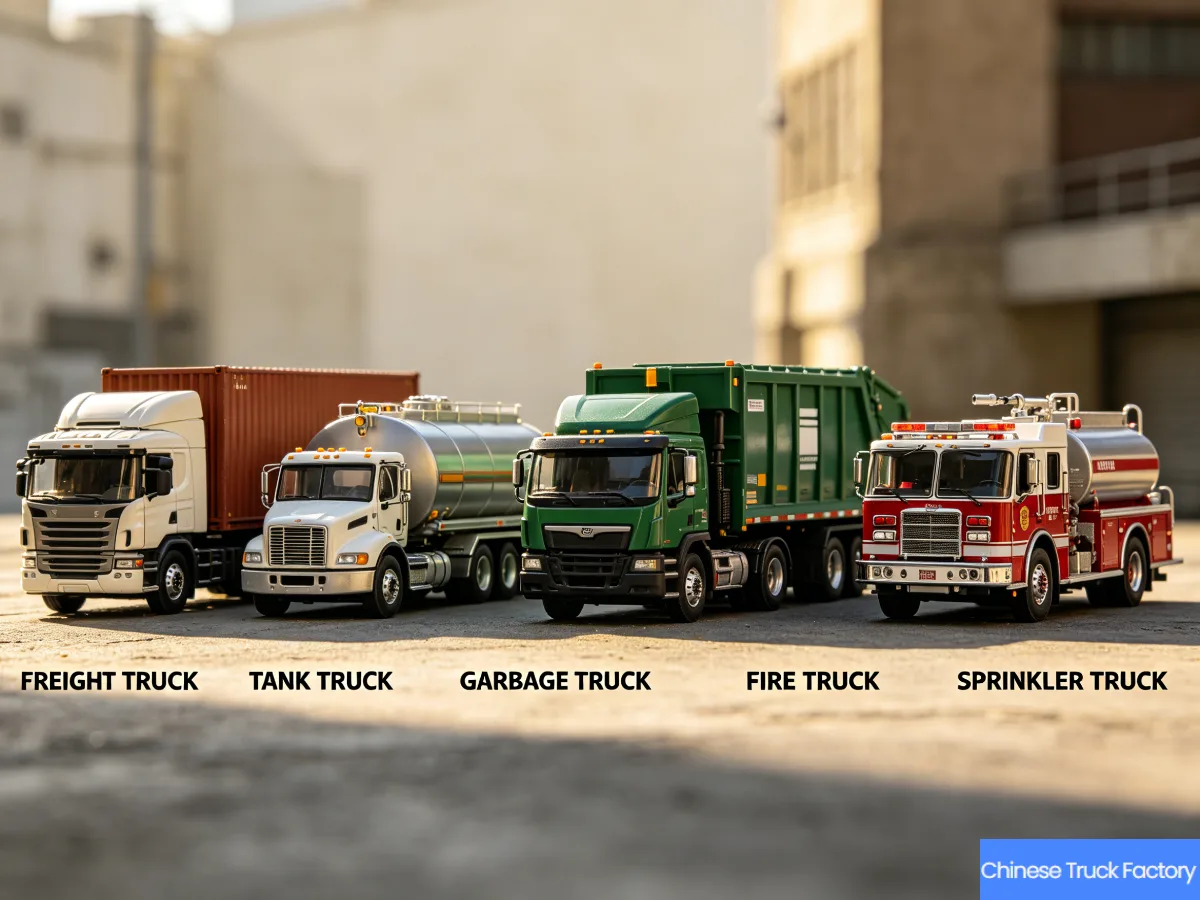
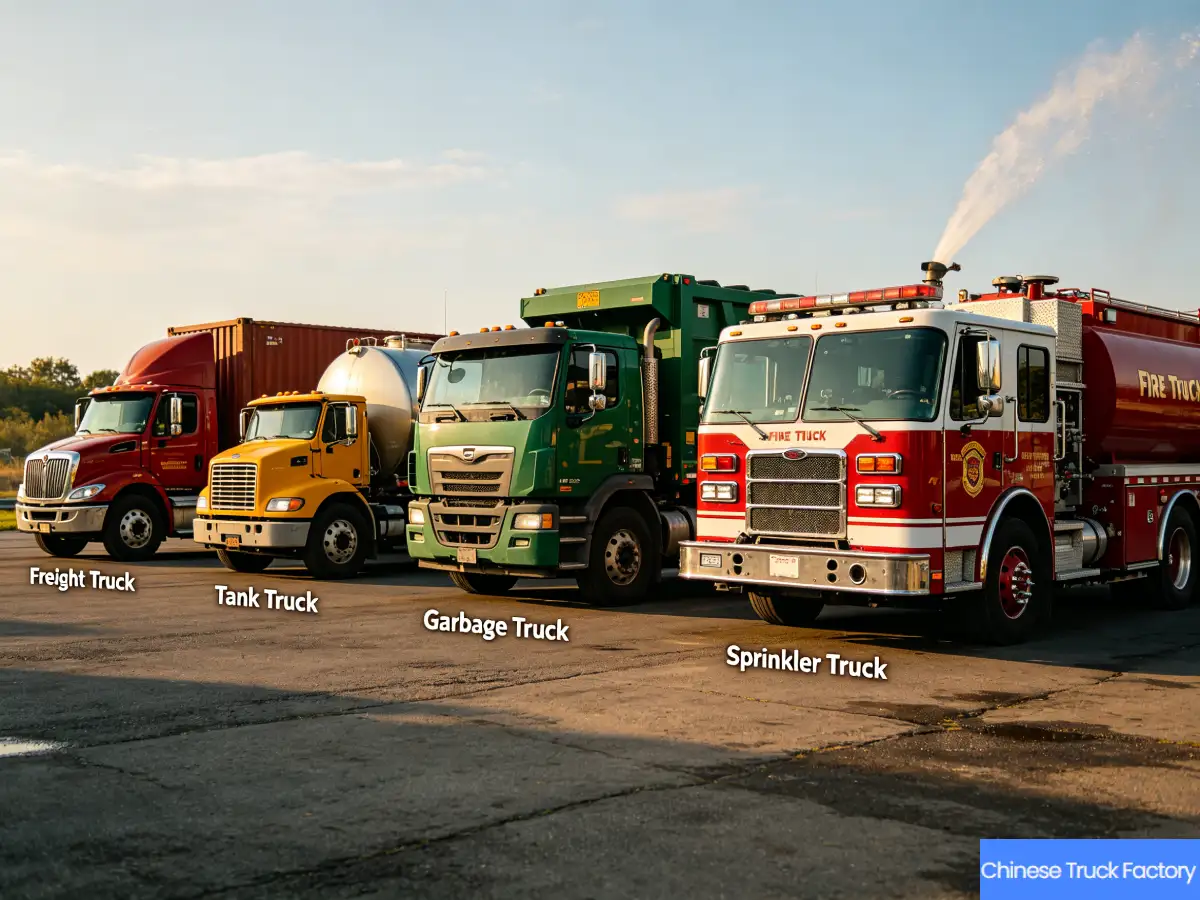
On a specialized vehicle, the body or superstructure is often where the real engineering work sits. The chassis is a platform; the body is what does the job.
Xe ben
Body volume, steel grade, floor thickness, sidewall thickness, subframe design, tipping angle, and hydraulic cylinder selection all interact. Thicker floors and higher-grade steel improve wear resistance but add tare weight, which reduces legal payload. On a high-cycle quarry operation, that trade-off usually favors a heavier body. On a lower-cycle construction job with softer material, a lighter body often makes more sense.
The hydraulic system deserves particular attention. A single-cylinder front-end telescopic system and a multi-stage underbody system behave differently in terms of tipping speed, stability, and maintenance access. Neither is universally better — it depends on the body length, the material being dumped, and how often the truck will tip per day.
Xe chở rác có thiết bị nén rác
Compactor trucks are not just dump trucks with a box on the back. Waste density, bin type, loading method, compaction ratio, hopper design, hydraulic cycle time, and leachate management all affect whether the truck actually achieves the payload it’s rated for. A compactor sized for low-density residential waste will be overloaded quickly in a commercial waste stream. Buyers evaluating this category should look at the full range of xe chuyên dụng phục vụ vệ sinh rather than comparing body volumes alone.
Truck-mounted cranes
This is where the most expensive misunderstandings happen. A crane rated at 12 tonnes does not lift 12 tonnes at full boom extension. Rated capacity applies at a specific radius, and the load chart is the only document that tells you what the crane can actually do at the radius and height you need.
Selection requires: maximum load weight, horizontal working radius, lifting height, boom configuration, outrigger setup, chassis capacity, axle loading, and — critically — the remaining cargo payload after the crane’s own weight is subtracted. A larger crane reduces the cargo you can legally carry. Anyone comparing cranes by nominal tonnage alone is comparing the wrong number. Buyers evaluating lifting capacity should compare the actual load chart before selecting a cần cẩu gắn trên xe tải.
Tàu chở dầu
Tank volume, material, compartment count, baffle design, pumping system, and product compatibility all matter. Center of gravity shifts with partial loads, which is why baffling is not optional on liquid transport. Compartment configuration should match how the product will actually be loaded and unloaded at the destination.
Fire apparatus
Water and foam capacity, pump flow and pressure, monitor reach, equipment compartment layout, and crew accommodation all have to be defined before the chassis is selected. A larger tank on an undersized chassis creates braking and stability problems that no amount of equipment can fix. Fire apparatus standards are highly destination-specific, so compliance should be confirmed with the local authority before ordering, not after. The xe cứu hỏa category page covers the main configuration variables.
Productivity and Fuel Consumption: The Numbers That Decide Profitability
Purchase price is a one-time number. Productivity and fuel are what determine whether the truck makes money.
Productivity for a haul truck is best measured as tonnes moved per operating hour hoặc cost per tonne moved. That number is driven by payload per trip, cycle time (loading + travel + dumping + return), average operating speed, and vehicle availability. A truck that carries 2 tonnes more per trip but spends an extra 20 minutes per day in the workshop is often the worse choice.
Fuel consumption cannot be quoted as a single figure. It depends on:
- Gross vehicle weight on the loaded leg
- Đặc điểm tuyến đường và độ dốc
- Average speed and traffic conditions
- Idling time (loading, queuing, dumping)
- Hành vi của người lái xe
- Tỷ số truyền trục và áp suất lốp
- Climate, altitude, and engine calibration
Any fuel figure given without those conditions attached is a marketing number, not an engineering one. If a supplier quotes a specific consumption value, ask what gross weight, route, and average speed it was measured at.
For electric trucks, the equivalent question is kWh per kilometre under the actual duty cycle, not the headline range figure. Usable battery capacity, route predictability, charging power, depot dwell time, ambient temperature, and battery degradation all affect whether an electric truck pencils out. For fixed-route, high-cycle operations with reliable depot charging, the math can work well. For unpredictable routing or long daily mileage, it usually doesn’t yet. Buyers should compare the total cost of ownership between electric and diesel tractor trucks under their own assumptions before committing.
Compliance, Registration, and Destination-Market Reality
There is no such thing as a truck that is “compliant globally.” Every destination market has its own rules, and they change. Before ordering, buyers should confirm at minimum:
- Tiêu chuẩn khí thải: what the destination country requires for import and registration
- Chứng nhận tương đương hoặc chứng nhận kiểu loại: whether the model is recognized by the local authority
- Cấu hình hệ thống lái: left-hand or right-hand drive
- Axle-weight and gross-weight limits: what the truck can legally carry on public roads
- Kích thước xe: length, width, height, and any local restrictions
- Lighting and braking requirements: often differ from the source market
- Chất lượng nhiên liệu và tình trạng sẵn có của DEF/AdBlue: matters for modern emission systems
- Registration eligibility: some markets restrict import age or require specific documentation
Regulatory details vary by country and change over time. Rather than relying on a supplier’s general statement, buyers should verify against the destination country’s transport ministry or customs authority directly. The Các quy định về phương tiện giao thông của UNECE và U.S. EPA emission standards are useful starting points for understanding how the frameworks differ, but the final word is always the destination authority.
The same principle applies to the configuration itself. A truck ordered for one market will not automatically suit another. Climate, altitude, road condition, and parts availability all shape the right specification, which is why a Chinese truck buying guide should always be read alongside destination-specific requirements rather than in place of them.
Shipping, Incoterms, and Landed Cost
How the truck gets to you affects both cost and risk allocation. The main options are RoRo, breakbulk, flat rack, and container where the vehicle fits. The right choice depends on vehicle dimensions, weight, whether it can be driven onto a vessel, quantity, route, and destination port.
Commercial terms matter just as much. FOB, CFR, and CIF place different responsibilities on the buyer and seller, and the price difference between them is not arbitrary — it reflects who pays freight and insurance. Comparing an FOB quote from one supplier against a CIF quote from another is meaningless unless both are converted to the same basis. The same applies to landed cost, which includes freight, insurance, port charges, customs clearance, import duty, and inland transport. A detailed explanation of what an FOB truck price includes and what it does not is worth reading before comparing quotes side by side.
Total Cost of Ownership: The Comparison That Actually Decides
Purchase price is roughly 20–30% of a truck’s lifetime cost in most heavy-duty applications. The rest is fuel, tires, maintenance, repairs, downtime, and residual value. A truck that costs 15% more up front but returns 8% better fuel economy and spends three fewer days per year in the workshop is often the cheaper truck over five years.
| Loại chi phí | What drives it | Typical buyer oversight |
|---|---|---|
| Giá mua | Chassis, engine, transmission, body, options | Comparing quotes with different scopes |
| Vận chuyển và bảo hiểm | Shipping method, route, vehicle size | Ignoring it in the initial comparison |
| Nhập khẩu và tuân thủ | Duty, clearance, registration, homologation | Not budgeting for it at all |
| Nhiên liệu hay điện | Duty cycle, gearing, driver, climate | Using a quoted figure instead of a calculated one |
| Lốp xe | Axle load, road surface, alignment | Underestimating on rough haul roads |
| Bảo trì theo lịch trình | Operating hours, oil and filter intervals | Not planning parts availability |
| Các công việc sửa chữa ngoài kế hoạch | Component quality, duty severity | Assuming zero, which is never true |
| Thời gian ngừng hoạt động | Parts lead time, local service capability | Ignoring this entirely — often the largest hidden cost |
| Giá trị còn lại | Brand, condition, market demand | Not factoring it in |
Downtime is the line item most often left out and most often the largest. A truck sitting for two weeks waiting on a hydraulic cylinder costs more than the cylinder. Before ordering, confirm that critical spare parts are available in the destination market or that a sensible spares package is included with the shipment.
Supplier Selection: What to Actually Verify
Supplier quality varies widely, and the difference shows up after delivery, not before. A practical evaluation framework should cover:
- Năng lực kỹ thuật: can they discuss axle ratios, body design, and duty cycle matching, or do they only quote from a catalog?
- Tính minh bạch trong thông số kỹ thuật: do they provide a written technical file with actual weights, dimensions, and component models?
- Compliance handling: do they ask about the destination country’s requirements, or assume one spec fits all?
- Shipping coordination: do they understand RoRo, breakbulk, and container logistics, and can they advise on the right method?
- Lập kế hoạch phụ tùng thay thế: do they help build a spares package, or leave the buyer to figure it out?
- Phạm vi bảo hành: written, specific, and covering what actually fails
- Dịch vụ hỗ trợ sau bán hàng: a real channel for technical questions after delivery
- Verification: a physical address, verifiable business registration, and references that can be checked
Chinese Truck Factory is structured around this framework. The site is built by people who work with commercial vehicle configuration and export logistics, and the technical content reflects that — payload calculations, axle ratio explanations, shipping method comparisons, and destination-market considerations are all covered in depth rather than reduced to a single spec sheet. Buyers can review the Chinese truck buying guide và supplier verification checklist before sending any deposit, and can request a configuration review for their specific duty cycle.
Request a Configuration Review for Your Duty Cycle
Maintenance Planning: What to Set Up Before Delivery
Maintenance is not something to figure out after the truck arrives. The daily and periodic checks below are standard for heavy-duty trucks and specialized vehicles, and the intervals should always follow the actual vehicle, engine, and component manufacturer manuals — not a generic schedule.
Kiểm tra hàng ngày: tire condition and pressure, fluid leaks, hydraulic hoses, lights, air system pressure, warning indicators, and for specialized bodies, the specific mechanism (tipping cylinder, compactor cycle, crane pins, pump operation).
Kiểm tra định kỳ: engine oil and filters, transmission and differential fluids, brake system and wear, suspension components, wheel bearings, hydraulic oil and filter, PTO operation, and body-specific wear points such as dump body hinges, compactor wear plates, or crane structural welds.
The most common mistake here is treating maintenance as a cost to minimize rather than an uptime investment. On a truck running 250 days a year, one extra day of downtime costs more than a year’s worth of scheduled maintenance parts. Buyers should plan the parts supply chain before delivery, not after the first failure.
Các câu hỏi thường gặp
Làm thế nào để chọn tải trọng phù hợp cho hoạt động của mình?
Start with the material or cargo density, multiply by the body volume you need, and check that against the chassis GVW minus curb weight. Then verify the result against the destination country’s legal gross weight and axle-load limits. All three checks have to pass. Payload is not a single number — it’s the lowest of the technical, structural, and legal limits.
Which axle configuration should I choose?
It depends on the route and payload. 4×2 suits light urban work and paved-road tankers. 6×4 is the general-purpose choice for construction haulage and tractor units. 6×6 and 8×8 are for severe off-road conditions. 8×4 gives higher payload capacity but adds tare weight, tire cost, and turning radius. The right answer comes from the duty cycle, not the catalog.
Tình trạng đường xá ảnh hưởng như thế nào đến việc lựa chọn xe tải?
Rough or unpaved haul roads require more suspension travel, stronger frame and body construction, and often a shorter axle ratio for better low-speed torque. Paved highway work favors taller gearing and lighter bodies for fuel economy. Gradient on the loaded leg is the single biggest factor in powertrain selection.
Những yếu tố nào ảnh hưởng đến mức tiêu thụ nhiên liệu của xe tải nặng?
Gross weight, route profile, average speed, idling time, driver behavior, axle ratio, tire pressure, climate, and altitude all matter. Any fuel figure quoted without these conditions attached is not useful for comparison. Ask what duty cycle the number was measured under.
Làm thế nào để ước tính tổng chi phí sở hữu?
Add purchase price, freight, insurance, import and compliance costs, fuel or electricity, tires, scheduled maintenance, unscheduled repairs, spare parts, and downtime, then subtract residual value. Downtime is the most commonly overlooked line and often the largest. Purchase price is typically only a fraction of the lifetime cost.
Tôi cần cung cấp những thông tin nào để nhận được báo giá chính xác?
Destination country and port, application, cargo or material, required payload, body capacity, daily mileage, road condition, gradient, drive configuration, steering side, emission requirement, quantity, and any required options. For crane trucks, add maximum lifting weight, working radius, and lifting height. For tankers, add product type and compartment requirements. For fire apparatus, add water and foam capacity and pump requirements.
Làm thế nào để xác nhận việc tuân thủ các quy định của nước đến?
Check with the destination country’s transport ministry or customs authority directly. Confirm emission standard, homologation or type approval, registration eligibility, axle-weight limits, vehicle dimensions, steering side, lighting, braking, and safety requirements. Regulatory details change, so verify against the current official source rather than relying on a supplier’s general statement.
Xe tải được vận chuyển từ Trung Quốc như thế nào?
The main methods are RoRo, breakbulk, flat rack, and container where the vehicle fits. The right choice depends on vehicle dimensions, weight, whether it can be driven onto the vessel, quantity, route, and destination port. Commercial terms (FOB, CFR, CIF) determine who pays freight and insurance, and quotes should always be compared on the same basis.
What Actually Decides the Right Truck
The final specification is determined by the duty cycle, the payload requirement, the legal weight limits of the destination country, the road and climate conditions, the maintenance capability available locally, and the total cost of ownership over the expected service life. Those six factors drive everything else — axle configuration, engine and transmission choice, axle ratio, body design, and shipping method.
The parameters most worth confirming first are payload versus GVW versus legal limits, emission and homologation requirements for the destination market, and parts availability for the components most likely to wear. Buyers who confirm those three things before ordering rarely end up with a truck that doesn’t fit the job.
The most common mistakes are all variations on the same theme: starting with a model instead of a task, comparing prices on different bases, assuming body volume equals payload, and treating compliance as a formality rather than a design input. Each one is avoidable with a bit of discipline at the specification stage.
Do đó, chiếc xe tải phù hợp nhất không nhất thiết phải là mẫu xe có công suất cao nhất hay thùng xe lớn nhất. Đó chính là cấu hình đáp ứng được tải trọng, lộ trình, giới hạn trọng lượng theo quy định, khả năng bảo dưỡng và chu kỳ vận hành dự kiến với ít sự thỏa hiệp nhất.