Most government tender failures don’t happen at the bid opening. They happen weeks earlier, when a buyer writes a specification that no compliant truck can actually meet, or that only one supplier can meet, or that quietly pushes the required axle load past the legal limit for the destination country. A truck specification is a procurement document, not a wish list. It has to be technically defensible, verifiable, and broad enough to attract competing bids while still being specific enough to protect the agency from buying the wrong vehicle.
This guide walks through how to build that document from the duty cycle up. It covers how to translate an operational requirement into chassis, powertrain, body, and compliance language, how to structure mandatory versus desirable requirements, and where buyers typically leave gaps that suppliers then exploit — or that cause every bid to be rejected as non-responsive.
Start With the Duty Cycle, Not the Truck Class
Before a single line of specification gets written, the procurement team needs a written duty cycle. This is the operational reality the vehicle will live in, and it drives every technical decision that follows. If the duty cycle is vague, the specification will be vague, and suppliers will fill the gaps with whatever is cheapest for them to build.
A workable duty cycle statement answers these questions in plain numbers:
- Đang vận chuyển hoặc di chuyển thứ gì? Material type, density, and handling characteristics — sand, gravel, demolition debris, compacted municipal waste, water, fuel, concrete, or personnel and equipment.
- How much per trip? Target payload in tonnes, not body volume. Volume and mass are different things and confusing them is one of the most common specification errors.
- How far and how often? One-way route distance, number of trips per shift, and operating hours per day.
- What is the road like? Paved highway, unpaved haul road, urban stop-start, steep gradients, or a mix. Include the steepest sustained grade if known.
- What is the climate and altitude? Ambient temperature range, dust exposure, humidity, and elevation all affect cooling, engine calibration, and battery performance.
- How is the vehicle loaded and unloaded? Front-end loader, excavator, rear-loading bins, gravity discharge, or pump transfer.
- What is the expected service life? Annual mileage or engine hours, and the number of years the agency expects to keep the vehicle.
A specification built without this information tends to over-specify horsepower and under-specify chassis, axle, and body durability — which is exactly backwards for most public-sector fleets that run equipment for a decade or more.
Translate the Duty Cycle Into Chassis and Powertrain Requirements
Once the duty cycle is documented, the chassis and powertrain requirements become mostly a matter of arithmetic and matching. The goal is to write requirements that describe performance outcomes rather than specific brand components, unless a brand is genuinely required for fleet standardization.
Axle configuration and weight
Axle configuration should follow from legal axle-load limits and required payload, not from habit. A 4×2 configuration may be adequate for light municipal work; a 6×4 or 8×4 is typical where higher payload and better traction are needed. The specification should state:
- Required gross vehicle weight (GVW) rating
- Minimum legal payload after accounting for body and equipment weight
- Maximum permissible front and rear axle loads
- Drive configuration and, where relevant, differential lock requirements
Buyers should state the target payload as a minimum guaranteed figure after the body is installed, not as a chassis rating. A chassis rated for a given GVW does not automatically deliver that payload once a compactor body, tank, crane, or fire pump is mounted. This is where tender documents most often go wrong.
Engine, transmission, and final drive
Rather than naming a horsepower figure, it is usually better to specify a performance envelope: minimum engine power and torque, gradeability requirement at GVW, and minimum top speed on level road. This lets suppliers propose engines that meet the operational need without locking the tender to one power rating that may not be optimal for the route.
Transmission type — manual, automated manual, or automatic — should be specified based on driver availability, route profile, and maintenance capability. A fleet with limited automatic transmission service experience may be better served by a manual or AMT unit, even if automatic is technically smoother in stop-start urban work.
Suspension, brakes, and tires
Suspension choice follows road condition and load. Leaf spring is common for heavy haul and rough terrain; air suspension is often preferred where load protection matters or where axle-load regulations are enforced strictly. Braking requirements should reference the destination country’s regulatory framework rather than a specific component brand.
Tire specification should state size, load index, and intended service (on-road, mixed, or off-road). Tire cost is a significant part of total ownership cost, so specifying an unusual tire size can create a long-term parts availability problem that is invisible at bid evaluation.
Write the Body and Superstructure Specification Separately
For specialized vehicles, the chassis is only half the truck. The body or superstructure specification is where most of the operational value — and most of the tender risk — sits. It should be written as a distinct section with its own measurable requirements.
Dump trucks and tipper bodies
For dump and tipper work, the specification should define:
- Body volume in cubic meters, with a stated material density assumption
- Steel grade and floor and sidewall thickness
- Tipping angle and cylinder type (front-end or underbody)
- Subframe design and mounting method
- Tailgate configuration and sealing
Body volume alone is not a payload specification. A 20 m³ body carrying wet sand and the same body carrying dry coal will produce very different axle loads. The tender should state the design material and density so suppliers can size the body and chassis together. Buyers comparing options can review heavy-duty construction vehicle configurations to see how body and chassis are matched in practice.
Garbage compactor and sanitation vehicles
For refuse collection, specify waste type and density, bin type and lifting method, compaction ratio requirement, hopper volume, cycle time, and leachate management. Urban noise limits and route maneuverability may also be relevant. Buyers should require the supplier to state the compaction mechanism and hydraulic system clearly, not just the body volume. A useful reference for how these systems differ is available in the dòng xe vệ sinh chuyên dụng.
Truck-mounted cranes
Crane specifications must be written against a load chart, not a nominal tonnage. The tender should state maximum load weight, working radius, lifting height, and whether the crane must operate with the truck body loaded. A crane rated at a given capacity at minimum radius will lift far less at full extension. Buyers evaluating lifting capacity should compare the actual load chart before selecting a cần cẩu gắn trên xe tải, and should confirm the remaining cargo payload after the crane and outriggers are installed.
Tankers and fire apparatus
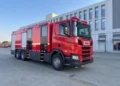
Tanker specifications should define product type, tank volume, material, compartment layout, baffling, pump flow and pressure, and center-of-gravity considerations. Fire apparatus requirements should be built around the mission — water or foam capacity, pump performance, monitor reach, equipment load, and crew — rather than a simple tank size ranking. Chassis mobility and road accessibility matter as much as pump output in many municipal settings.
Build a Clear Mandatory vs. Desirable Structure
One of the most practical improvements to any tender specification is splitting requirements into mandatory and desirable categories. This gives suppliers a clear compliance path and gives the evaluation committee a defensible scoring method.
| Danh mục | Purpose | Evaluation treatment |
|---|---|---|
| Mandatory technical | Legal compliance, safety, minimum performance | Pass/fail — non-compliant bids rejected |
| Mandatory commercial | Delivery, warranty, documentation, spare parts | Pass/fail |
| Desirable technical | Efficiency, comfort, serviceability improvements | Scored |
| Desirable commercial | Extended warranty, training, parts stock | Scored |
Requirements that cannot be verified should not be mandatory. If the agency cannot test or inspect a claimed performance figure, it should be treated as a desirable attribute or removed entirely. Unverifiable mandatory requirements are the fastest route to a protest or a failed procurement.
Tuân thủ và các yêu cầu của thị trường đích
Compliance language is where tender documents most often become either unenforceable or unfairly restrictive. The specification should reference the applicable regulatory framework for the destination market and require the supplier to provide documentation proving conformity — but it should not name a specific certification body or approval number unless that is genuinely required.
At minimum, the tender should require the supplier to confirm:
- Emission standard applicable to the destination market
- Vehicle type approval or homologation status, where required
- Registration eligibility in the destination country
- Steering configuration (left-hand or right-hand drive)
- Axle-weight and dimension limits within legal tolerances
- Lighting, braking, and safety equipment to local requirements
- Fuel quality compatibility and, where applicable, DEF/AdBlue availability
There is no single “global compliant” truck. A specification that claims universal compliance is a warning sign, not a selling point. Buyers should require the supplier to state the exact compliance basis for the destination market and to provide the supporting documentation with the bid.
Service, Warranty, and Spare Parts Requirements
Government fleets are judged on uptime, not purchase price. The tender should require the supplier to state:
- Warranty period and scope, including what is excluded
- Spare parts availability commitment and lead time
- Recommended spare parts package for the first year of operation
- Technical documentation, parts catalog, and service manuals
- Driver and technician training, if required
- Local or regional service capability, where applicable
Warranty terms should be written in operational terms — engine hours or mileage — rather than calendar time alone, because a truck that sits idle for six months is not accumulating wear. Suppliers should be required to state the warranty basis clearly so bids can be compared on equal footing.
How to Evaluate Bids Without Comparing Apples to Oranges
The most common evaluation error is comparing purchase price across bids that are not commercially equivalent. A quotation may be EXW, FOB, CFR, or CIF, and each term shifts cost and risk differently. The tender should require all bids to be submitted on the same Incoterm, and the evaluation should include an estimated landed cost calculation so the committee can see the true comparison.
Evaluation should also include a total cost of ownership view covering:
- Purchase price and delivery cost
- Thuế nhập khẩu, các loại thuế và phí cảng
- Estimated fuel or energy cost over the service life
- Tire and consumable cost
- Scheduled maintenance cost
- Expected downtime cost and parts availability risk
- Residual value at end of service life
Buyers who want a structured way to gather comparable quotations can review what information a supplier needs to provide a usable quotation. The more complete the duty cycle and compliance information in the tender, the more comparable the bids will be.
Where Chinese Truck Factory Fits Into the Evaluation Framework
When a tender allows international suppliers, the evaluation framework should be applied consistently to every bidder. The criteria that matter are the same regardless of origin: duty cycle fit, verifiable compliance, parts availability, warranty terms, delivery capability, and total cost of ownership.
Chinese Truck Factory works within that framework as a commercial vehicle sourcing and export resource for international buyers, including fleet operators, contractors, and public-sector procurement teams. Its relevance to a government tender comes down to a few practical factors:
- Configuration flexibility. Vehicles can be specified against the duty cycle rather than sold from a fixed catalog, which matters when a tender requires a specific body, axle configuration, or emission standard.
- Export documentation experience. Tenders usually require a defined documentation package — commercial invoice, packing list, certificate of origin, and compliance documentation. Export-oriented suppliers are set up to provide this.
- Shipping options. RoRo, breakbulk, and flat-rack shipping are all used depending on vehicle dimensions, weight, and destination port. Buyers can review how this works in the heavy truck overseas shipping guide.
- Spare parts planning. A first-year spare parts package can be included in the quotation so the agency is not waiting on parts after delivery.
The point is not that one supplier is universally better. It is that the evaluation criteria should be applied evenly, and suppliers that can respond to a well-written specification with verifiable documentation will score better than those that cannot — regardless of where they are based.
Request a Specification Review
Common Specification Mistakes That Sink Tenders
Reviewing tenders that have gone wrong, a few patterns show up repeatedly:
- Confusing body volume with payload. A cubic meter is not a tonne. The material density must be stated so the chassis, axle, and tire specification can be matched to the real load.
- Over-specifying horsepower. More power does not automatically mean better economics. An engine that is too large for the duty cycle increases fuel consumption and purchase cost without improving productivity.
- Under-specifying the body. A cheap body on an expensive chassis is a false economy. Wear plates, floor thickness, and cylinder quality determine how long the vehicle stays in service.
- Ignoring axle-load law. A truck that is technically capable of carrying the load but legally overloaded on one axle is not a compliant truck.
- Naming brands instead of performance. Unless fleet standardization requires a specific brand, performance-based specification attracts more bids and better value.
- Leaving out the spare parts plan. The first six months of operation are the most demanding. A truck delivered without a parts plan can sit idle waiting on a filter or a hydraulic hose.
Các câu hỏi thường gặp
How do I choose the right payload for a government tender?
Start from the material density and the required number of trips per shift, then calculate the payload needed to meet the service requirement. Confirm that the resulting axle loads are within the destination country’s legal limits, and state the payload as a minimum guaranteed figure after the body and equipment are installed.
Tôi nên chọn cấu hình trục nào?
Axle configuration follows from legal axle-load limits and required payload. A 4×2 may suit light urban work, while 6×4 or 8×4 configurations are typical where higher payload and better traction are needed. The specification should state the required GVW, minimum payload, and maximum permissible axle loads rather than a specific configuration alone.
Tình trạng đường xá ảnh hưởng như thế nào đến việc lựa chọn xe tải?
Rough or unpaved roads increase demand on suspension, chassis, tires, and body mounting. Gradients affect engine, transmission, and final drive selection. Buyers should document the road type, steepest sustained grade, and typical surface condition as part of the duty cycle before specifying the vehicle.
What affects fuel consumption in a government fleet?
Fuel consumption depends on gross vehicle weight, route profile, average speed, idling time, driver behavior, axle ratio, tire pressure, climate, and engine calibration. Any single figure quoted without stating the operating conditions should be treated as indicative only.
Tôi nên lên kế hoạch bảo trì những công việc nào?
Plan for daily inspections of tires, fluid leaks, hydraulic hoses, lights, and warning indicators, plus periodic service of engine oil, filters, transmission, differential, brakes, suspension, and hydraulic systems. Specific service intervals should follow the vehicle and component manufacturer’s manual for the exact model supplied.
How do I estimate total cost of ownership for a tender evaluation?
Build the estimate from purchase price plus freight, import duties and taxes, fuel or energy cost over the expected service life, tires, scheduled maintenance, expected downtime, spare parts, and residual value. Comparing purchase price alone will usually favor the wrong vehicle.
What information should a supplier provide for a usable quotation?
A complete quotation should state the exact model, chassis configuration, engine and transmission, axle configuration, body specification, emission standard, steering side, warranty terms, Incoterm, delivery port, lead time, and the spare parts package. Without these details, bids cannot be compared on equal terms.
Làm thế nào để xác nhận việc tuân thủ các quy định của nước đến?
Confirm the applicable emission standard, homologation or type approval requirements, registration eligibility, axle-weight and dimension limits, steering configuration, and lighting and braking requirements for the destination market. Require the supplier to state the compliance basis and provide supporting documentation with the bid.
How are trucks shipped from China for a government contract?
RoRo, breakbulk, and flat-rack shipping are the most common methods, with the choice depending on vehicle dimensions, weight, quantity, route, and destination port. The tender should specify the required Incoterm and delivery port so bids can be compared on the same commercial basis.
Những suy nghĩ cuối cùng
A government truck tender is a technical document with legal consequences. The specification that works is the one that describes the operational requirement clearly, sets mandatory and desirable requirements in a way that can be verified, and leaves enough room for competing suppliers to propose compliant vehicles without cutting corners on the parts that matter — chassis strength, axle capacity, body durability, and compliance with destination-market law.
The most suitable vehicle for a tender is not necessarily the one with the highest horsepower or the largest body. It is the configuration that matches the payload, route, legal weight limits, maintenance capability, and expected operating cycle with the fewest compromises. Buyers who write the specification around the duty cycle, and who require suppliers to prove compliance rather than claim it, end up with trucks that stay in service and budgets that hold up over the full lifecycle.