If you are sourcing trucks for a fleet, a construction project, a mine, or a municipal contract in Kenya, the shortlist almost always comes down to a handful of Chinese manufacturers and the export channels that represent them. The practical answer is that most Kenyan buyers end up working with Sinotruk (HOWO), Shacman, FAW Jiefang, Dongfeng, Foton, JAC, and Beiben chassis, sourced either through a factory export division, an authorized regional distributor, or an independent export supplier that handles specification, inspection, and shipping. The right supplier is not simply the one with the lowest quoted price. It is the one whose chassis, body, axle configuration, and after-sales support match the duty cycle the truck will actually run — and who can document that match before you send a deposit.
What follows is a selection framework rather than a league table. Brand strength matters, but it matters far less than whether a specific configuration can legally and reliably do the work you are paying it to do.
เริ่มจากอัตราการทำงาน ไม่ใช่จากแบรนด์
Before comparing suppliers, define the job. A truck hauling 30 tonnes of aggregate over a 40 km route with long grades needs a different chassis than one collecting refuse on stop-start urban routes, and both need something different from a tractor pulling a 40-foot container on the highway between Mombasa and Nairobi.
Write down the following before you request any quotation:
- ประเภทสินค้าหรือวัสดุ — sand, gravel, rock, coal, soil, construction debris, containerized cargo, water, fuel, waste
- น้ำหนักบรรทุกต่อเที่ยว — in tonnes, not cubic meters
- ความหนาแน่นของวัสดุ — this converts body volume into real weight
- ความยาวและสภาพพื้นทาง — paved highway, gravel haul road, unimproved site road
- ความชัน — sustained grades above 8% change engine, transmission, and axle ratio selection
- ความสูงและอุณหภูมิรอบตัว — both affect engine derate and cooling
- Daily cycles and annual mileage — drives maintenance intervals and lifecycle cost
- วิธีการโหลดและขนถ่าย — excavator, wheel loader, manual, tipper, crane
A common mistake is to specify a body volume and assume it equals payload. A 20 m³ dump body carrying dry sand at roughly 1.6 t/m³ would theoretically hold 32 tonnes — well beyond what most 6×4 chassis can legally carry on Kenyan roads. The same body carrying coal at around 0.9 t/m³ would be underloaded. Volume is a container size; payload is a weight limit. They are not interchangeable, and the lower of the two governs.
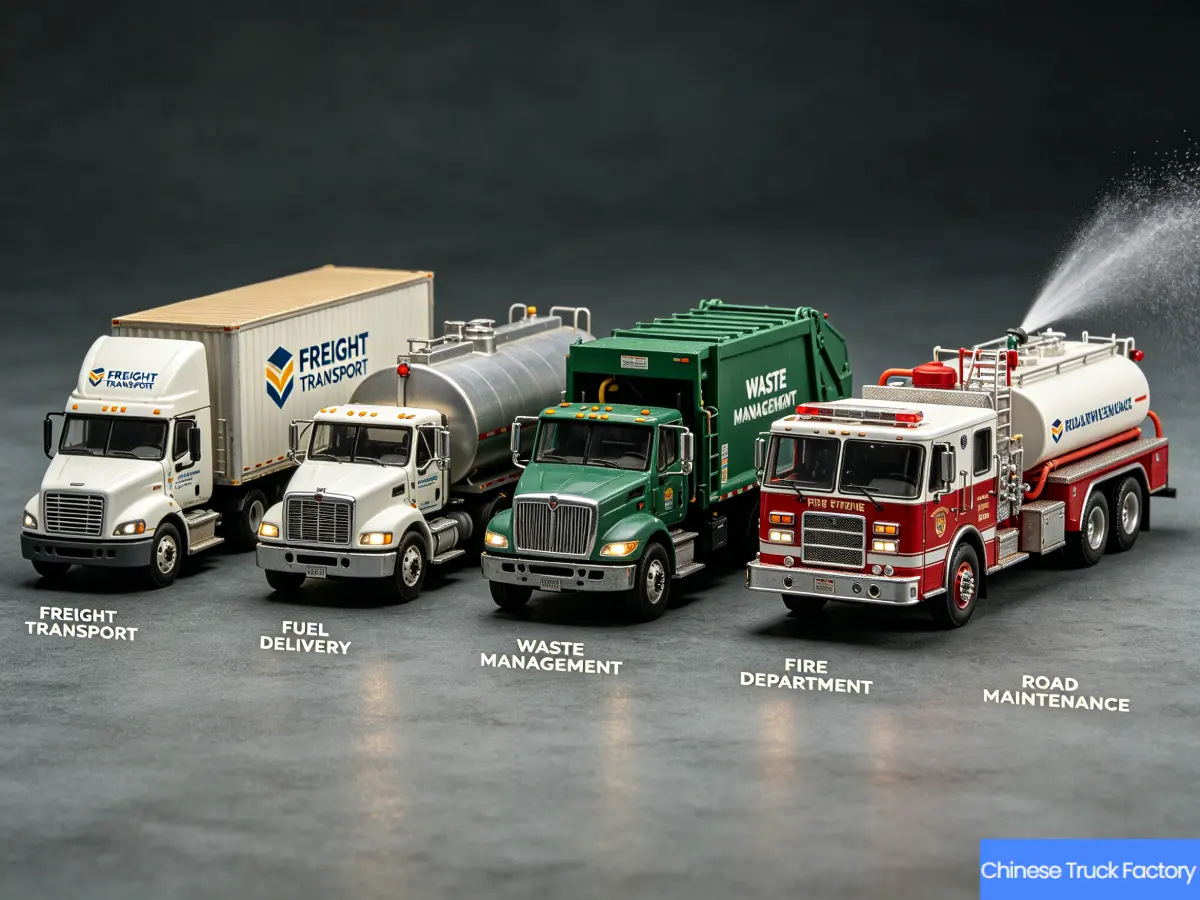
How Chinese Truck Suppliers Actually Reach Kenya
There are three broad supply routes, and each has different implications for price, lead time, warranty, and parts support.
1. Factory Export Division
Working directly with a manufacturer’s export arm can give you access to current production specifications and, in some cases, factory-backed warranty terms. The trade-off is that factories typically prioritize volume orders and may not provide much hand-holding on destination-specific compliance, shipping coordination, or body installation. If you are ordering a standard tractor or dump chassis in quantity, this route can be efficient. If you need a specialized body — a compactor, a crane, a tanker — you will usually still need a body builder and an export coordinator.
2. Authorized Regional Distributor
An authorized distributor in the region typically stocks or can source common models, handles local registration paperwork, and provides a service point. The cost is higher than direct sourcing, and the model range is narrower because distributors focus on configurations they can support. For fleet operators who value uptime and local parts over the lowest possible unit price, this is often the more defensible choice.
3. Independent Export Supplier
This is where most first-time and mid-size buyers land. An experienced export supplier sources the chassis, coordinates body installation, arranges inspection, handles shipping, and prepares documentation. The quality range here is wide. Some suppliers are essentially trading companies with no engineering capability; others function as application engineers who will push back on a specification that will not work. The difference shows up in the details — whether they ask about axle load limits, whether they can explain the load chart on a crane, whether they will let you inspect before shipment.
Buyers who need to understand the mechanics of moving a unit from the factory to the port of destination should read this guide to วิธีการขนส่งรถบรรทุกขนาดใหญ่จากจีนไปยังต่างประเทศ, since shipping method affects both cost and the risk of transit damage.
Comparing the Main Chassis Options
The table below summarizes how the most common Chinese heavy truck platforms are typically positioned. This is not a ranking. Each has configurations that suit specific operating conditions, and each has configurations that would be a poor fit elsewhere.
| Brand / Platform | Common Configurations | การใช้งานทั่วไป | ข้อควรพิจารณา |
|---|---|---|---|
| Sinotruk (HOWO series) | 4×2, 6×4, 8×4; 290–460 hp range | Dump, tractor, mixer, tanker, sanitation | Widely represented in export markets; parts network relatively broad |
| Shacman (F3000, X3000, X6000) | 6×4, 8×4; Weichai and Cummins engine options | Construction, mining, long-haul | Strong chassis reputation; confirm axle ratio for your route |
| FAW Jiefang | 6×4, 8×4; broad engine range | General haulage, construction | Established brand; verify local service coverage |
| ดงเฟิง | 4×2, 6×4; lighter to medium-heavy | Urban distribution, municipal, light construction | Good fit for lighter duty cycles; check payload ceiling |
| Foton Auman | 6×4, 8×4 | Haulage, construction | Competitive pricing; confirm body compatibility |
| JAC | 4×2, 6×4 | Medium-duty, distribution | Suited to lighter applications |
| Beiben | 6×4, 6×6, 8×4 | Mining, rough-terrain haulage | Heavier-duty chassis options; verify parts availability |
None of these platforms is universally better. A HOWO 6×4 dump truck and a Shacman 8×4 dump truck can both be correct answers for different jobs — the first for a tighter site with moderate payload, the second for higher legal payload on roads that permit the extra axle. The decision belongs to the duty cycle, not the badge.
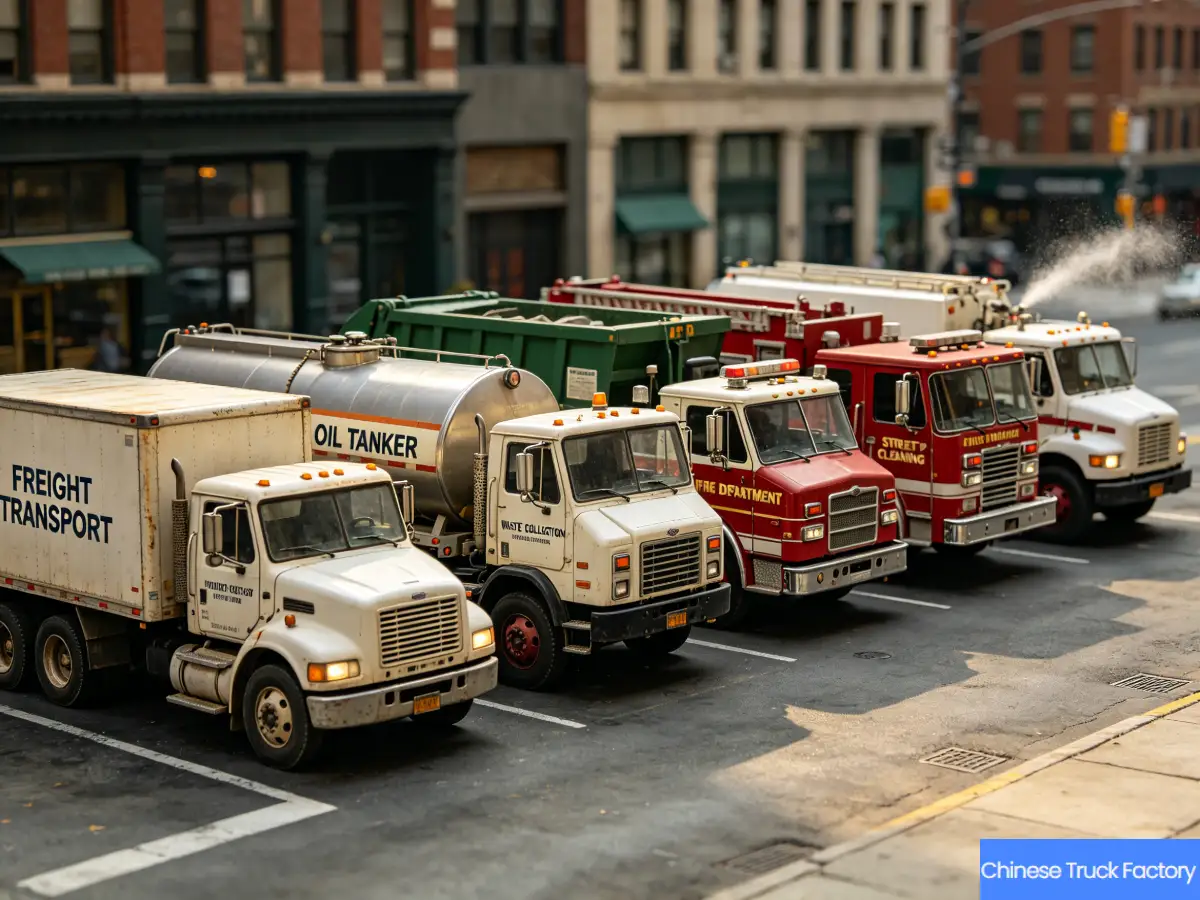
Payload, GVW, and the Legal Weight Question
This is where a large share of imported trucks run into trouble after delivery. Three numbers get confused constantly:
- น้ำหนักตัวรถ (น้ำหนักเปล่า) — the truck with fuel, fluids, and body, no cargo
- ข้อมูลที่ส่ง — the weight of cargo the truck can carry
- GVW / GVWR — the maximum total weight of the loaded vehicle
The arithmetic is simple: payload = GVW − curb weight. If a chassis has a factory GVW rating of 31 tonnes and the completed truck with body weighs 14 tonnes empty, the theoretical payload is 17 tonnes. But that is a technical figure. The legal payload in Kenya depends on the axle weight limits and gross vehicle weight limits that apply to the roads the truck will use, and those limits must be confirmed with the relevant authorities before the specification is frozen.
Two further cautions:
- Technical axle capacity is not legal axle load. An axle rated to 16 tonnes may only be permitted to carry 13 tonnes under local rules.
- Factory-rated GVW is not automatically the registered GVW. Registration documents in the destination market govern what you can legally operate.
For a deeper breakdown of how these figures interact, this explanation of ความจุบรรทุกของรถดัมพ์, น้ำหนักรวมของรถ (GVW), น้ำหนักรถเปล่า, และน้ำหนักบรรทุกตามกฎหมาย is worth reading before you finalize a body size.
A Worked Example (Illustrative)
Consider a quarry operation moving crushed rock over a 12 km haul route, half of it on a graded gravel road with a sustained 6% grade. Assume the material density is approximately 1.5 t/m³. If the target is 18 tonnes of payload per cycle, the required body volume is roughly 12 m³ — but the chassis must be able to carry 18 tonnes legally, which usually points to a 6×4 configuration with a suitable axle ratio for the grade. Increasing the body to 16 m³ would not increase payload; it would simply invite overloading, which accelerates tire, brake, and axle wear and creates a legal exposure. This is an engineering scenario, not a specific project.
Matching Configuration to Operating Conditions
The drive layout is the single most consequential configuration decision after payload.
| การตั้งค่า | เหมาะที่สุดสำหรับ | ข้อดีหลัก | ข้อจำกัดหลัก |
|---|---|---|---|
| 4×2 | Urban distribution, light municipal work | Lower cost, tighter turning radius | Lower payload ceiling |
| 6×4 | General construction, haulage, dump work | ความสมดุลที่ดีระหว่างน้ำหนักบรรทุกและแรงดึง | น้ำหนักตัวรถสูงกว่าแบบ 4×2 |
| 6×6 | Rough terrain, mining access roads | All-wheel traction | Higher cost, more driveline complexity |
| 8×4 | High legal payload on permitted roads | Higher GVW capability | Longer wheelbase, higher tire cost, tighter route constraints |
Engine power should be matched to gross weight and gradient, not chosen for its own sake. A 460 hp engine in a truck that never exceeds 25 tonnes gross will burn more fuel than a well-matched 380 hp unit. Conversely, an underpowered truck on a sustained grade spends more time at high load and high exhaust temperature, which shortens component life. Transmission selection, final drive ratio, and tire specification all interact with this — a numerically higher axle ratio improves gradeability at the cost of top-end fuel economy.
Where the application involves lifting rather than hauling, the selection logic changes entirely. Buyers evaluating lifting capacity should compare the actual load chart before selecting a เครนติดตั้งบนรถบรรทุก — rated tonnage at minimum radius tells you very little about what the crane can lift at working radius.
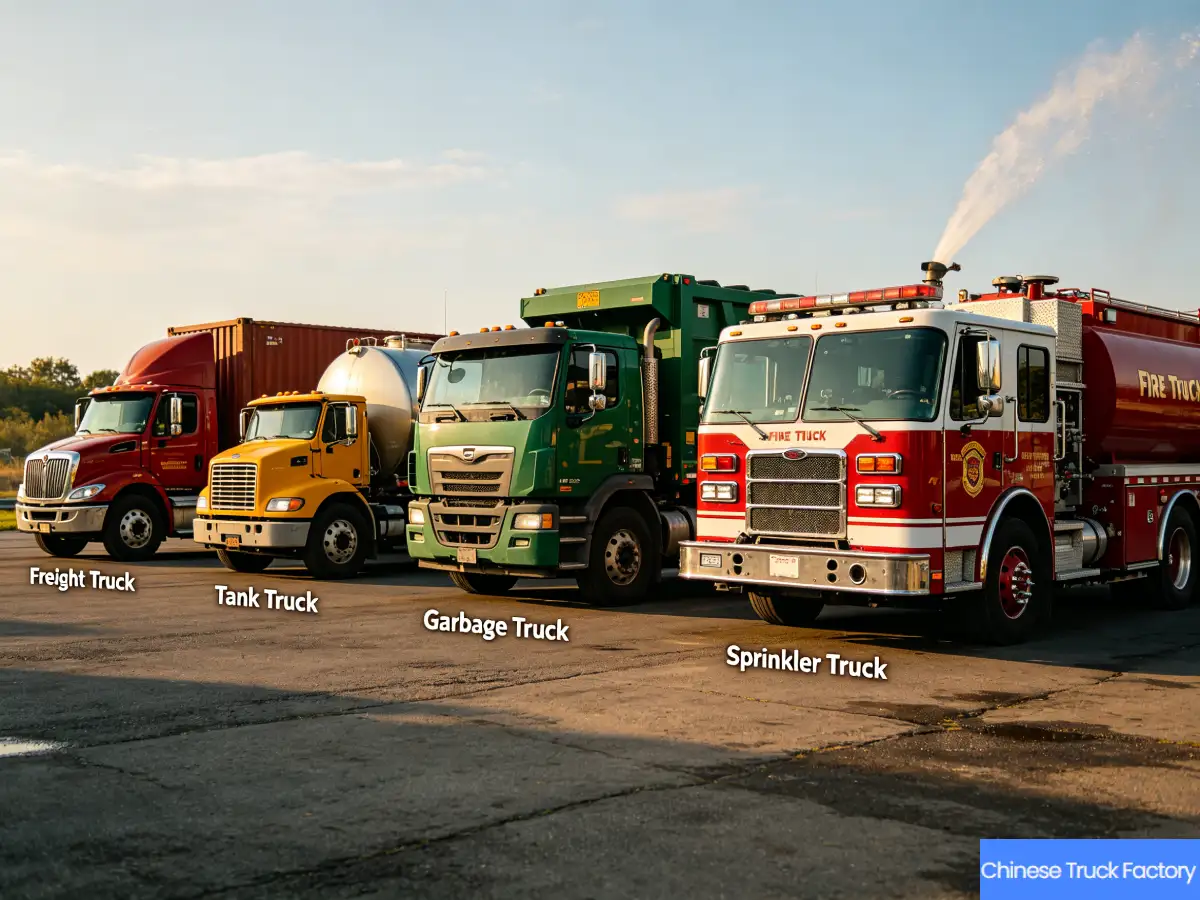
Body and Superstructure: Where Specifications Quietly Go Wrong
For any specialized vehicle, the body is not an accessory. It is part of the engineering problem, and it affects axle loading, center of gravity, and legal payload.
รถบรรทุกเทท้าย
Body volume, steel grade, floor thickness, sidewall thickness, tipping angle, hydraulic cylinder type, and subframe design all matter. A thicker floor resists abrasion from rock but adds tare weight, which reduces payload. A high-tipping-angle body dumps cleanly but may require a longer cylinder and more hydraulic capacity. For mining and quarry work, the economics should be judged on cost per tonne moved, not purchase price alone. This guide to การเลือกรถบรรทุกเทท้ายสำหรับการทำเหมือง walks through the sequence properly.
รถบรรทุกบีบอัดขยะ
Waste density, collection route, bin type, loading method, compaction mechanism, hopper design, hydraulic cycle time, and leachate management all drive the specification. A compactor sized for low-density household waste will behave very differently from one handling commercial waste with higher density. Municipal buyers should review the full range of รถบริการทำความสะอาดแบบมืออาชีพ before committing to a body volume.
เครนติดตั้งบนรถบรรทุก
Rated capacity does not mean the crane can lift that weight at full boom extension. Actual selection requires the maximum load weight, horizontal working radius, lifting height, the crane load chart, boom configuration, outrigger setup, chassis capacity, axle loading, and remaining cargo payload. A larger crane reduces the cargo you can legally carry — a trade-off that is often overlooked.
รถดับเพลิง
Water and foam capacity, pump flow and pressure, monitor specification, equipment compartment volume, crew size, and chassis mobility all interact. A municipal pumper and an industrial fire truck serving a fuel depot are different vehicles. Buyers should review the available รถดับเพลิง configurations against the mission profile rather than the tank size alone.
Fuel Consumption: A Range, Not a Number
Any supplier who quotes a single fuel consumption figure for a heavy truck is simplifying to the point of being misleading. Actual consumption depends on gross vehicle weight, route profile, average speed, gradient, traffic, idling time, driver behavior, axle ratio, tire pressure and type, aerodynamics, ambient temperature, altitude, and engine calibration.
What you can reasonably do is establish an indicative operating range for your specific duty cycle and then track actual consumption after delivery. For a loaded 6×4 dump truck on mixed roads, consumption is typically higher than for the same chassis running empty on a highway. For tractor units on long-haul routes, steady-state consumption is lower per tonne-km than for stop-start urban work. The variables that most often move the number are average payload, average speed, and idling.
For electric trucks, the equivalent metric is kWh per kilometer, and it is affected by payload, route profile, ambient temperature, and battery thermal management. Usable battery capacity, not nominal capacity, determines real range, and charging power determines how quickly the truck returns to service. Depot charging, opportunity charging, and battery swapping each impose different infrastructure requirements and different lifecycle cost assumptions.
การบำรุงรักษา ชิ้นส่วน และเวลาทำงาน
Downtime usually costs more than the repair that caused it. A truck sitting idle for two weeks waiting for a hydraulic hose or a brake chamber is a truck not earning. This makes parts availability and service accessibility as important as any specification on the datasheet.
Practical maintenance planning for a Chinese heavy truck in Kenya typically covers:
- รายวัน: สภาพและแรงดันของยาง, การรั่วของของเหลว, ท่อไฮดรอลิก, ไฟ, แรงดันอากาศ, สัญญาณเตือน
- ตามช่วงเวลา: engine oil and filters, transmission and differential oil, brake system, suspension components, wheel bearings, hydraulic oil, PTO, dump body hinges or compactor mechanism, crane pins and outriggers
- Emission-related: DEF/AdBlue quality and SCR system function where applicable
Specific service intervals should always follow the engine and component manufacturer’s manual for the exact model supplied. Do not rely on generic intervals copied from a different configuration.
When diagnosing a fault, work from symptom to cause to corrective action. If a dump body rises slowly, the inspection sequence should run through hydraulic oil level, oil temperature, filter restriction, pump pressure, PTO engagement, control valve function, cylinder leakage, hose restriction, and finally overload. Replacing the pump first is rarely the right move.
ค่าใช้จ่ายรวมในการเป็นเจ้าของ: ตัวเลขที่สำคัญจริงๆ
Purchase price is one line in a much longer calculation. A defensible TCO comparison includes:
- Vehicle purchase price (with the Incoterm clearly stated — EXW, FOB, CFR, or CIF are not comparable)
- ประกันสินค้าและประกันทางทะเล
- Import duty, VAT, and port charges
- ค่าใช้จ่ายในการปฏิบัติตามกฎระเบียบและการจดทะเบียน
- เชื้อเพลิงหรือไฟฟ้าตลอดอายุการใช้งานที่คาดการณ์ไว้
- ยางรถยนต์
- การบำรุงรักษาตามกำหนด
- การซ่อมแซมที่ไม่ได้กำหนดไว้ล่วงหน้า
- สต็อกชิ้นส่วนอะไหล่
- ค่าใช้จ่ายจากเวลาหยุดทำงาน
- ค่าใช้จ่ายสำหรับผู้ขับขี่ (หากมี)
- มูลค่าคงเหลือเมื่อกำจัด
Two trucks with the same sticker price can have very different five-year costs if one has better parts availability, a more suitable axle ratio, or a body that lasts longer under abrasive material. This is why comparing FOB prices across suppliers without normalizing the scope is a common and expensive error. A CIF price and an FOB price are not the same thing, and the gap between them includes real costs you will pay either way.
การปฏิบัติตามกฎระเบียบและข้อกำหนดของตลาดเป้าหมาย
There is no such thing as a globally compliant truck. Emission standards, homologation requirements, axle weight limits, dimension limits, steering side, lighting, braking, and safety requirements are all set at the destination market level and change over time. Before finalizing a specification, confirm with the relevant Kenyan authorities and your customs broker:
- Emission standard required for the vehicle class and year of import
- ข้อกำหนดเกี่ยวกับการรับรองแบบหรือการอนุมัติแบบ
- เงื่อนไขการจดทะเบียนและข้อจำกัดด้านอายุของรถยนต์นำเข้า
- Axle weight and gross weight limits applicable to your routes
- ข้อจำกัดเกี่ยวกับขนาดของยานพาหนะ
- Steering configuration (Kenya operates right-hand drive)
- Lighting and reflectivity requirements
- ข้อกำหนดเกี่ยวกับระบบเบรกและอุปกรณ์ความปลอดภัย
- Fuel quality available and its compatibility with the engine’s emission calibration
- ความพร้อมของ DEF/AdBlue หากเครื่องยนต์ใช้ระบบ SCR
- Local service capability for the specific brand and model
Regulatory details are high-timeliness information. Treat any specification sheet as provisional until the destination requirements are confirmed in writing for your specific order.
ข้อควรพิจารณาเกี่ยวกับการขนส่งและการนำเข้า
How a truck is shipped depends on its dimensions, weight, whether it can be driven, the quantity, the route, and the destination port. The main options are RoRo (roll-on/roll-off), breakbulk, flat rack, and container where the vehicle fits and the loading plan allows. RoRo is often the simplest for complete, drivable units. Flat rack and container options can make sense for smaller vehicles, for multiple units, or where RoRo service is limited.
Beyond the ocean freight, budget for port handling, customs clearance, inland transport to the final site, and marine insurance. These costs vary by port and by the completeness of your documentation. Buyers who want to understand what is and is not included in a quotation should review the explanation of ราคา FOB สำหรับรถบรรทุก, because assuming the wrong Incoterm is one of the more common and more costly import mistakes.
การประเมินผู้จัดหา: กรอบงานเชิงปฏิบัติ
Once the technical specification is clear, the supplier evaluation becomes more objective. Use these criteria:
- ความเข้าใจเกี่ยวกับแอปพลิเคชัน — does the supplier ask about duty cycle, payload, and route before quoting?
- Specification transparency — are chassis, engine, transmission, axle, and body specifications provided in writing with the exact model codes?
- Compliance awareness — does the supplier acknowledge that destination requirements must be confirmed rather than claiming universal compliance?
- Inspection access — can you inspect the vehicle before shipment, or arrange a third-party inspection?
- เอกสาร — can the supplier provide the export documentation, certificates, and inspection reports required for clearance?
- การวางแผนด้านชิ้นส่วนและบริการ — is there a realistic plan for spare parts and service support after delivery?
- Warranty clarity — what is covered, for how long, and who performs the work?
- การสื่อสาร — does the supplier answer technical questions directly, or deflect them?
Chinese Truck Factory works within this framework. It functions as an export and application-engineering channel rather than a single-brand dealership, which means the recommendation is driven by the duty cycle rather than by what happens to be in stock. Buyers can request a specification matched to their payload, route, and destination requirements, and receive a written configuration with the chassis, body, and shipping terms clearly separated so the cost structure is visible. The company does not claim official authorization, exclusive agency, or joint-venture status with any manufacturer, and any specification remains subject to confirmation against the exact model and destination requirements.
For buyers who are ready to move from specification to a written quotation, the next step is to provide the destination port, application, payload, daily mileage, road conditions, drive configuration, steering side, emission requirement, and quantity. That information is what turns a generic price into a usable offer.
Request a Specification and Quotation
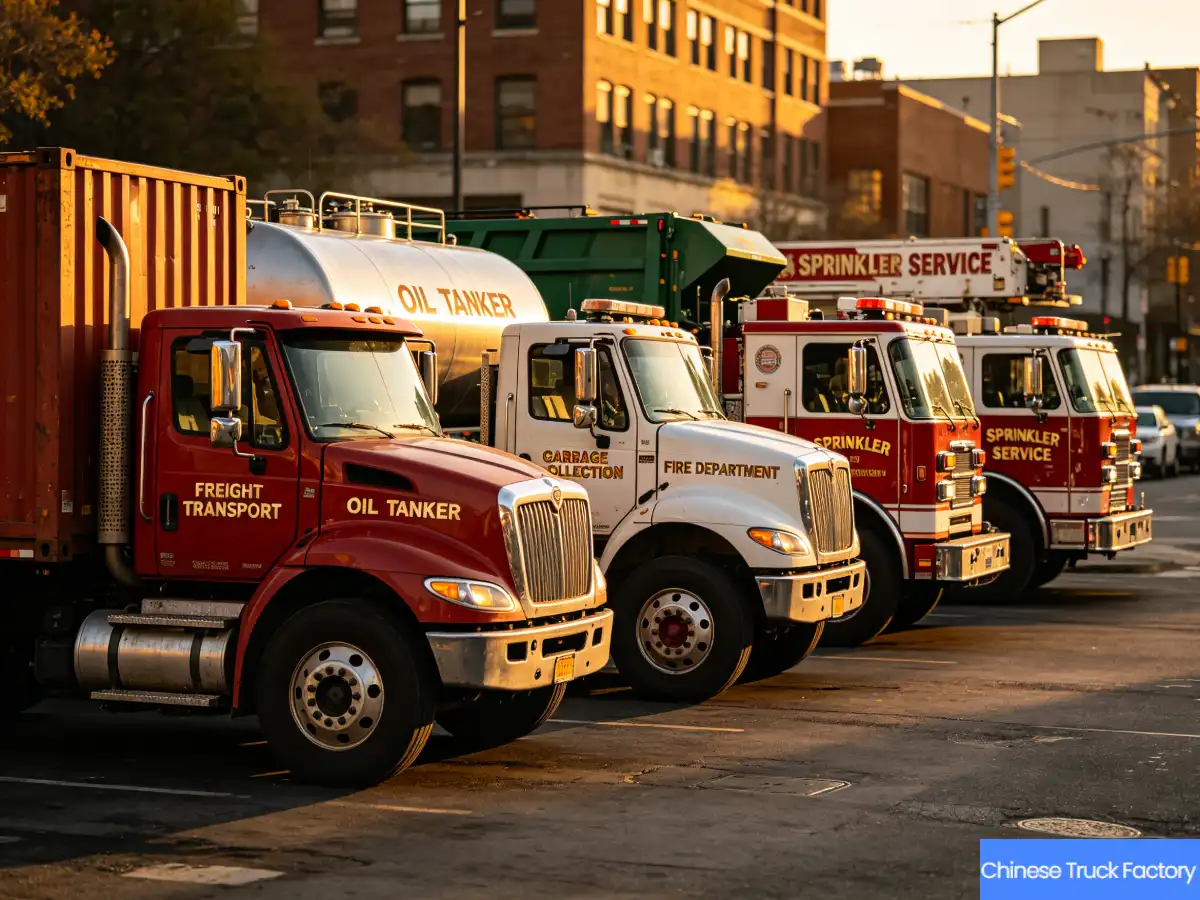
Common Engineering Trade-Offs Buyers Should Expect
A few trade-offs come up repeatedly, and understanding them in advance prevents expensive surprises:
- Larger body, less payload. A heavier body increases tare weight and reduces legal payload.
- Larger engine, not always cheaper to run. Oversized power increases fuel consumption when the truck is not working at high load.
- 8×4 adds payload capability but costs more. Higher purchase price, higher tire cost, longer wheelbase, and tighter route constraints.
- Thicker wear plates improve body life but reduce payload. The right thickness depends on material abrasiveness and expected service life.
- Larger crane reduces cargo capacity. Crane deadweight comes directly out of the payload available for goods.
- Electric trucks shift cost from fuel to infrastructure. Lower energy and some maintenance costs, but higher initial cost and dependence on charging infrastructure.
None of these trade-offs has a universally correct answer. Each is resolved by the specific operation.
คำถามที่มักถูกถาม
Which Chinese truck brands are most commonly supplied to Kenya?
Sinotruk (HOWO), Shacman, FAW Jiefang, Dongfeng, Foton, JAC, and Beiben chassis are the most frequently encountered in export configurations. The right choice depends on the application, payload requirement, route conditions, and the availability of parts and service for that specific model in your operating area.
ฉันควรเลือก payload ที่เหมาะสมกับการทำงานของฉันอย่างไร?
Start from the material or cargo you will carry, its density, and the legal axle and gross weight limits that apply to your routes. Calculate payload as GVW minus curb weight, then confirm that the resulting figure is legal in the destination market. Do not assume body volume equals payload.
ควรใช้การจัดวางเพลาแบบใด?
4×2 suits lighter urban and distribution work. 6×4 is the general-purpose choice for construction and haulage. 6×6 is for rough terrain and mining access roads. 8×4 provides higher legal payload capability where roads and regulations permit, at the cost of purchase price, tire cost, and maneuverability.
สภาพถนนมีผลต่อการเลือกรถบรรทุกอย่างไร?
Unpaved and graded haul roads increase demand on suspension, tires, and driveline, and often require a higher axle ratio and more robust cooling. Sustained gradients affect engine power and transmission selection. Paved highway routes favor configurations optimized for fuel economy at steady speed.
What factors affect fuel consumption most?
Gross vehicle weight, average speed, gradient, idling time, driver behavior, and axle ratio are the largest variables. Tire pressure and type, aerodynamics, ambient temperature, and altitude also contribute. Any quoted figure should be treated as an indicative range for a defined duty cycle, not a guaranteed result.
ผมควรวางแผนการบำรุงรักษาอะไรบ้าง?
Plan for daily checks of tires, fluids, lights, and hydraulic hoses, plus periodic service of engine oil and filters, transmission and differential, brakes, suspension, wheel bearings, hydraulic oil, PTO, and body-specific components such as dump hinges, compactor mechanisms, or crane pins. Follow the exact manufacturer’s service schedule for the model supplied.
How do I estimate total ownership cost?
Add purchase price, freight, insurance, import duty and taxes, compliance and registration costs, fuel or electricity, tires, scheduled and unscheduled maintenance, spare parts, downtime, and driver cost, then subtract residual value. Compare suppliers on a normalized Incoterm and scope, not on headline price alone.
ผมต้องให้ข้อมูลอะไรเพื่อขอใบเสนอราคา?
Destination country and port, application, cargo or material type, required payload, body capacity, daily mileage, road conditions, gradient, drive configuration, steering side, emission requirement, quantity, and any required options. For crane trucks, add maximum lift weight, working radius, and lifting height. For fire trucks, add water and foam capacity and pump requirements. For garbage trucks, add waste type, bin type, and loading method.
ทำอย่างไรเพื่อตรวจสอบว่าประเทศปลายทางปฏิบัติตามข้อกำหนด?
Confirm emission standards, homologation or type approval, registration eligibility, axle and gross weight limits, dimension limits, steering side, lighting, braking, and safety requirements with the relevant authorities and your customs broker before finalizing the specification. Requirements change, so verify current rules for your specific import.
How are trucks shipped from China to Kenya?
RoRo is common for complete, drivable units. Breakbulk and flat rack options apply to certain sizes, quantities, and routes. Container shipping can work for smaller vehicles or where loading plans allow. Shipping method affects cost, transit time, and risk of damage, so it should be decided alongside the vehicle specification rather than after.
หลักการคัดเลือกขั้นสุดท้าย
The most suitable truck for a Kenyan operation is not necessarily the one with the highest horsepower, the largest body, or the lowest quoted price. It is the configuration that matches the payload requirement, the route and gradient, the legal weight limits, the maintenance capability available to you, and the expected operating cycle with the fewest compromises.
Confirm the duty cycle first. Confirm the legal weight limits second. Confirm the destination compliance requirements third. Only then compare chassis, body, and supplier options. Buyers who reverse that order — starting from a price and working backward — usually end up adjusting the specification after the order is placed, which is the most expensive time to make changes.
Where the specification is genuinely uncertain, the right move is not to guess. It is to describe the operation clearly, ask for a written configuration with the reasoning behind it, and compare that reasoning across suppliers. A supplier who can explain why a particular axle ratio, body thickness, or crane size was recommended is a supplier worth continuing the conversation with.



