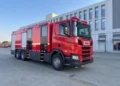
There is no single supplier that fits every special purpose truck requirement, and anyone who tells you otherwise is selling something. The right supplier depends on what you actually need to move, lift, pump, compact, or extinguish — and on whether they can deliver a chassis and superstructure that match your duty cycle, your road conditions, and your registration rules. In practice, the strongest results come from working with suppliers who can handle both the truck chassis and the body integration under one technical responsibility, because that is where most delivery problems start. This article lays out an evaluation framework you can use to compare special purpose truck suppliers, then explains how those criteria apply to real procurement decisions.
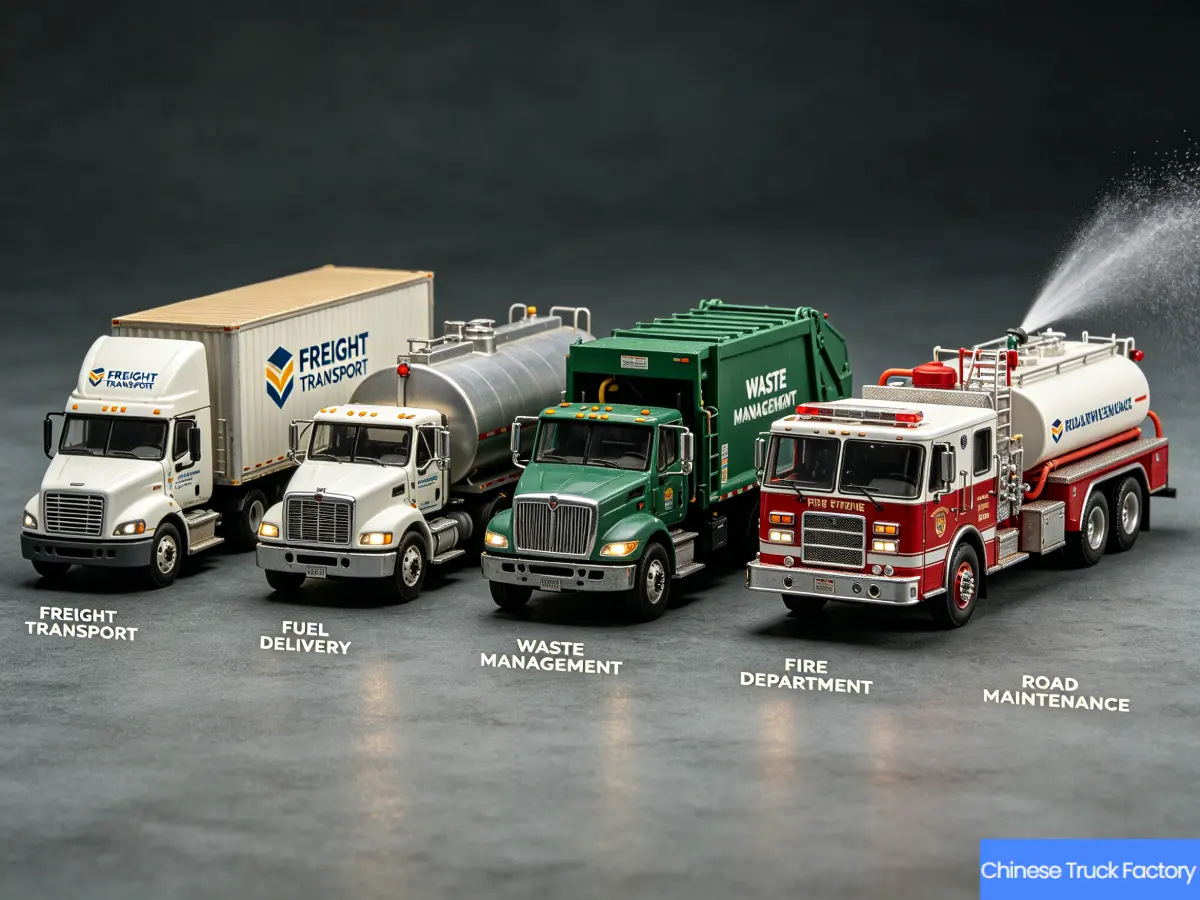
What “Special Purpose Truck” Actually Means in a Procurement Context
The term gets used loosely. In an import or fleet procurement file it usually covers any truck whose function depends on a body, superstructure, or hydraulic system mounted on a commercial chassis. That includes:
- Dump trucks and tipper trucks
- Truck-mounted cranes
- Garbage compactor trucks and other sanitation vehicles
- Water tankers and fuel tankers
- Concrete mixer trucks
- Fire trucks
- Vacuum sewage and septic tank trucks
- Street sweepers and vacuum sweepers
- Muck transport and specialized construction vehicles
The reason this matters for supplier selection is simple. A chassis-only dealer can sell you a cab and frame. A body builder can weld a tank or a tipping body. But when the truck fails to perform on a grade, overloads an axle, or cannot be registered at the target gross weight, the buyer is stuck between two parties who each point at the other. Suppliers who manage chassis selection and superstructure design together avoid that gap. That is the first filter I apply when shortlisting.
The Evaluation Framework I Use Before Contacting Any Supplier
Before requesting quotations, I build a one-page specification brief. It forces clarity and it makes supplier responses comparable. The core items:
| หมวดหมู่ | What to Define |
|---|---|
| ใบสมัคร | Material or cargo type, density, daily volume, haul or route distance |
| ข้อมูลที่ส่ง | Required payload per trip, body or tank volume, expected cycles per day |
| Route | Road surface, gradient, altitude, climate, urban vs. highway vs. unpaved |
| การตั้งค่า | Drive layout (4×2, 6×4, 8×4, 6×6), steering side, wheelbase |
| การปฏิบัติตามกฎระเบียบ | Emission standard, axle-weight limits, dimensions, lighting, registration rules |
| Commercial | Quantity, Incoterm, destination port, warranty expectations, spare parts scope |
Suppliers who ask for this information before quoting are usually the ones who can actually engineer a solution. Suppliers who quote a price off a single line item are usually reselling a catalog configuration that may or may not fit.
Chassis and Superstructure Integration: The Real Differentiator
Most special purpose truck problems I have seen traced back to integration, not to the chassis brand. A few examples of what integration actually means in practice:
Weight Distribution and Axle Loading
A crane mounted behind the cab shifts weight to the front axle. A rear-mounted compactor body shifts weight to the rear. A tanker with a high center of gravity changes roll behavior. The supplier needs to calculate front and rear axle loads with the body installed and loaded, not just quote a chassis GVW. If they cannot show you the axle load calculation, that is a warning sign.
PTO and Hydraulic System Matching
Dump bodies, compactors, cranes, and mixers all rely on a power take-off driving a hydraulic pump. The PTO ratio, pump displacement, and cylinder sizing determine cycle time and reliability. A supplier who selects these components based on the chassis engine torque curve — rather than guessing — will deliver a truck that lifts and cycles consistently. This is where cheap quotes often hide undersized hydraulics.
Frame Reinforcement and Subframe Design
Heavy superstructures require a subframe that distributes load along the chassis rails without creating stress concentrations. On dump trucks and compactors, the subframe design also affects body hinge life and tipping stability. Suppliers who build their own bodies typically control this. Suppliers who buy bodies from a third party and bolt them onto a chassis need to prove they have verified the interface.
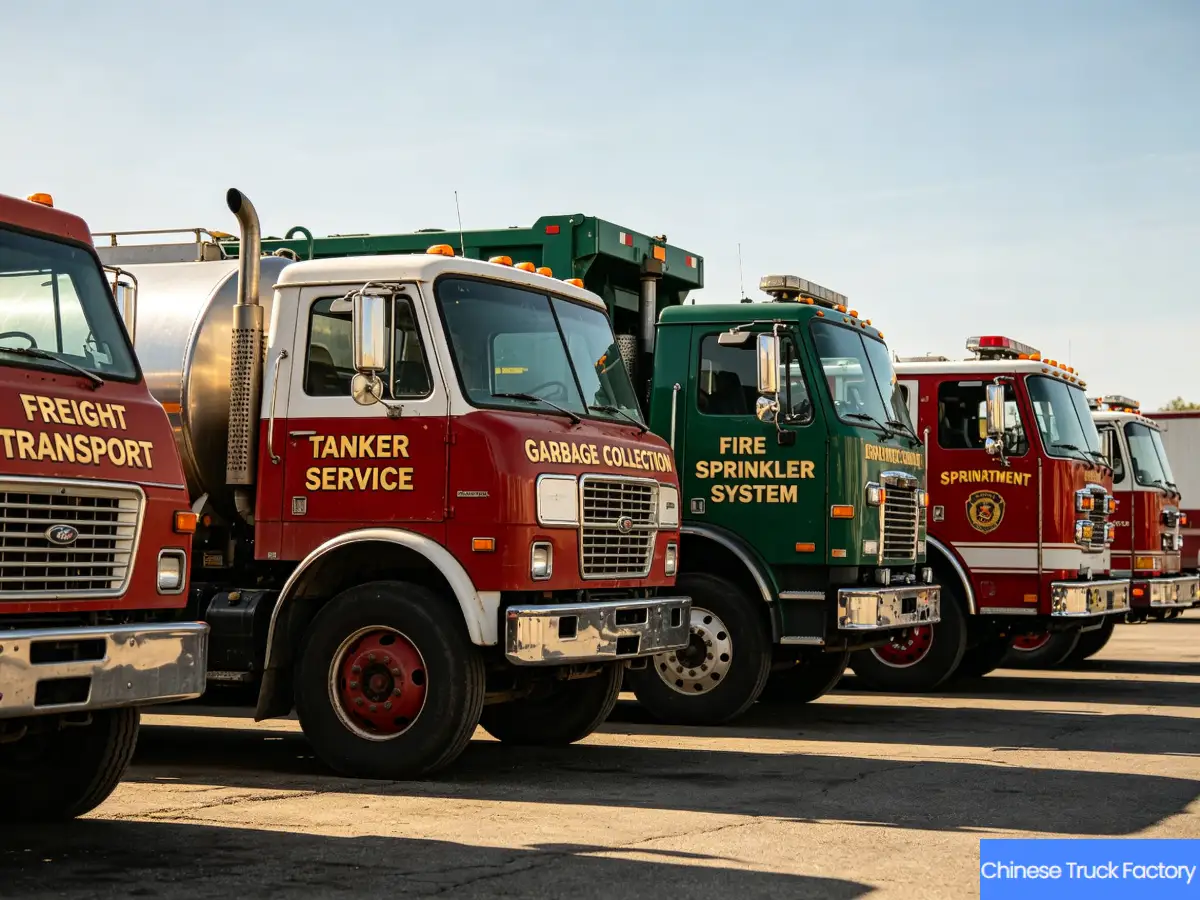
How to Compare Suppliers Across the Main Truck Categories
The priorities shift by application. Here is how I weight the evaluation criteria depending on what you are buying.
| หมวดหมู่ | Weighting Priority | สิ่งที่ต้องตรวจสอบ |
|---|---|---|
| Dump / tipper trucks | Body steel grade, floor thickness, hydraulic cylinder reliability, axle ratio for grade | Body volume vs. material density, legal payload, tipping stability on side slopes |
| Truck-mounted cranes | Crane load chart at working radius, outrigger spread, remaining cargo payload | Rated tonnage alone is meaningless without radius and boom configuration |
| Garbage compactor trucks | Compaction ratio, hopper design, bin lifter compatibility, leachate management | Waste density assumptions, route stop frequency, hydraulic cycle time |
| Tankers (water, fuel, sewage) | Tank material, baffle design, compartment layout, pump and valve quality | Product compatibility, center of gravity, discharge rate |
| Fire trucks | Pump flow and pressure, monitor reach, equipment compartment layout | Mission type (municipal, industrial, wildland), chassis mobility, crew access |
| Concrete mixer trucks | Drum capacity, water system, chute configuration, mixer drive | Discharge rate, slump retention on route, axle load with full drum |
Notice that in every row, the first thing to check is not the brand name. It is whether the configuration matches the job. A supplier who can walk through these items with you — and push back when your assumptions are wrong — is worth more than one who simply confirms everything you ask for.
ตำแหน่งของโรงงานผลิตรถบรรทุกจีนในกรอบนี้
โรงงานผลิตรถบรรทุกของจีน operates as an export-oriented supplier covering both chassis sourcing and superstructure integration across a range of special purpose categories. Against the evaluation criteria above, here is how that translates:
- Application matching: The supplier works across dump trucks, cranes, sanitation vehicles, tankers, mixers, and specialized units, which means the same technical team can advise on the right chassis and body combination for a given duty cycle rather than forcing a single product line.
- Chassis and body integration: Because the business covers both, the axle load, PTO, and subframe questions get answered by one party instead of being split between a chassis dealer and a body builder.
- Export documentation and shipping: The supplier handles the export side, including การขนส่งรถบรรทุกขนาดใหญ่ไปยังต่างประเทศ arrangements, which matters when you are comparing RoRo, breakbulk, and flat-rack options for oversized units.
- ความยืดหยุ่นในการตั้งค่า: Left-hand drive and right-hand drive options, emission variants, and body specifications can be adjusted to destination requirements, subject to confirmation on the specific order.
- Spare parts planning: A practical parts package can be built into the order, which is often the difference between a truck that stays in service and one that waits weeks for a filter or hydraulic hose.
That is not a claim that Chinese Truck Factory is the only viable option. It is a claim that the supplier meets the structural criteria that matter — integrated engineering responsibility, export capability, and configuration flexibility — which is what the framework is designed to test.
Payload, GVW, and Legal Weight: The Most Common Buyer Mistake
This deserves its own section because it causes more failed imports than any other single issue.
Payload is not the same as GVW. Body volume is not the same as payload. Technical axle capacity is not the same as legal axle load. A factory-rated capacity is not the same as the legally permitted payload in every destination.
Consider a 20 m³ dump body. If you fill it with dry sand at roughly 1.6 tonnes per cubic meter, you are looking at around 32 tonnes of material. If you fill it with wet gravel at 2.0 tonnes per cubic meter, that becomes 40 tonnes. The body volume did not change, but the load did. The chassis, axles, tires, and legal weight limits all have to accommodate the heavier case, or the truck is overloaded every trip.
The correct approach is to work backward from the material:
- Identify the material and its density range.
- Calculate the required body volume for the target payload.
- Check that the resulting gross vehicle weight fits within the destination’s axle and gross weight limits.
- Confirm the chassis, suspension, tires, and brakes are rated for that gross weight.
- Only then finalize the body specification.
For a deeper look at how these numbers interact, the payload capacity explanation covering GVW, curb weight, and legal payload is a useful reference before you finalize a dump truck specification.
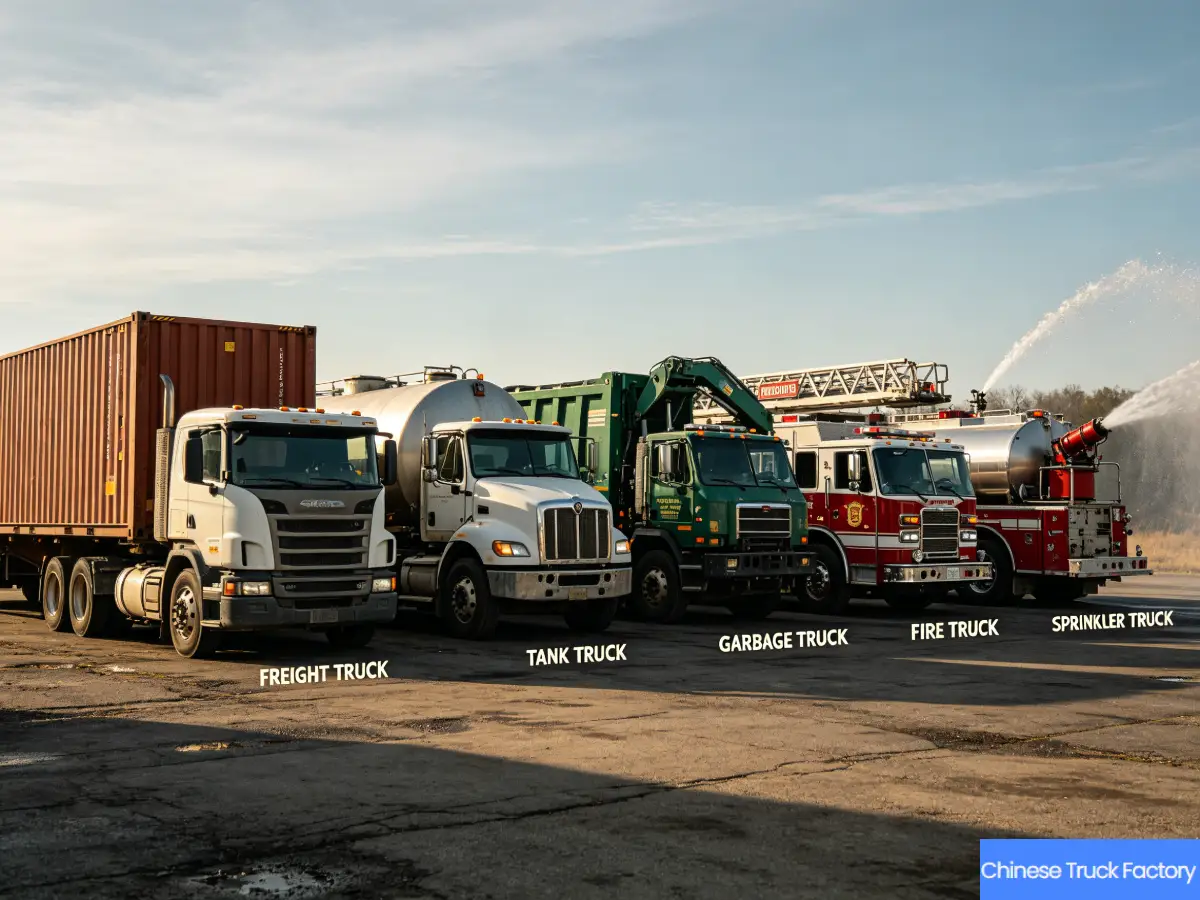
Operating Conditions That Change the Specification
Two buyers can order the same nominal truck and get very different results because their operating conditions differ. The variables that most often force a specification change:
Gradient and Gradeability
A truck that performs well on flat urban routes may struggle on a sustained 8% grade when fully loaded. Gradeability depends on engine torque, transmission ratios, final drive ratio, tire size, and gross weight. Suppliers who ask about your steepest sustained grade are doing their job. Suppliers who only ask about payload are not.
Road Surface and Tire Selection
Unpaved haul roads with sharp rock require different tire compounds and tread patterns than paved highways. The same applies to suspension: leaf spring setups that work on paved roads may need reinforcement or a different configuration for constant rough-road use.
Ambient Temperature and Altitude
High ambient temperatures stress cooling systems and hydraulic oil. High altitude reduces naturally aspirated engine performance and affects turbocharged engine calibration. Both should be disclosed to the supplier so cooling capacity and engine settings can be matched.
Duty Cycle and Annual Mileage
A truck running 200 km per day on highway has different maintenance and specification priorities than one running 40 km per day in stop-start urban collection. Annual mileage drives the total cost of ownership calculation more than purchase price does in most cases.
Total Cost of Ownership: What to Compare Beyond Purchase Price
The purchase price is one line in a much longer equation. When comparing suppliers, I build a simple TCO model with these components:
| องค์ประกอบค่าใช้จ่าย | หมายเหตุ |
|---|---|
| ราคาซื้อ | Must be quoted on the same Incoterm basis (EXW, FOB, CFR, CIF) |
| ประกันสินค้าและประกันทางทะเล | Depends on shipping method and destination port |
| Import duties and clearance | Destination-specific; confirm before comparing landed cost |
| เชื้อเพลิงหรือพลังงาน | Driven by duty cycle, gross weight, terrain, and idling time |
| ยางรถยนต์ | High consumption item on rough roads and heavy loads |
| การบำรุงรักษาตามกำหนด | Oil, filters, hydraulic fluid, brake components, PTO service |
| การซ่อมแซมที่ไม่ได้กำหนดไว้ล่วงหน้า | Often driven by overload, poor road conditions, or undersized components |
| ชิ้นส่วนสำรอง | Availability and lead time matter as much as unit price |
| เวลาหยุดทำงาน | Frequently the largest hidden cost in a fleet |
| มูลค่าคงเหลือ | Affects the true cost over the ownership period |
A supplier quoting a lower FOB price but with no spare parts support and a two-month parts lead time can easily cost more over three years than a supplier with a slightly higher purchase price and a stocked parts package. This is why I treat parts planning as a supplier selection criterion, not an afterthought.
Maintenance and Reliability: What to Plan For
Special purpose trucks have more maintenance points than a standard cargo truck because of the hydraulic and body systems. A practical maintenance plan covers:
- รายวัน: tire condition, fluid leaks, hydraulic hose condition, lights, air pressure, warning indicators
- ตามช่วงเวลา: engine oil and filters, transmission and differential fluid, brake system, suspension, wheel bearings, hydraulic oil, PTO engagement, body hinges, crane pins, compactor mechanism
Specific service intervals should always follow the actual chassis, engine, and component manufacturer manuals for the delivered vehicle. They vary by model and by operating condition, and guessing them is a good way to shorten component life.
When something does go wrong, the diagnostic sequence matters. Take a dump body that rises slowly. The correct approach is to check in order:
- Hydraulic oil level
- Oil temperature
- Filter restriction
- Pump pressure
- PTO engagement
- Control valve function
- Cylinder leakage
- Hose restriction
- Overload condition
Jumping straight to replacing the cylinder is expensive and often wrong. Suppliers who can walk you through this kind of diagnostic logic are genuinely more valuable than suppliers who only quote parts.

การปฏิบัติตามกฎระเบียบและข้อกำหนดของตลาดเป้าหมาย
There is no such thing as a globally compliant truck. Every destination has its own requirements, and these change over time. Before finalizing any order, confirm:
- Emission standard accepted for import and registration
- ข้อกำหนดเกี่ยวกับการรับรองแบบหรือการอนุมัติแบบ
- เงื่อนไขการสมัครและข้อจำกัดเกี่ยวกับอายุของรถ
- ขีดจำกัดน้ำหนักต่อเพลาและน้ำหนักรวม
- ขนาดสูงสุดของยานพาหนะ
- ด้านพวงมาลัย (พวงมาลัยซ้ายหรือพวงมาลัยขวา)
- Lighting and safety equipment requirements
- Fuel quality available and whether DEF/AdBlue is locally available
- Local service capability for the chassis and body systems
Because these rules vary significantly by country and are updated periodically, the correct approach is to verify current requirements with the destination’s transport authority and customs before you commit to a specification. Suppliers should be able to provide the technical documentation you need for that verification, but the final compliance check is the buyer’s responsibility.
Shipping and Import Considerations for Special Purpose Trucks
Special purpose trucks are often larger and heavier than standard cargo trucks, which limits shipping options. The main methods:
- RoRo (roll-on/roll-off): Cost-effective for drivable units, but schedule-dependent and not available at every port.
- สินค้าชิ้นใหญ่: Flexible for oversized or non-drivable units, but usually more expensive.
- ชั้นวางแบบแบน: Useful for units that fit within flat-rack dimensions but cannot be driven onto a RoRo vessel.
- คอนเทนเนอร์: Only practical for smaller units or partial disassembly; most full-size special purpose trucks do not fit.
The choice depends on vehicle dimensions, weight, drivability, quantity, route, and destination port. For a detailed comparison of these methods, see the guide to RoRo, container, and breakbulk shipping compared. Marine insurance, port handling, customs clearance, and inland transport all need to be planned as part of the landed cost.
สิ่งที่ควรเตรียมไว้ก่อนขอใบเสนอราคา
Suppliers can only quote accurately if they have the right inputs. For special purpose trucks, prepare:
- ประเทศและท่าเรือปลายทาง
- Application and material or cargo type
- Required payload and body or tank capacity
- ระยะทางและเวลาทำงานต่อวัน
- สภาพถนนและความชันสูงสุด
- การจัดวางระบบขับเคลื่อนและด้านพวงมาลัยที่ชอบ
- ข้อกำหนดเกี่ยวกับการปล่อยมลพิษ
- จำนวน
- Required options (crane capacity and radius, pump flow, bin lifter type, etc.)
For crane trucks, add maximum lifting weight, working radius, and lifting height. For fire trucks, add water/foam capacity, pump requirement, and mission type. For garbage trucks, add waste type, bin type, and loading method. The more precise the brief, the more comparable the quotes.
If you want to move from framework to an actual specification discussion, you can start a special purpose truck inquiry with your operating details and the supplier can respond with a matched configuration rather than a generic catalog entry.
Common Mistakes Buyers Make When Choosing a Supplier
- การเปรียบเทียบราคา FOB กับค่าใช้จ่ายในการนำเข้า. These are different numbers. Always normalize to the same Incoterm.
- Choosing based on body volume alone. Volume without density and legal weight limits is meaningless.
- Ignoring axle load calculations. A truck that cannot legally carry its rated payload is not a bargain.
- Assuming one supplier’s configuration fits another destination. Emission, steering, and weight rules differ.
- ไม่เลือกแพ็กเกจชิ้นส่วนสำรอง. Parts availability drives uptime more than initial price.
- Not verifying the supplier’s integration capability. Chassis-only and body-only suppliers create finger-pointing when something fails.
- Treating rated crane tonnage as lifting capacity at all radii. The load chart is what governs.
คำถามที่มักถูกถาม
How do I choose the right payload for a special purpose truck?
Start from the material or cargo and its density, not from the body volume. Calculate the weight you actually need to move per trip, then confirm that the resulting gross vehicle weight fits within the destination’s axle and gross weight limits. The chassis, tires, suspension, and brakes all have to be rated for that weight. The legal payload is usually the binding constraint, not the technical one.
Which axle configuration should I use for rough roads and heavy loads?
For heavy loads on rough or unpaved roads, 6×4 and 8×4 configurations are common because they distribute load across more axles and provide better traction. However, they also add curb weight, cost, and turning radius. The right choice depends on your legal axle limits, the road surface, the gradient, and the payload. A 4×2 may be sufficient for lighter urban work, while a 6×6 may be needed where traction is the limiting factor.
How does road condition affect truck and body selection?
Rough roads increase tire wear, stress suspension components, and accelerate body and subframe fatigue. They also reduce average operating speed, which affects cycle time and productivity. For these conditions, reinforced suspension, appropriate tire compounds, and heavier body construction may be justified. The trade-off is higher curb weight and purchase cost, so the decision should be based on expected annual mileage and road severity.
What affects fuel consumption on a special purpose truck?
Actual fuel consumption depends heavily on gross vehicle weight, average speed, terrain, idling time, driver behavior, axle ratio, tire pressure, and duty cycle. A truck doing stop-start urban collection will consume far more per kilometer than the same truck on a highway run. Any figure quoted by a supplier should be treated as an indicative operating range for a specific duty cycle, not a universal number.
What maintenance should I plan for on a special purpose truck?
Beyond standard chassis maintenance, special purpose trucks need hydraulic system checks, PTO inspection, body hinge and cylinder service, and application-specific items such as compactor mechanism inspection or crane pin lubrication. Daily inspections should cover tires, leaks, hoses, and warning indicators. Periodic service intervals should follow the actual component manufacturer manuals for the delivered vehicle.
How do I estimate total cost of ownership before buying?
Build a model that includes purchase price, freight, import duties, fuel or energy, tires, scheduled maintenance, expected unscheduled repairs, spare parts, and downtime. Subtract the estimated residual value at the end of the ownership period. Comparing only purchase price between suppliers will usually lead to the wrong decision, because the operating costs over three to five years typically outweigh the initial price difference.
ผมต้องให้ข้อมูลอะไรเพื่อให้ได้รับใบเสนอราคาที่ถูกต้อง?
At minimum: destination country and port, application, material or cargo type, required payload, body or tank capacity, daily mileage, road condition, maximum gradient, preferred drive configuration, steering side, emission requirement, and quantity. For crane trucks, add lifting weight, working radius, and lifting height. For fire trucks, add water/foam capacity and pump requirements. For garbage trucks, add waste type and bin type.
How do I confirm that a truck will be compliant in my destination country?
Verify current requirements with the destination’s transport authority and customs before finalizing the specification. Key items include emission standard, homologation or type approval, registration eligibility, axle and gross weight limits, dimensions, steering side, and lighting requirements. These rules change over time and vary by country, so the supplier’s documentation should be used as input to your own verification, not as a substitute for it.
How are special purpose trucks shipped from the factory?
Most full-size units ship via RoRo if they are drivable and the destination port handles RoRo traffic. Oversized or non-drivable units may require breakbulk or flat-rack shipping. Smaller units can sometimes be containerized. The right method depends on vehicle dimensions, weight, quantity, route, and port capabilities. Marine insurance and inland transport should be planned as part of the landed cost.
What is the biggest mistake buyers make when selecting a supplier?
Comparing purchase prices without normalizing the Incoterm, and choosing a supplier who cannot take engineering responsibility for both the chassis and the body. The first leads to misleading cost comparisons. The second leads to integration problems that surface after delivery, when the buyer is caught between two parties. A supplier who can show axle load calculations, PTO and hydraulic matching, and a spare parts plan is usually the safer choice even at a slightly higher price.
ข้อคิดสุดท้าย
The most suitable special purpose truck supplier is not the one with the lowest headline price or the largest catalog. It is the one that can match the chassis, body, and hydraulic system to your actual duty cycle, confirm the legal weight and compliance situation for your destination, and support the truck with parts and technical guidance after delivery. The parameters most worth confirming early are payload versus body volume, axle load versus legal limits, gradient and road condition versus powertrain and suspension, and total cost of ownership versus purchase price. Buyers who skip these steps usually discover the mismatch after the truck has arrived, when correcting it is far more expensive than specifying it correctly in the first place.