There is no single “best” truck for a government or municipal fleet. The right answer depends on what the vehicle actually does every day — refuse collection on residential streets, snow removal on arterial roads, water delivery to construction sites, fire response, utility crew transport, or bulk material hauling. A 6×4 heavy-duty chassis that works well for a rear-loader garbage truck may be completely wrong for a street sweeper that needs a short wheelbase and a low cab. This article walks through how municipal procurement teams, fleet managers, and government buyers should evaluate trucks by duty cycle, payload, chassis configuration, body design, compliance, and total cost of ownership — not by horsepower or sticker price alone.
Mulailah dari Siklus Kerja, Bukan Truknya
Municipal fleets are unusual because a single department may operate vehicles that have almost nothing in common. A public works department might run a dump truck, a water tanker, a bucket truck, and a street sweeper — each with a different duty cycle, different legal weight limits, and different maintenance requirements. Before looking at any chassis or body, procurement teams should document what each vehicle actually does.
Key questions to answer before writing a specification:
- Apa yang sedang dibawa atau dipindahkan? Refuse, water, sand, gravel, asphalt, personnel, tools, or firefighting foam — each has different density and handling requirements.
- How far does the vehicle travel per day? A refuse truck may cover 40–120 km with hundreds of stop-start cycles. A water tanker on a construction site may run 200 km per day on rough access roads.
- What is the road surface? Paved city streets, unpaved access roads, gravel haul roads, or a mix.
- What are the gradients? A route with sustained 8–12% grades demands different gearing and cooling than flat urban operation.
- How many loading and unloading cycles per shift? This drives hydraulic system sizing, body wear, and cycle time targets.
- What is the climate? Ambient temperature range, altitude, humidity, and road salt exposure all affect specification choices.
Without this information, any truck recommendation is guesswork. A chassis that is perfectly matched to one duty cycle can be chronically overloaded or underutilized in another.
Vehicle Types Commonly Used in Government and Municipal Fleets
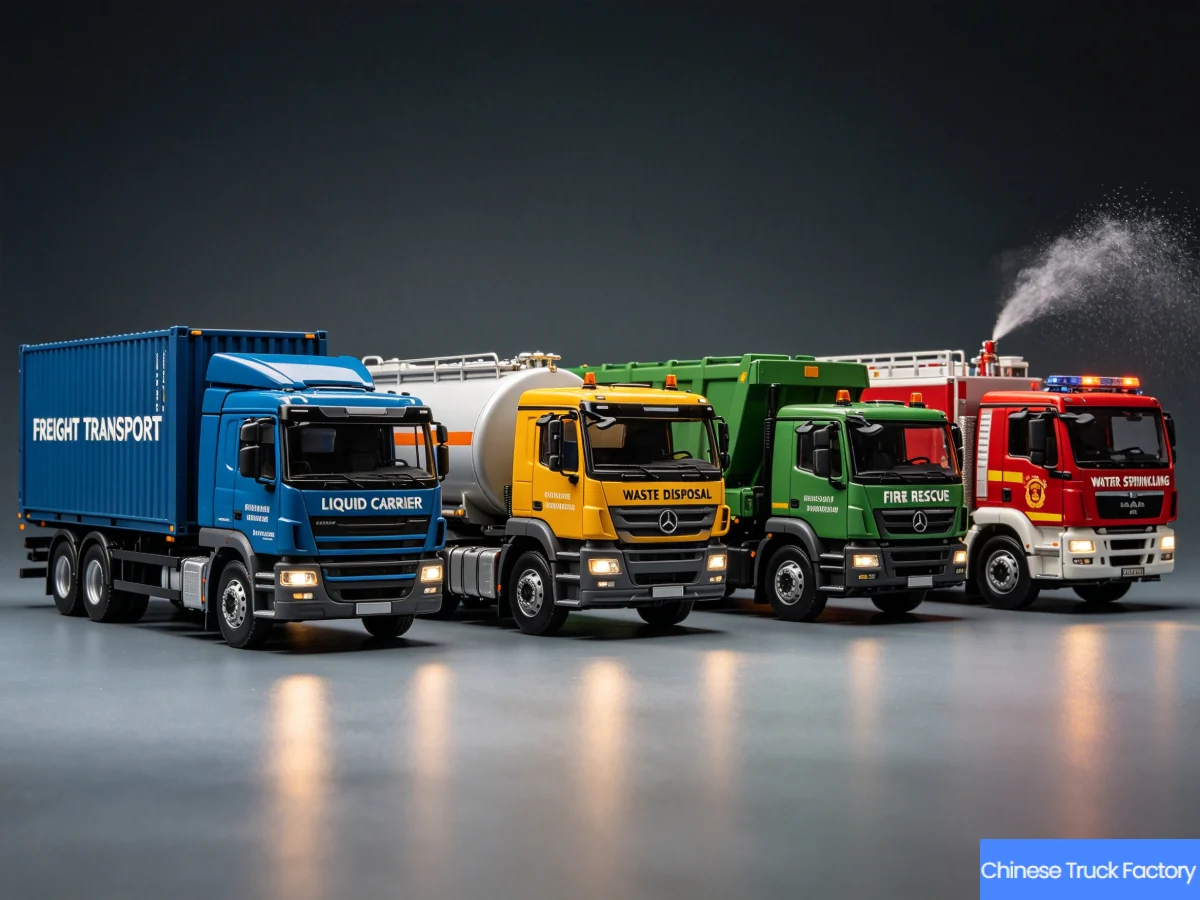
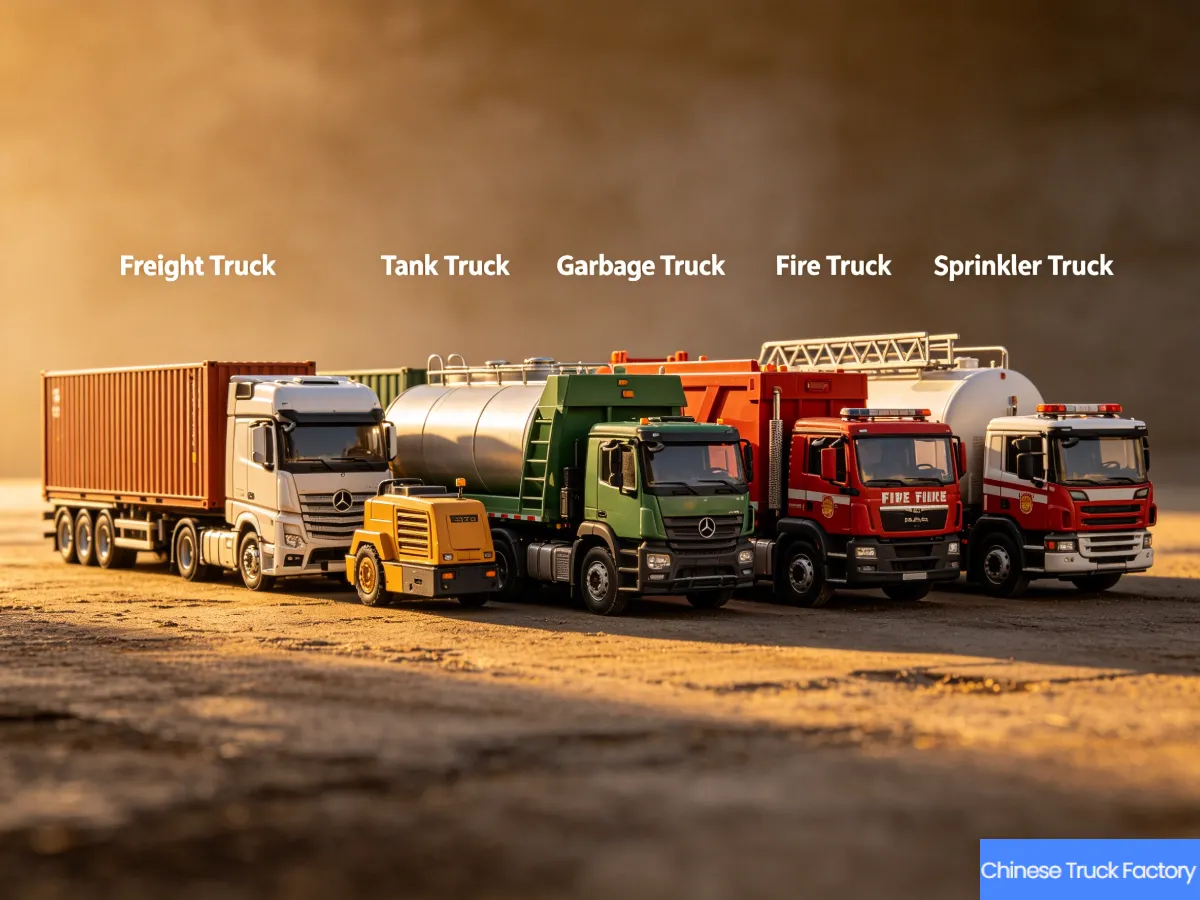
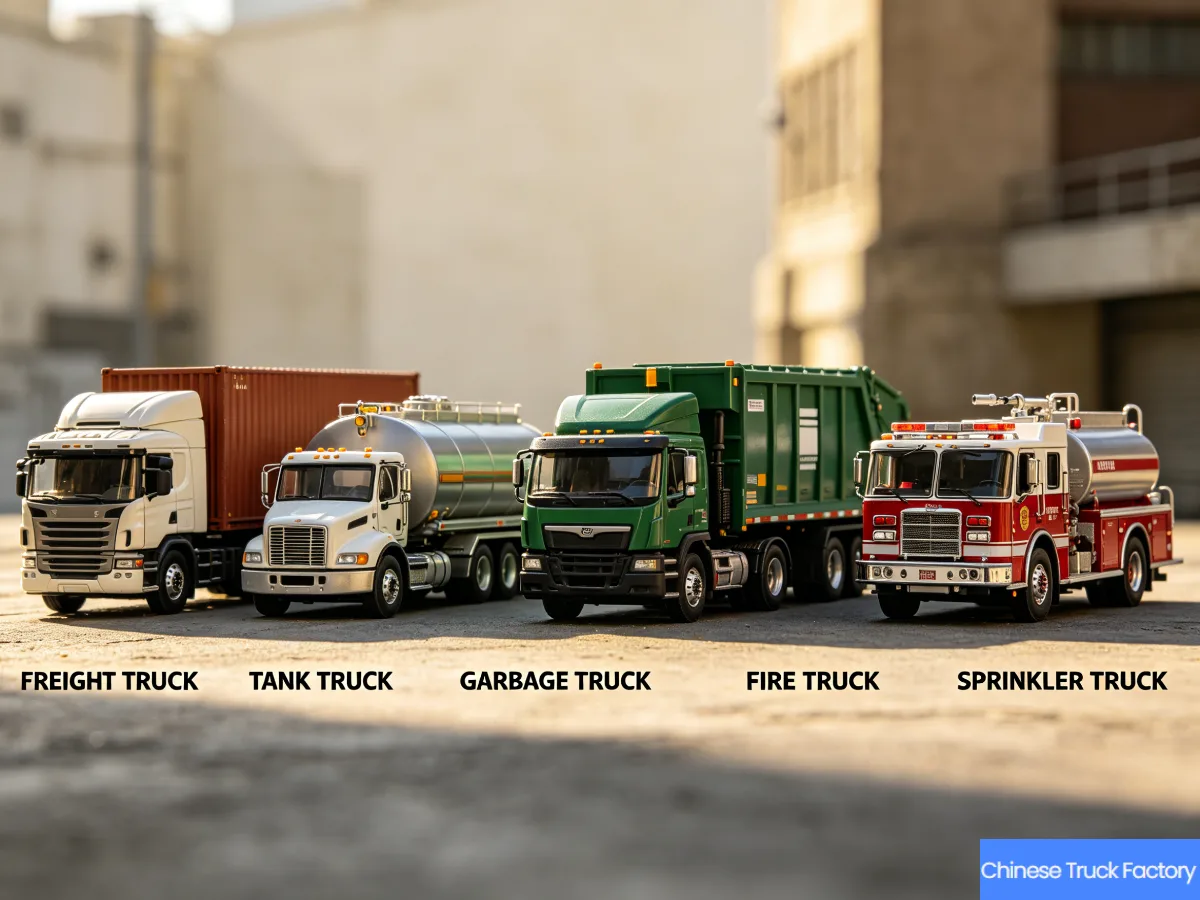
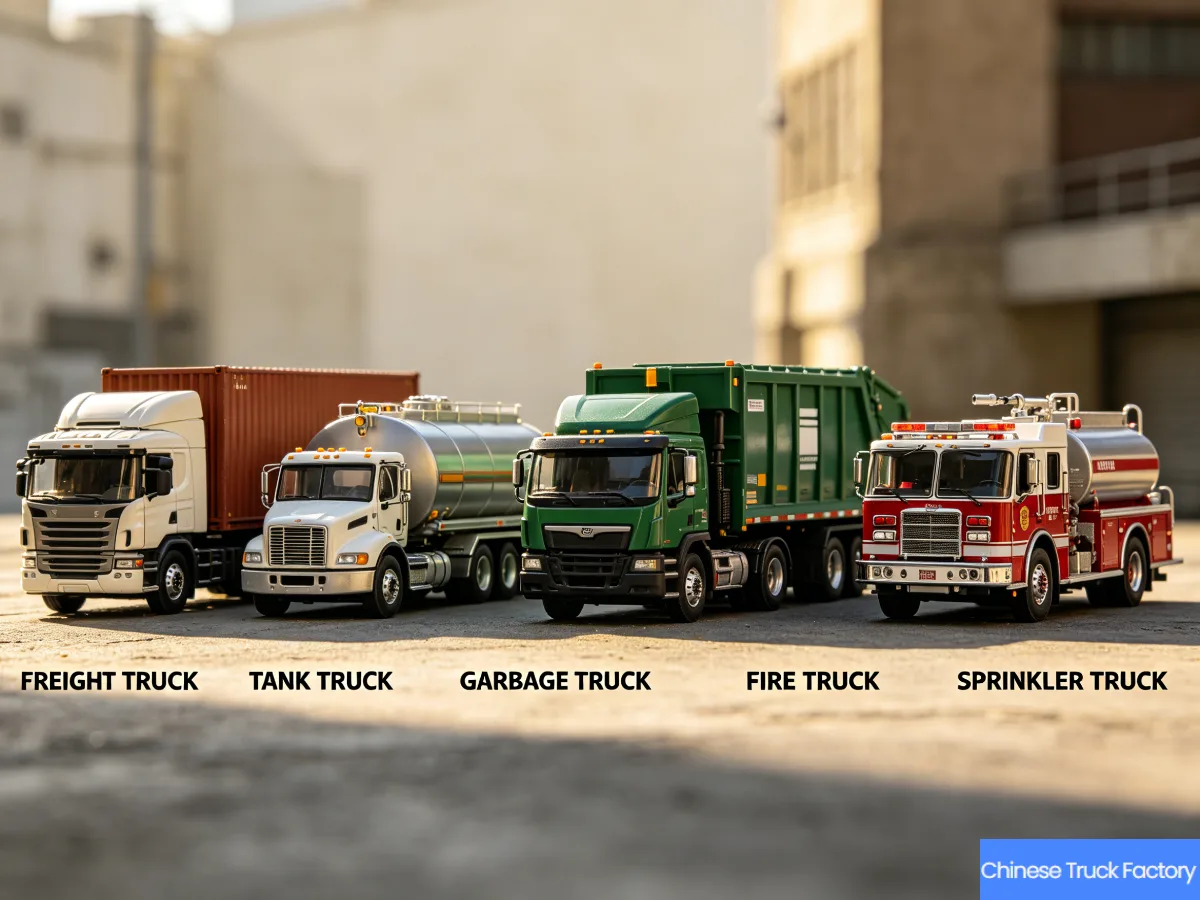
Municipal fleets typically include several distinct vehicle categories. Each has its own engineering priorities.
| Jenis Kendaraan | Primary Duty | Konfigurasi Standar | Faktor Penentu Utama |
|---|---|---|---|
| Rear-loader garbage truck | Residential and commercial refuse collection | 4×2 or 6×4 chassis, compactor body | Body volume, compaction ratio, bin compatibility |
| Truk pengangkut | Road maintenance, snow hauling, bulk material | 6×4 or 8×4 chassis, tipper body | Payload, body volume, material density |
| Water tanker | Dust suppression, street washing, emergency supply | 4×2 or 6×4 chassis, tank body | Tank volume, pump flow, axle loading |
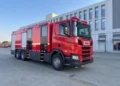
| Mobil pemadam kebakaran | Structural firefighting, rescue, wildland response | 4×2 or 4×4 chassis, pump and tank | Pump performance, water/foam capacity, crew space |
| Derek yang dipasang di truk | Utility work, sign installation, material handling | 6×4 chassis, telescopic or articulating crane | Load chart, working radius, remaining payload |
| Street sweeper | Road cleaning, debris collection | Purpose-built or truck-mounted | Hopper capacity, water tank, brush configuration |
| Tanker truck | Fuel, water, or chemical transport | 6×4 chassis, compartmented tank | Product compatibility, baffling, center of gravity |
| Kendaraan khusus | Vacuum trucks, sewer cleaners, utility bodies | Various chassis | PTO capacity, body integration, auxiliary systems |
Buyers evaluating sanitation and waste collection vehicles can review a range of kendaraan kebersihan profesional to understand how body design and compaction systems differ between applications.
Chassis Configuration: Matching the Truck to the Route
Axle Configuration
The drive layout is one of the first decisions that locks in payload capacity, maneuverability, and cost. The most common configurations for municipal work are:
- 4×2: Two axles, one driven. Suitable for lighter municipal duties — small dump trucks, water tankers, utility vehicles. Lower cost, better fuel economy, tighter turning circle. Limited by rear axle load capacity.
- 6×4: Three axles, two driven. The workhorse for refuse trucks, dump trucks, and tankers. Higher payload capacity, better traction on poor roads. Longer wheelbase reduces maneuverability in tight residential streets.
- 6×6: Three axles, all driven. Required for off-road access, steep gradients, and soft ground. Higher curb weight and fuel consumption.
- 8×4: Four axles, two driven. Used where high payload is needed but a tractor-trailer is impractical. Higher purchase cost, more tires, larger turning radius.
The trade-off is straightforward: more axles mean more payload capacity but also more weight, more cost, and less agility. For a refuse truck working narrow residential streets, a 4×2 chassis with a well-designed compactor body may be more productive than a 6×4 that cannot navigate the route efficiently.
Engine and Powertrain
Engine selection should be based on the actual power demand of the duty cycle, not on the highest available horsepower. A municipal water tanker that runs at 60 km/h on flat roads does not need the same engine as a dump truck climbing a 10% grade with a full load.
Factors that influence engine choice:
- Gross vehicle weight: Heavier combinations require more torque to maintain speed on grades.
- Profil rute: Sustained gradients demand higher torque backup and adequate cooling capacity.
- PTO requirements: Refuse compactors, cranes, and hydraulic systems draw power from the engine. The engine must be able to run auxiliary equipment without compromising driveability.
- Standar emisi: The destination market’s emission requirements will determine which engine variants are available. This is not a global standard — it varies by country and region.
Transmission selection follows the same logic. Manual transmissions are common in municipal fleets because they are simpler to maintain and drivers are familiar with them. Automated manual transmissions (AMT) can reduce driver fatigue in stop-start refuse collection, but they add complexity and may require different maintenance procedures.
Axle Ratio and Final Drive
The final drive ratio determines the balance between top speed and gradeability. A numerically higher ratio improves climbing ability and acceleration but increases engine RPM at highway speed, which affects fuel consumption. A lower ratio is better for long-distance highway operation but may struggle on steep grades with a full load.
For municipal fleets that operate primarily in urban areas with frequent stops, a moderate ratio that balances acceleration and fuel economy is usually appropriate. For vehicles that must climb steep grades regularly, a higher numerical ratio may be necessary.
Suspension and Tires
Leaf spring suspension is common on municipal trucks because it is durable, simple, and well understood by maintenance crews. Air suspension is increasingly used on refuse trucks and fire apparatus because it provides better ride quality, allows kneeling for easier loading, and reduces shock loads on the chassis and body.
Tire selection depends on road surface, load, and climate. Municipal fleets operating in areas with snow and ice may need different tread patterns than fleets in dry climates. Tire pressure monitoring and automatic inflation systems can reduce downtime and improve fuel economy, but they add maintenance complexity.
Payload and Weight Engineering: Where Most Specifications Go Wrong
Payload is not the same as gross vehicle weight (GVW). Body volume is not the same as payload. Technical axle capacity is not the same as legal axle load. These distinctions matter because a truck that is technically capable of carrying a load may be legally prohibited from doing so on public roads.
Key definitions:
- Curb weight (tare weight): The weight of the vehicle with fuel, fluids, and standard equipment but no cargo or passengers.
- Muatan: The weight of cargo, passengers, and equipment that the vehicle can carry. Payload = GVW − curb weight.
- GVW / GVWR: The maximum allowable total weight of the vehicle including chassis, body, payload, fuel, and passengers.
- Beban poros depan: The weight carried by the front axle. Affected by cab design, engine position, and body mounting.
- Beban poros belakang: The weight carried by the rear axle(s). Critical for dump trucks, refuse trucks, and tankers where the body is mounted behind the cab.
A common mistake is to specify a body volume that, when filled with the intended material, exceeds the legal payload. For example, a 20 m³ dump body filled with wet sand at 1.6 tonnes per m³ would weigh 32 tonnes — far more than most 6×4 chassis can legally carry on public roads. The same body filled with dry coal at 0.8 tonnes per m³ would weigh 16 tonnes, which may be within limits.
Municipal procurement teams must confirm:
- The density of the material to be carried.
- The legal axle weight limits in the destination jurisdiction.
- The legal gross vehicle weight limit.
- The vehicle registration requirements.
These limits vary by country, state, and even by road class. A truck that is legal in one jurisdiction may require special permits in another. Final legal payload must be confirmed against the specific destination-market regulations before the order is placed.
Desain Rangka dan Superstruktur
For municipal fleets, the body is often more important than the chassis. A well-specified chassis with a poorly designed body will underperform, wear out faster, and cost more to maintain.
Truk Pemadat Sampah
Refuse collection is one of the most demanding municipal duty cycles because of the stop-start nature of the work and the abrasive, corrosive nature of the material. Key body considerations include:
- Body volume: Determined by the collection route, waste density, and number of stops. Residential routes with low-density waste may need larger bodies; commercial routes with denser waste may need smaller bodies with higher compaction force.
- Compaction system: The compaction ratio determines how much waste can be packed into the body. Higher compaction ratios reduce trips to the disposal site but increase hydraulic system demands and body wear.
- Hopper and bin lifter: Must match the bin types used in the collection area. Different regions use different bin standards.
- Leachate management: Collection and containment of liquid runoff is important for environmental compliance and to prevent corrosion.
- Hydraulic system: Must be sized for the required cycle time and duty cycle. Undersized systems overheat and fail prematurely.
Buyers comparing waste collection options should understand how a garbage compactor truck actually processes waste, because compaction mechanism design directly affects payload, cycle time, and maintenance cost.
Truk Pengangkut
Municipal dump trucks are used for road maintenance, snow hauling, and bulk material transport. Body design considerations:
- Body volume and material density: The body must be sized so that the intended material does not exceed legal payload. Heavier materials require smaller bodies or lighter chassis.
- Steel grade and thickness: Higher-grade steel and thicker floors improve wear resistance but add tare weight, which reduces payload.
- Tipping angle: Must be sufficient to discharge the material completely, especially for sticky or cohesive loads.
- Hydraulic cylinder: Front-mounted cylinders provide better lifting force and stability than underbody cylinders, but require more space and may interfere with body mounting.
- Subrangka: Must be designed to distribute loads evenly to the chassis and prevent stress concentrations.
For municipalities that need to move bulk materials, understanding kapasitas muatan truk pengangkut is essential before specifying body volume, because the relationship between GVW, curb weight, and legal payload determines what the truck can actually carry.
Derek yang Dipasang pada Truk
Utility and public works departments often use truck-mounted cranes for sign installation, material handling, and equipment loading. The most common mistake is to select a crane based on its nominal tonnage rating without checking the load chart.
A crane rated at 10 tonnes may only lift 2 tonnes at full boom extension. The load chart shows the actual lifting capacity at each working radius and boom length. Selection must be based on:
- Maximum load weight to be lifted.
- Horizontal working radius required.
- Lifting height required.
- Load chart for the specific crane model.
- Outrigger configuration and spread.
- Chassis capacity and axle loading with the crane mounted.
- Remaining cargo payload after the crane weight is deducted.
Pembeli yang ingin menilai kapasitas angkat sebaiknya membandingkan tabel beban aktual sebelum memilih sebuah derek yang dipasang di truk, because nominal tonnage alone does not indicate real-world capability.
Mobil Pemadam Kebakaran
Fire apparatus specification is highly dependent on the mission. A municipal fire department may need structural firefighting capability, rescue capability, wildland response, or a combination. Key considerations:
- Water and foam capacity: Determined by the type of incidents the truck will respond to and the availability of water supply.
- Pump performance: Flow rate and pressure must match the required firefighting operations.
- Fire monitor: Required for large-scale incidents or industrial firefighting.
- Equipment compartments: Must be sized for the tools, hose, and equipment the crew carries.
- Chassis mobility: Urban departments may need a shorter wheelbase for narrow streets; rural departments may need 4×4 for off-road access.
Fire equipment standards and certification requirements are highly jurisdiction-specific. Buyers should confirm the destination market’s requirements before specifying a chassis or body. More information on mobil pemadam kebakaran configurations is available for buyers comparing options.
Performance and Productivity: What Actually Matters
Municipal fleet managers should evaluate trucks by productivity metrics, not by engine horsepower. The most important metrics are:
- Muatan per perjalanan: The actual legal payload the truck can carry, not the body volume or rated capacity.
- Cycle time: The time required to complete one loading, transport, and unloading cycle. Includes loading time, travel time, unloading time, and any waiting time.
- Trips per day: The number of complete cycles the truck can perform in a shift. This determines daily productivity.
- Cost per ton moved: The total operating cost divided by the total tonnage moved. This is the most useful metric for comparing different configurations.
- Vehicle availability: The percentage of time the truck is available for service. Downtime directly reduces productivity.
For example, a refuse truck with a larger body may reduce trips to the disposal site but may also be slower to load, less maneuverable on residential streets, and more expensive to operate. The optimal body size depends on the specific route and waste characteristics.
Konsumsi Bahan Bakar dan Energi
Fuel consumption cannot be represented by a single number. It depends on gross vehicle weight, route profile, average speed, idling time, driver behavior, axle ratio, tire pressure, aerodynamics, climate, altitude, and engine calibration.
For municipal fleets, the most significant factors are usually:
- Idling time: Refuse trucks and utility vehicles spend a large percentage of their operating time idling while the crew works. Idle reduction strategies can have a significant impact on fuel consumption.
- Stop-start frequency: Frequent acceleration and braking increases fuel consumption compared to steady highway operation.
- Gross vehicle weight: Heavier vehicles consume more fuel, especially on grades.
- Profil rute: Hilly routes increase fuel consumption compared to flat routes.
For electric trucks, energy consumption is measured in kWh per kilometer and depends on payload, route profile, ambient temperature, and driving behavior. Battery capacity, usable battery capacity, charging power, and charging window must all be considered. Depot charging is usually the most practical option for municipal fleets because vehicles return to a central location at the end of each shift.
Buyers comparing electric and diesel options should review total cost of ownership comparisons that account for energy cost, maintenance, and infrastructure investment — not just purchase price.
Pemeliharaan dan Keandalan
Downtime is often more expensive than the repair itself. A refuse truck that is out of service for a day may require the municipality to rent a replacement vehicle or delay collection. A fire truck that is unavailable for a shift may compromise emergency response capability.
Maintenance planning should include:
- Daily inspections: Tire condition, fluid leaks, hydraulic hoses, lights, air pressure, and warning indicators.
- Periodic inspections: Engine oil, filters, transmission, differential, brake system, suspension, wheel bearings, hydraulic oil, PTO, crane pins, dump body hinges, and compactor mechanism.
- Ketersediaan suku cadang: Common wear parts should be available locally or through a reliable supply chain. Uncommon parts can cause extended downtime.
- Service accessibility: Components that are difficult to access increase maintenance time and cost.
Specific maintenance intervals should always be based on the vehicle manufacturer’s manual and the component manufacturer’s recommendations. Operating conditions — dust, temperature, load, and duty cycle — affect service intervals and should be factored into the maintenance plan.
Total Biaya Kepemilikan
Purchase price is only one component of total cost of ownership. A complete TCO analysis should include:
- Purchase price: Chassis, body, and optional equipment.
- Freight and import costs: Shipping, insurance, customs duties, and destination port charges.
- Compliance costs: Homologation, registration, and any required modifications.
- Fuel or electricity: Based on the actual duty cycle and local energy prices.
- Ban: Based on expected tire life and replacement cost.
- Scheduled maintenance: Parts, labor, and consumables.
- Unscheduled repairs: Based on expected reliability and operating conditions.
- Waktu henti: Lost productivity or rental cost during repairs.
- Residual value: The expected resale or trade-in value at the end of the service life.
Municipal fleets often keep vehicles for 10–15 years, so residual value and long-term maintenance costs have a significant impact on TCO. A lower-purchase-price truck with poor parts availability and high downtime may cost more over its service life than a higher-priced truck with better support.
Kepatuhan dan Persyaratan Pasar Tujuan
There is no such thing as “global compliance” for commercial vehicles. Every destination market has its own requirements for emission standards, homologation, registration, axle weight limits, vehicle dimensions, steering configuration, lighting, braking, and safety. Buyers must confirm these requirements before specifying a vehicle.
Key items to verify:
- Standar emisi: The required emission level for the destination market. This determines which engine variants are available.
- Homologation: Whether the vehicle type is approved for registration in the destination market.
- Konfigurasi kemudi: Left-hand drive or right-hand drive, depending on the destination market.
- Axle weight and dimension limits: Legal limits for the destination jurisdiction.
- Lighting and safety requirements: May require specific lighting configurations or additional safety equipment.
- Kualitas bahan bakar dan ketersediaan DEF/AdBlue: Affects engine selection and aftertreatment system requirements.
Regulations change frequently. Buyers should verify current requirements with the relevant authority in the destination market rather than relying on general information.
Hal-hal yang Perlu Diperhatikan Terkait Pengiriman dan Impor
Municipal fleets procuring vehicles from overseas need to plan for shipping and import logistics. The most common methods are:
- RoRo (Roll-on/Roll-off): The vehicle is driven onto the ship. Suitable for vehicles that are operational and can be driven. Usually the most cost-effective option for complete vehicles.
- Barang curah: The vehicle is lifted onto the ship by crane. Suitable for vehicles that cannot be driven or that require special handling.
- Kontainer: The vehicle is loaded into a shipping container. Suitable for smaller vehicles or when RoRo service is not available.
- Rak datar: The vehicle is secured to a flat rack and shipped. Suitable for oversized vehicles or when container shipping is not practical.
The choice of shipping method depends on vehicle dimensions, weight, quantity, route, and destination port. Buyers should also plan for inland transport, port handling, marine insurance, customs clearance, and import taxes. A clear understanding of bagaimana truk-truk berat dikirim ke luar negeri helps procurement teams budget accurately and avoid delays.
Evaluating Suppliers for Government and Municipal Fleets
Government procurement usually requires a transparent evaluation framework. When comparing suppliers, the following criteria are more useful than brand reputation alone:
| Kriteria Evaluasi | Hal-hal yang Perlu Diperiksa | Mengapa Hal Ini Penting |
|---|---|---|
| Kesesuaian aplikasi | Does the supplier understand the duty cycle and propose a configuration that matches it? | A mismatched configuration costs more over the vehicle’s life than a slightly higher purchase price. |
| Kemampuan teknik | Can the supplier provide chassis-body integration drawings, weight distribution calculations, and axle load analysis? | Poor integration leads to premature wear, handling problems, and compliance issues. |
| Dukungan kepatuhan | Can the supplier provide documentation for homologation, emission certification, and registration? | Without proper documentation, the vehicle may not be registrable in the destination market. |
| Ketersediaan suku cadang | Is there a spare parts supply plan? Are common wear parts available locally? | Parts shortages cause extended downtime and reduce fleet availability. |
| Cakupan garansi | What is covered, for how long, and what are the exclusions? | Warranty terms affect the financial risk of the purchase. |
| Delivery and shipping | Can the supplier manage RoRo, breakbulk, or container shipping and provide the required documentation? | Shipping delays and documentation errors increase cost and delay deployment. |
| Layanan purna jual | Is there technical support, training, and access to service information? | Municipal fleets need to maintain vehicles over a long service life. |
Chinese Truck Factory works with international buyers on municipal and government fleet projects, providing chassis selection, body integration, compliance documentation, and shipping coordination. Buyers can review contact options to discuss specific requirements. The evaluation framework above is the same one that should be applied to any supplier — the goal is to compare engineering capability, compliance support, and after-sales service, not just purchase price.
Common Mistakes in Municipal Fleet Procurement
Several recurring mistakes increase cost and reduce fleet effectiveness:
- Specifying by body volume instead of payload: A large body that cannot be legally filled is a waste of money and reduces productivity.
- Ignoring legal weight limits: A truck that is technically capable of carrying a load may be legally prohibited from doing so.
- Choosing the highest horsepower: More power does not always mean better fuel economy or lower operating cost.
- Underestimating maintenance requirements: Complex bodies and hydraulic systems require more maintenance than simple ones.
- Overlooking parts availability: A truck that is waiting for a part is not productive.
- Comparing purchase prices only: TCO includes fuel, maintenance, downtime, and residual value.
- Assuming global compliance: Every market has different requirements.
Pertanyaan yang Sering Diajukan
How do I choose the right payload for a municipal truck?
Start with the material to be carried and its density. Calculate the weight of a full load based on body volume and material density. Then compare that weight to the legal payload limit for the destination jurisdiction. The legal payload is determined by the gross vehicle weight limit minus the curb weight, and must also respect axle weight limits. If the calculated load weight exceeds the legal payload, reduce the body volume or select a chassis with higher legal weight capacity.
Which axle configuration is best for municipal fleets?
It depends on the duty cycle. A 4×2 configuration is suitable for light municipal duties where maneuverability and low operating cost are priorities. A 6×4 configuration is the standard for refuse trucks, dump trucks, and tankers because it provides higher payload capacity and better traction. A 6×6 configuration is used where off-road capability is required. An 8×4 configuration is used where high payload is needed but a tractor-trailer is impractical. The best choice depends on route conditions, legal weight limits, and payload requirements.
Bagaimana kondisi jalan memengaruhi pemilihan truk?
Poor road conditions increase wear on tires, suspension, and chassis components. They also reduce average speed and increase fuel consumption. For unpaved roads or rough terrain, a higher ground clearance, more robust suspension, and possibly a 6×6 configuration may be necessary. For paved urban roads, a standard 4×2 or 6×4 configuration is usually sufficient.
What affects fuel consumption in municipal trucks?
Fuel consumption depends on gross vehicle weight, route profile, average speed, idling time, driver behavior, axle ratio, tire pressure, and climate. In municipal operations, idling time is often the largest controllable factor because refuse trucks and utility vehicles spend a significant portion of their operating time stationary with the engine running. Reducing idle time through crew scheduling or auxiliary power units can have a measurable impact on fuel consumption.
Perawatan apa saja yang sebaiknya saya rencanakan?
Plan for daily inspections of tires, fluids, lights, and hydraulic hoses. Schedule periodic maintenance for engine oil, filters, transmission, differential, brakes, suspension, wheel bearings, and hydraulic systems. For vehicles with cranes or compactors, inspect the hydraulic system, PTO, and structural components regularly. Specific maintenance intervals should be based on the manufacturer’s manual and adjusted for operating conditions.
Bagaimana cara menghitung perkiraan total biaya kepemilikan?
Add purchase price, freight and import costs, compliance costs, fuel or electricity, tires, scheduled maintenance, unscheduled repairs, downtime, and driver cost where applicable. Then subtract the expected residual value. Compare this total cost against the expected productivity — tons moved, trips completed, or hours of service — to determine cost per unit of work. The lowest purchase price does not always produce the lowest total cost of ownership.
What information is needed for a quotation?
Provide the destination country and port, application, cargo or material type, required payload, body capacity, daily mileage, road conditions, gradient, drive configuration, steering side, emission requirement, quantity, and any required options. For crane trucks, include maximum lifting weight, working radius, and lifting height. For fire trucks, include water and foam capacity, pump requirements, and application. For garbage trucks, include waste type, bin type, loading method, and body capacity. The more detailed the information, the more accurate the quotation.
How do I confirm destination-market compliance?
Contact the relevant vehicle registration authority in the destination market and confirm the emission standard, homologation requirements, axle weight limits, dimension limits, steering configuration, lighting requirements, and safety requirements. Regulations change, so verify current requirements rather than relying on general information. The supplier should provide documentation to support the registration process, but the buyer is responsible for confirming that the vehicle meets local requirements.
The most suitable truck for a government or municipal fleet is not necessarily the one with the highest horsepower or the largest body. It is the configuration that matches the payload, route, legal weight limits, maintenance capability, and expected operating cycle with the fewest compromises. Start with the duty cycle, confirm the legal weight limits, specify the body to match the material, and evaluate total cost of ownership rather than purchase price alone. That approach produces a fleet that performs reliably over its full service life.