Importing Chinese trucks into Latin America is a structured procurement process, not a simple vehicle purchase. The short answer: identify the duty cycle first, then match chassis, powertrain, body and legal weight limits to that duty cycle, and only then compare suppliers and prices. Buyers who start with a price list instead of an operating profile almost always end up with the wrong truck. The variables that decide success are payload, road and gradient conditions, axle-load regulation in the destination country, emission requirements, steering configuration, parts availability and after-sales support. Get those right and the import itself — shipping, customs, registration — becomes a manageable logistics exercise rather than a source of expensive surprises.
This guide walks through that sequence from an engineering and procurement standpoint. It covers configuration selection, weight engineering, body design, shipping methods, compliance checks and total cost of ownership, with the practical detail that fleet managers and importers actually need before signing a purchase order.
Why Latin America Is Not One Market
Treating Latin America as a single destination is the first mistake many first-time importers make. The region spans very different operating and regulatory environments, and the same truck specification rarely works everywhere.
Three factors drive most of the variation:
- Terrain and altitude. Coastal and lowland routes are relatively easy on powertrains. Andean corridors involve sustained gradients and, at higher elevations, reduced air density that affects naturally aspirated and turbocharged diesel performance differently. Engine power, cooling capacity and axle ratio selection must reflect this.
- Road surface and duty cycle. Urban distribution, highway long-haul, quarry haulage and construction-site work each demand a different chassis and body combination. A truck optimized for paved highway work will not survive a mining haul road, and vice versa.
- Regulation and registration. Emission standards, axle-weight limits, overall dimension limits, steering side, lighting and braking requirements are set nationally, and in some cases at state or municipal level as well. There is no single “Latin America specification.”
Before any configuration discussion, confirm the destination country’s current rules on emission levels, maximum gross vehicle weight, maximum axle loads and vehicle dimensions. These are the hard boundaries that a specification must fit inside. Suppliers can build to a wide range of configurations, but they cannot build a truck that legally registers where the numbers do not add up.
Mulailah dari Siklus Kerja, Bukan Truknya
Every configuration decision flows from what the truck does every day. I ask buyers to write down the following before discussing models, because without it, any recommendation is guesswork:
- What is being carried — bulk material, palletized cargo, liquid, waste, equipment?
- What is the required payload per trip, in tonnes, not in cubic meters?
- What is the material density, if bulk? Sand, gravel, rock, coal, soil and construction debris all behave differently in the same body volume.
- How long is the route, and what is the road surface?
- What is the maximum gradient on the loaded leg?
- What is the altitude range?
- How many trips or cycles per day, and what is the annual mileage?
- How is the truck loaded and unloaded — excavator, loader, forklift, manual, tipper, pump?
- What is the ambient temperature range and rainfall pattern?
Payload and material density together determine body volume. Route length and gradient determine powertrain and axle ratio. Loading method determines body structure and wear protection. Cycle frequency determines whether you need one truck or three. None of this can be reverse-engineered from a price sheet.
Matching Vehicle Configuration to the Job
Once the duty cycle is clear, the configuration follows logically. The table below shows how common operating profiles typically map to chassis and drive layouts. These are indicative patterns, not fixed rules — final specification must be confirmed against the exact model and destination requirements.
| Operating Profile | Typical Drive Layout | Typical Body / Equipment | Key Selection Driver |
|---|---|---|---|
| Urban distribution, light cargo | 4×2 | Cargo body, box, small tanker | Maneuverability, low curb weight |
| Regional and long-haul freight | 6×4 tractor | Tractor head plus semi-trailer | GCW, fuel range, driver comfort |
| Pengangkutan material konstruksi dan tambang | 6×4 atau 8×4 | Dump body | Payload, body wear, gradeability |
| Severe off-road and mining access | 6×6 or 8×8 | Dump body, service body | Traction, ground clearance, axle strength |
| Municipal waste collection | 4×2 or 6×4 | Compactor or rear-loader body | Compaction ratio, bin compatibility, route stop density |
| Liquid and fuel transport | 6×4 atau 8×4 | Tanker with baffles and pumping system | Tank volume, product compatibility, center of gravity |
| Lifting and installation work | 6×4 atau 8×4 | Truck-mounted crane plus cargo deck | Load chart, working radius, remaining payload |
Two configuration choices deserve specific attention because they are frequently misunderstood.
Tata Letak Penggerak dan Konfigurasi As Roda
A 6×4 gives two driven rear axles and generally higher traction and payload capacity than a 4×2, at the cost of higher curb weight, a wider turning circle, more tires and a higher purchase price. An 8×4 spreads load across four axles and is often the right answer where legal axle limits are strict and payload demand is high, but it also increases tare weight and tire cost. Where regulations cap gross weight tightly, adding axles does not automatically add legal payload — it may simply add cost.
Powertrain and Final Drive Ratio
Engine power alone tells you very little. What matters is the combination of engine torque curve, transmission ratios and final drive ratio relative to the operating speed and gradient profile. A truck geared for highway cruising will struggle on a sustained loaded climb, and a truck geared for climbing will burn more fuel at highway speed. Buyers comparing trucks on horsepower figures alone are comparing the wrong number.
For construction and mining applications, the starting point should be the cost per tonne moved, not the purchase price. A cheaper truck that is down for repairs twice a month is more expensive than a properly specified one that runs continuously.
Buyers evaluating haulage equipment for aggregate and quarry work should review the selection logic in this guide to choosing a dump truck for mining before fixing a body volume or axle configuration.
Payload, Weight and Legal Limits: Getting the Numbers Right
This is where most import projects go wrong, and the confusion is understandable because the industry uses overlapping terms. They are not interchangeable.
- Berat kosong (tare): the truck as delivered, with fuel, fluids and standard equipment, no cargo.
- Muatan: the weight of cargo the truck can carry, calculated as GVW minus curb weight.
- GVW / GVWR: the maximum total weight of the loaded vehicle, set by the chassis manufacturer.
- GCW / GCWR: the maximum combined weight of a tractor plus loaded trailer, relevant for tractor heads.
- Body volume: the internal capacity of the body in cubic meters. This is not payload.
- Legal payload: the payload permitted by the destination country’s road regulations, which is often lower than the technical payload.
The critical relationship is this: body volume × material density = cargo weight, and that cargo weight plus curb weight must stay within both the chassis GVW and the legal gross weight in the destination country.
A 20 m³ dump body does not automatically mean 20 tonnes of payload. Loaded with dry sand at roughly 1.6 t/m³, that body could hold around 32 tonnes of material — far beyond what most 6×4 chassis can legally carry. Loaded with coal at a lower density, the same body might be underfilled. The body volume must be sized to the material, not chosen because it looks bigger.
Final legal payload depends on the destination country’s axle-load and gross-weight regulations, the specific chassis rating, tire load ratings and the registration authority’s approval. Always confirm these before finalizing a body size.
Axle load distribution matters as much as total weight. Overloading the front axle affects steering and braking; overloading the rear axle damages suspension, tires and the frame. A proper weight study, including body and equipment weight, should be part of the specification package for any specialized vehicle.
Body and Superstructure: Where the Real Engineering Sits
For specialized vehicles, the chassis is only half the truck. The body or superstructure determines whether the vehicle actually performs the job, and it is often the component most affected by operating conditions.
Dump Trucks and Tippers
Body volume, steel grade, floor thickness, sidewall thickness, tailgate design, tipping angle and hydraulic cylinder arrangement all affect durability and cycle time. Thicker, harder-wearing plate increases service life in abrasive material but adds tare weight, which reduces legal payload. That trade-off has to be made deliberately. Hydraulic cylinder selection and subframe design determine tipping stability, particularly on uneven ground.
Garbage Compactor and Sanitation Vehicles
Waste density, bin type and loading method drive the specification. Compaction ratio, hopper design, hydraulic cycle time, leachate management and control system layout all matter, and so does stop-start frequency in dense urban routes. A compactor sized for low-density residential waste will behave very differently on commercial or construction waste. Buyers comparing body volumes should also compare how the compaction mechanism handles the specific waste stream.
Derek yang Dipasang pada Truk
Rated capacity is the most misread number in this category. A “12-ton” crane cannot lift 12 tonnes at full boom extension — the load chart defines what can be lifted at each working radius and boom length. Selection must start from the maximum load weight, the required horizontal working radius and the lifting height, then check the load chart, outrigger configuration, chassis capacity and the remaining cargo payload after the crane’s own weight is deducted. Buyers evaluating lifting capacity should compare the actual load chart before selecting a derek yang dipasang di truk.
Tankers and Liquid Transport
Tank volume, material compatibility, compartment layout, baffle design, pumping system and center of gravity all affect safety and performance. Baffles are not optional on partial loads — they control liquid movement that would otherwise destabilize the vehicle in turns and braking. Tank material must be compatible with the product being carried.
Fire and Emergency Vehicles
Water and foam capacity, pump flow and pressure, monitor performance, equipment compartment layout and chassis mobility all need to match the mission. A municipal pumper and an industrial or wildland unit have very different requirements. Fire equipment standards and certification are highly destination-specific, so compliance must be confirmed locally rather than assumed.
Performance and Productivity: What Actually Matters
Productivity is not a single specification — it is the output of a system. For any haulage or collection operation, the numbers that determine profitability are:
- Payload per trip (legal, not technical)
- Cycle time, including loading, travel, queuing and unloading
- Trips per day achievable within the working shift
- Average operating speed on the actual route
- Gradeability on the steepest loaded section
- Fuel consumed per cycle
- Vehicle availability — the percentage of scheduled days the truck is actually working
Availability deserves emphasis. A truck with slightly lower payload but 95% availability will out-produce a higher-payload truck that is in the workshop 20% of the time. This is why spare parts planning and local service capability are procurement decisions, not afterthoughts.
For fleets running mixed duty cycles, it often makes sense to standardize on a smaller number of models. Fewer variants mean simpler parts inventory, faster technician familiarity and lower training burden. That trade-off is covered in more detail in this guide to fleet standardization.
Fuel and Energy Consumption: No Single Number Exists
Anyone who quotes a fixed fuel consumption figure for a heavy truck without stating the operating conditions is giving you a number that will not hold. Actual consumption depends heavily on gross weight, average speed, terrain, gradient, traffic, idling time, driver behavior, axle ratio, tire pressure and climate.
What can be said with confidence is that fuel consumption per tonne-kilometer improves when the truck is loaded closer to its legal limit on the outbound leg and when the route avoids unnecessary climbing and idling. For buyers comparing configurations, the useful approach is to estimate consumption for the specific route profile rather than to compare generic figures.
For electric trucks, the same logic applies with different variables. Battery capacity, usable capacity, consumption in kWh per kilometer, payload impact of the battery pack, route profile, charging power, available charging window and depot dwell time all determine whether an electric truck is viable. Battery thermal management matters in hot climates, and battery degradation over the vehicle’s life affects both range and residual value. Charging infrastructure and grid capacity at the depot are frequently the limiting factors, not the truck itself. Fleet operators evaluating electrification for fixed-route work can review the configurations described in these port and terminal electric truck solutions, where duty cycles are predictable and depot charging is practical.
Maintenance, Reliability and Uptime
Downtime usually costs more than the repair that caused it. A truck off the road for a week means lost revenue, disrupted schedules and, in construction or mining, cascading delays to other equipment.
Practical maintenance planning for an imported Chinese truck looks similar to any heavy-duty diesel vehicle:
- Daily checks: tire condition and pressure, fluid leaks, hydraulic hoses, lights, air system pressure, warning indicators.
- Periodic service: engine oil and filters, transmission and differential oil, brake system, suspension components, wheel bearings, hydraulic oil and filters, PTO operation, dump body hinges or compactor mechanism, crane pins and wear pads.
- Emission-related items: DEF/AdBlue quality and availability, SCR system function, and DPF where fitted.
Specific service intervals should always come from the actual vehicle, engine and component manufacturer’s manual for the delivered specification — never from a generic schedule. What matters at the procurement stage is confirming that consumables, filters and common wear parts are available locally or can be stocked economically. A spare parts package included with the initial shipment is often the difference between a smooth commissioning period and months of waiting.
When diagnosing hydraulic faults, work from symptom to cause rather than replacing parts. If a dump body rises slowly, the sequence should be: check hydraulic oil level and temperature, then filter restriction, then pump pressure, then PTO engagement, then control valve function, then cylinder leakage, then hose restriction, and finally whether the load exceeds the body’s rated capacity. Jumping straight to the cylinder wastes time and money.
Shipping and Import Logistics
How trucks move from the factory to the destination port depends on vehicle size, weight, quantity, route and destination port capability. The main options are:
| Metode Pengiriman | Paling Cocok Untuk | Hal-hal yang Perlu Dipertimbangkan |
|---|---|---|
| RoRo (roll-on/roll-off) | Complete, driveable trucks in small to medium quantities | Usually the simplest method; limited by sailing schedule and port availability |
| Barang curah | Large or specialized units that cannot roll on | More handling, requires lifting equipment at both ports |
| Rak datar | Oversized units, some specialized vehicles | Higher cost per unit; useful when RoRo space is unavailable |
| Kontainer | Partial or disassembled units, spare parts | Practical only for smaller vehicles or CKD/SKD arrangements |
Beyond the ocean freight, the landed cost includes marine insurance, port handling at both ends, customs clearance, import duties and taxes, inland transport to the operating site, and any local modification or homologation work required before registration. Buyers comparing FOB prices between suppliers should convert everything to an estimated landed cost before deciding, because the cheapest FOB quote is not always the cheapest delivered truck.
Shipping method selection depends on the specific vehicle dimensions and weight, so it should be confirmed with the supplier once the configuration is fixed. A general overview of the process is available in this guide to bagaimana truk-truk berat dikirim ke luar negeri.
Kepatuhan dan Persyaratan Pasar Tujuan
There is no such thing as a truck that is “compliant worldwide.” Compliance is defined by the destination country, and it changes over time. Before finalizing any order, confirm the following with local authorities or a qualified customs broker:
- Emission standard required for new vehicle registration
- Persyaratan homologasi atau persetujuan tipe
- Maximum gross vehicle weight and axle-load limits
- Dimensi maksimum kendaraan (panjang, lebar, tinggi)
- Konfigurasi kemudi — kemudi di sebelah kiri atau di sebelah kanan
- Lighting, braking and safety equipment requirements
- Kualitas bahan bakar dan ketersediaan DEF/AdBlue
- Import age limits, if applicable to used vehicles
- Local service and parts capability for the selected brand
Emission standards in particular vary widely and are enforced differently across the region. Buyers should verify the current requirement directly rather than relying on a supplier’s general statement. For reference on international vehicle regulations, the Peraturan UNECE tentang kendaraan provide a useful technical framework, though national requirements may differ.
Evaluating Suppliers: A Practical Framework
Supplier selection is where many importers rely on intuition rather than criteria. A structured evaluation reduces risk considerably. I use the following framework:
- Configuration capability. Can the supplier build to the specific chassis, body and emission configuration required, or only offer fixed catalog models?
- Engineering documentation. Are weight studies, load charts, body drawings and technical specifications provided before purchase?
- Verification. Can the supplier provide verifiable business registration, factory information and references?
- Dukungan suku cadang. Is there a defined parts package, and can common wear parts be supplied on an ongoing basis?
- Kejelasan garansi. Apa saja yang ditanggung, berapa lama masa pertanggungan, dan bagaimana proses klaim ditangani lintas batas?
- Komunikasi. Does the supplier respond to technical questions with engineering answers, or only with price quotes?
- Contract terms. Are Incoterms, inspection rights, delivery timelines and payment terms clearly defined in writing?
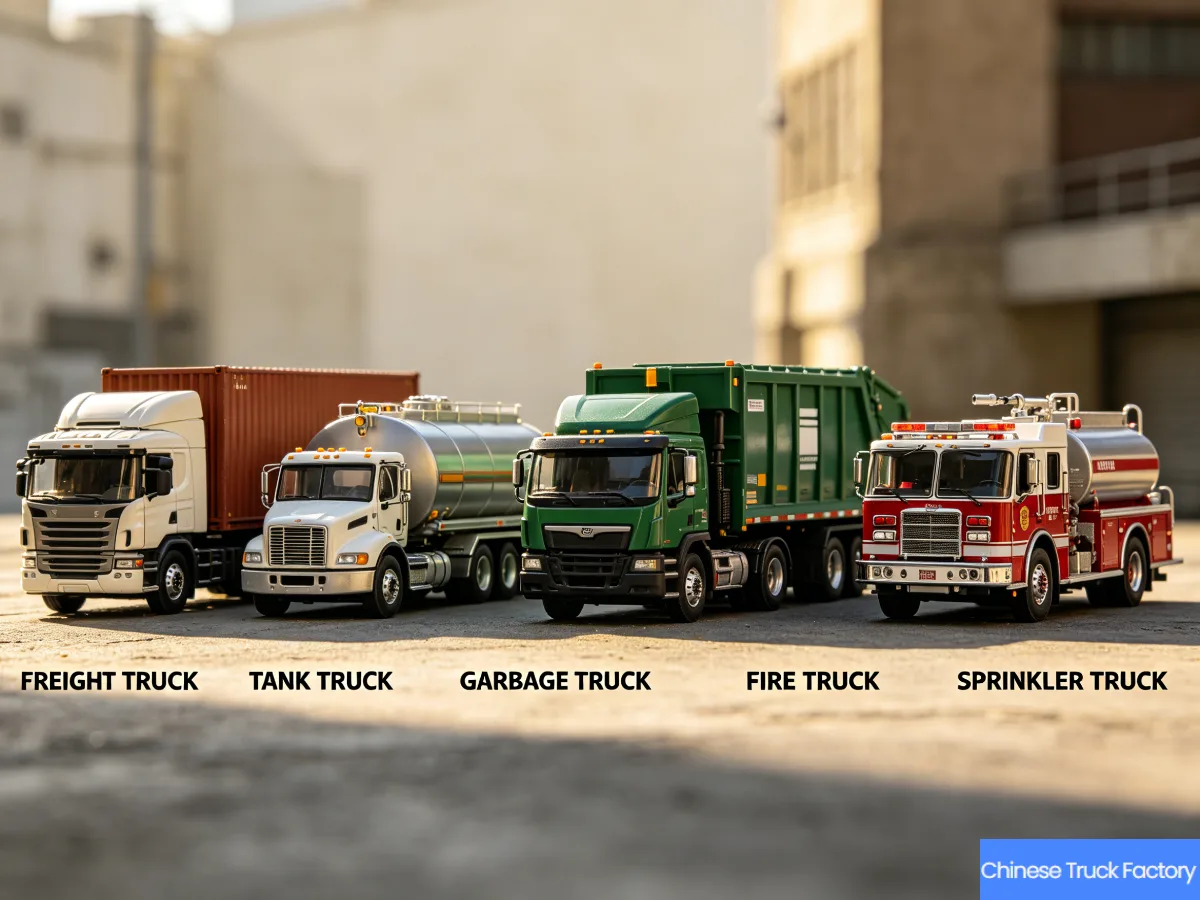
Chinese Truck Factory operates as a direct manufacturer and exporter of commercial vehicles and specialized equipment, and it fits this framework in several practical ways. The company builds to specification rather than offering only fixed models, which matters when a destination market requires a particular emission level, drive layout or body configuration. Technical documentation, including weight and body specifications, is part of the quotation process rather than an afterthought. Spare parts packages can be planned alongside the vehicle order, which reduces the commissioning risk that affects many first-time importers. And because the company works directly with overseas buyers, communication on technical questions happens with people who understand the configuration, not just the price.
Buyers who want to compare their specific requirements against available configurations can request a detailed quotation through the halaman kontak, providing the duty cycle information outlined earlier in this guide.
Total Biaya Kepemilikan: Satu-satunya Perbandingan yang Adil
Purchase price is the smallest part of the decision over a truck’s service life. A proper TCO comparison includes:
- Purchase price, stated clearly as EXW, FOB, CFR or CIF
- Pengiriman laut dan asuransi maritim
- Import duties, taxes and customs clearance
- Local homologation, modification and registration costs
- Bahan bakar atau listrik selama masa pakai yang diperkirakan
- Tires, which are a significant recurring cost on heavy vehicles
- Scheduled maintenance — oil, filters, consumables
- Unscheduled repairs and parts
- Downtime cost, which is often the largest hidden item
- Driver cost, where relevant to the application
- Nilai sisa pada akhir masa pakai yang direncanakan
Two trucks with the same purchase price can have very different five-year costs. The one with better parts availability, simpler maintenance and higher availability usually wins, even if it costs more upfront.
Kesalahan Umum yang Harus Dihindari
Most import problems trace back to a small number of recurring errors:
- Sizing the body by volume without checking material density against legal payload
- Comparing FOB prices as if they were landed costs
- Assuming emission standards are uniform across the region
- Ordering a crane by nominal tonnage without checking the load chart
- Ignoring axle-load limits and discovering the problem at registration
- Failing to plan spare parts for the first year of operation
- Not confirming steering configuration before production
- Treating fuel consumption figures as fixed rather than route-dependent
Each of these is avoidable with a proper specification review before the order is placed.
Pertanyaan yang Sering Diajukan
Bagaimana cara memilih muatan yang tepat untuk operasi saya?
Start from the material or cargo you will carry, its density, and the number of trips per day you need. Calculate the required payload in tonnes, then check that the resulting gross vehicle weight stays within the chassis GVW and the destination country’s legal weight limits. Body volume should be sized so that a full load matches the legal payload, not the other way around.
Which axle configuration should I use?
It depends on payload, road conditions and legal axle limits. A 4×2 suits lighter urban work, a 6×4 covers most construction and regional haulage, and an 8×4 or 6×6 is appropriate where higher payload or off-road traction is required. More axles increase cost, tare weight and tire consumption, so the configuration should be the minimum that meets payload and traction requirements.
Bagaimana kondisi jalan memengaruhi pemilihan truk?
Poor roads and steep gradients require more torque, better traction and stronger suspension. They also accelerate wear on tires, body components and hydraulic systems. A truck specified for smooth highway work will have a shorter service life on unpaved haul roads, so the configuration should reflect the worst conditions on the route, not the average.
Apa saja yang memengaruhi konsumsi bahan bakar pada truk berat?
Gross weight, average speed, gradient, traffic, idling time, driver behavior, axle ratio, tire pressure and climate all influence consumption. There is no single figure that applies across routes. Estimating consumption for the specific route profile gives a far more useful number than comparing generic published values.
Perawatan apa saja yang sebaiknya saya rencanakan?
Plan for daily inspections of tires, fluids, hydraulic hoses and lights, plus periodic service of engine oil and filters, transmission and differential oil, brakes, suspension and hydraulic systems. Service intervals should come from the manufacturer’s manual for the actual delivered specification. The most important procurement decision is ensuring that consumables and common wear parts are available locally.
Bagaimana cara menghitung perkiraan total biaya kepemilikan?
Add purchase price, freight, insurance, import duties, registration and homologation costs, fuel, tires, scheduled maintenance, unscheduled repairs, parts and downtime, then subtract residual value at the end of the planned service life. Downtime is often the largest hidden cost and should be estimated using realistic availability assumptions.
What information do I need to provide for a quotation?
Destination country and port, application, cargo type and density, required payload, body capacity, daily mileage, road and gradient conditions, drive configuration, steering side, emission requirement, quantity and any required options. For cranes, add maximum lifting weight, working radius and lifting height. For tankers, add product type and required volume. For waste vehicles, add waste type, bin type and loading method.
Bagaimana cara memastikan kepatuhan negara tujuan?
Contact the national vehicle registration authority or a qualified customs broker in the destination country and confirm the current emission standard, homologation requirements, axle-weight limits, dimension limits, steering side and lighting requirements. Regulations change, so verify against current official sources rather than supplier statements.
Bagaimana cara pengiriman truk dari Tiongkok?
Complete driveable trucks are usually shipped by RoRo, which is generally the simplest method. Oversized or specialized units may require breakbulk or flat rack shipping. Containers are practical for smaller vehicles, disassembled units or spare parts. The right method depends on vehicle dimensions, weight, quantity and destination port capability.
Final Considerations
The trucks that succeed in Latin American operations are not necessarily the most powerful or the largest. They are the ones whose payload, chassis, powertrain, body and legal weight all line up with the actual duty cycle, and whose parts and service support can be sustained over the vehicle’s life.
The parameters worth confirming first are payload in tonnes, material density, legal axle and gross weight limits in the destination country, emission requirement, steering configuration and parts availability. Everything else — engine power, body volume, axle ratio, crane capacity — follows from those.
The most common error is treating the purchase as a price comparison rather than an engineering match. Two trucks with similar price tags can have very different five-year costs depending on how well each fits the job. The right configuration is the one that meets the payload, route, legal limits, maintenance capability and operating cycle with the fewest compromises — not the one with the largest body or the highest horsepower rating on the specification sheet.